
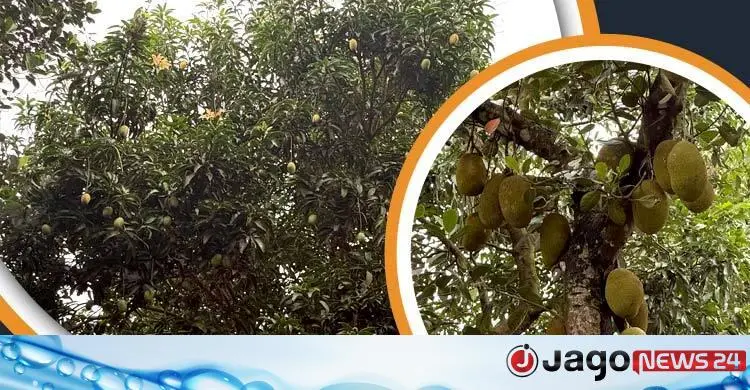
Ninety-two per cent of the soil in the Sylhet region is acidic, and 26 per cent of it is highly acidic. Such soils mainly favour citrus fruit, so it is popularly said that Sylhet, known as the heart of the country's tea industry, grows citrus. But that picture is changing over time: mango and jackfruit are now the most produced fruits in Sylhet division.
Yet despite their large area and output, the two fruits have little impact on Sylhet's economy, and people there still depend on mango and jackfruit from Rajshahi, Chapainawabganj and Tangail.
Experts say Sylhet's soil is by its nature suited mainly to sour fruit, and its hilly areas also suit jackfruit. Even though the conditions are not ideal for it, mango holds the second-highest position among fruits every year. The agriculture department says jara lemon, a citrus fruit, is produced only in very limited quantities but is being exported abroad.
New possibilities on the hillocks
Experts say climate change, advances in farm technology and projects to expand fruit orchards have opened new possibilities for fruit growing in Sylhet. Land that once grew only lemons or traditional crops now has mixed orchards, and many farmers are growing mango, jackfruit and pineapple on hillocks around the tea gardens.
According to people in the sector, Sylhet's hilly, hillock-studded terrain suits fruit farming, and if fruit growing is expanded in a planned way, Sylhet's position as one of the country's main fruit-producing regions will grow stronger.
Md Rakibul Islam Ruman, a horticulturist at the Horticulture Centre in Khadimnagar, Sylhet, said lemon, orange and malta grow very well in Sylhet because of the acidic soil, and a great deal of pineapple is now grown in Golapganj and Fenchuganj. Mango, jackfruit or watermelon can be grown in this soil, but it must first be neutralised by applying lime (dolomite). If the soil is not neutralised, the trees grow large but yields are disappointing, he said; commercial mango or jackfruit growing requires preparing the soil by following the right guidelines.
What the experts say
Dr Mohammad Shahidul Islam, dean of the Faculty of Agriculture at Sylhet Agricultural University, said the low pH of Sylhet's soil does not mean only citrus can be grown; other fruits also yield well. But high humidity and heavy rainfall affect fruit: excessive rain and fog bring more disease and pest attacks, which damage mango and other crops.
Sylhet's soil varies from place to place, he said. In the haor areas its properties change every kilometre, and on the hillocks it is different again. With proper soil care, all kinds of fruit can be grown, though malta, guava and citrus are best suited.
Asked why mango output is high, he said mango trees are common around homesteads because their roots can reach deep into the soil for nutrients. But the quality of Sylhet's mangoes is questionable because pest attacks and fruit drop are high, so nobody grows them commercially.
Dr Md Mosharraf Hossain, additional director of the Department of Agricultural Extension (DAE) in Sylhet, said the relatively high natural acidity of the region's soil is no major obstacle to fruit production; many fruits such as lemon, malta, orange, pineapple and guava do well in this environment. For commercial growing of mango, jackfruit or other fruit, however, special attention must be paid to soil pH, organic matter and balanced fertiliser management.
Because Sylhet has heavy annual rainfall, regular organic fertiliser is needed to maintain soil fertility, he said. Excess humidity also brings relatively more disease and pest attacks, so it is hard to get the desired yield without modern orchard management, integrated pest management and improved varieties.
The soil in figures
According to the Soil Resource Development Institute (SRDI), 96 per cent of the Sylhet region's soil is acidic, 26 per cent of it highly acidic. Because of this acidity not every kind of fruit grows in Sylhet, but citrus does well.
Researchers say 26 per cent of the region's soil has a pH below 4.5, 66 per cent a pH of 4.5 to 5.5, and only the remaining 8 per cent a pH of 5.6 to 6.5. On organic matter, 65 per cent of the land has 1.8 to 3.4 per cent, 21 per cent has 1.1 to 1.7 per cent, 3 per cent has less than 1 per cent and 11 per cent has 3.5 to 5.5 per cent.
Dipto Chakraborty, a scientific officer at the SRDI in Sylhet, said soil with a pH below 7 is called acidic, and about 80 per cent of Sylhet's soil has a pH between 4.5 and 5.5. Low-pH soil is suitable for citrus fruit.
About 75 per cent of Sylhet's area is haor, under water for most of the year, he said. Low-pH or acidic soil causes no problem for rice but is a major obstacle to fruit and vegetable production.
Sylhet is not a very suitable area for mango, Chakraborty said, as mango yields depend on temperature as well as soil. Mango trees grow naturally in Sylhet, but succeeding with commercial mango growing is difficult because a good year is usually followed by a gap year. The hilly areas of Sylhet and Moulvibazar produce a lot of jackfruit, so there is great scope for commercialising it, but here jackfruit is not grown commercially; it grows naturally, scattered over the hillocks.
Exports blocked at the airport
According to the Sylhet agriculture department, at least 51 kinds of fruit are grown in every district of Sylhet division, but no opportunity is being created to export any of them. Mango, jackfruit, pineapple and watermelon are produced most in the region, but because they are not grown commercially, no basis for exports is developing.
Among Sylhet's fruits, jara lemon is in considerable demand abroad. Although area and output are very small, it is the fruit currently being exported. But because Sylhet Osmani International Airport has no "warehouse packaging system", Sylhet traders cannot export it themselves; some Dhaka traders buy directly from Sylhet farmers and export it.
Cargo flights started at Osmani International Airport in April last year after a long-standing demand from Sylhet traders. But the main barrier to exporting from Sylhet is the lack of a warehouse packaging system, without which Sylhet's exporters cannot send goods to Europe, America and the Middle East.
Md Abul Kalam, one of Sylhet's fruit importers and exporters, said there is currently no way to export fruit directly from Sylhet. Satkara and jara lemon were once exported from Sylhet to London, but now only jara lemon is exported, and mostly by Dhaka traders. Because the airport has no warehouse packaging system, exporters send fruit through Dhaka, and in many cases small farmers sell their produce directly to Dhaka's wholesale markets, he said.
Md Hafiz Ahmed, director of Osmani International Airport, said the airport has all facilities. Without a warehouse packaging system, only exports of raw produce to Europe and America are not possible; exports to other countries can go from Sylhet. The warehouse packaging system exists only in Dhaka, where the agriculture department set it up, he said, adding that cargo flights from Sylhet have been running normally for the past two months.
Output by district
According to the DAE, jackfruit, mango and pineapple top the list of fruits produced in the four districts of Sylhet division, with Moulvibazar producing the most. Pineapple, watermelon and banana yields are also high in all four districts.
Moulvibazar is the division's biggest fruit-producing district. In the 2024-25 fiscal year jackfruit was grown there on 2,121 hectares. Mango covered even more, 2,239 hectares, yielding 28,815 tonnes. Lemon on 1,744 hectares yielded 28,244 tonnes, pineapple on 1,223 hectares 20,791 tonnes and banana on 956 hectares 18,976 tonnes. Jamun, guava, lychee, malta, orange and watermelon are also grown.
In Sylhet district mango covers the largest area, but watermelon leads in output: 27,888 tonnes from 664 hectares. Jackfruit yielded 19,915 tonnes from 569 hectares, banana 10,450 tonnes from 594 hectares, pineapple 4,015 tonnes from 489 hectares and lemon 3,558 tonnes from 281 hectares. Jara lemon yielded 1,137 tonnes from 127 hectares.
Habiganj produced the most jackfruit: 13,055 tonnes from 960 hectares. Mango yielded 8,137 tonnes from 1,260 hectares, lemon 4,383 tonnes from 636 hectares and banana 4,136 tonnes from 350 hectares. Pineapple, jamun, malta, watermelon, pomelo and orange are grown on a smaller scale.
In the haor district of Sunamganj, watermelon covers the largest area, yielding 14,755 tonnes from 576 hectares. Jackfruit yielded 7,020 tonnes from 196 hectares, mango 5,713 tonnes from 433 hectares and lemon 2,231 tonnes from 162 hectares. Banana, guava, jamun, pineapple, malta, pomelo and orange are also grown in the district.
Source: Jagonews24. First published in Bengali on The Agro News.


Comments
(0)