
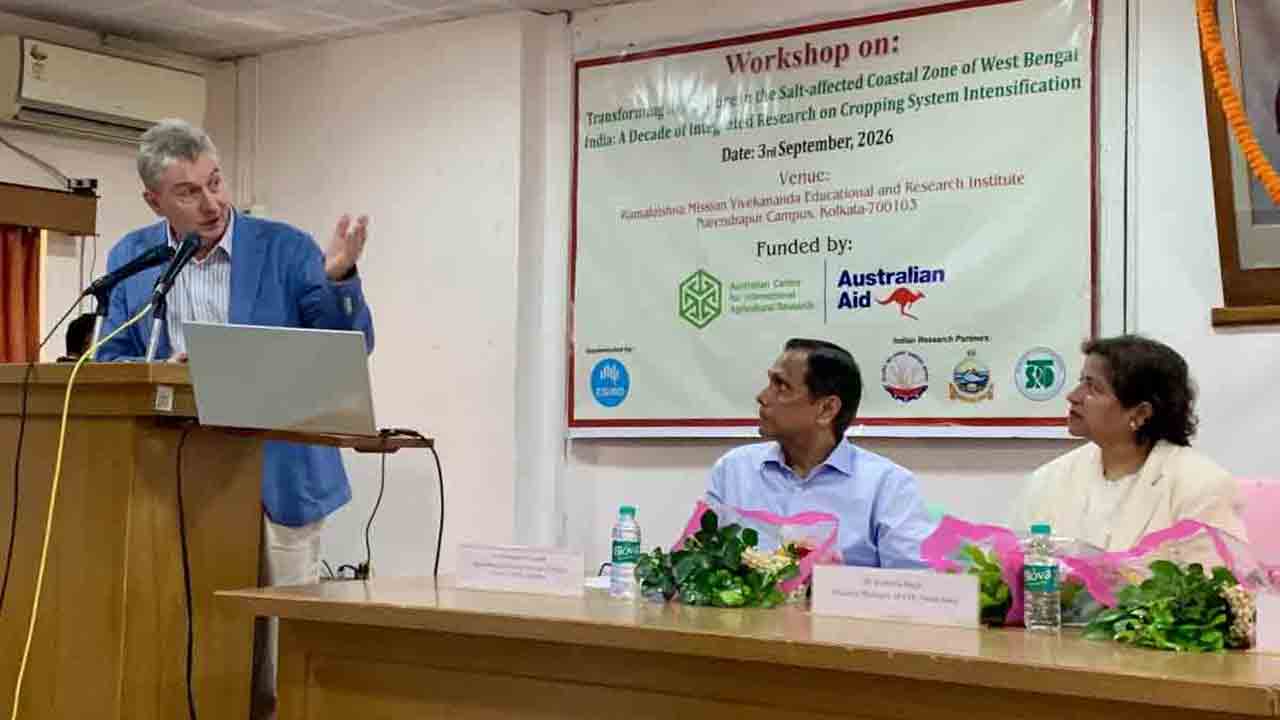
A journey that began a decade ago to organise farmers on West Bengal's disaster-prone coast beside the Sundarbans and settle them into alternative farming has delivered results, presented recently at a seminar at the Ramakrishna Mission Vivekananda Educational and Research Institute in Narendrapur. PhD and postgraduate researchers, students and agricultural scientists lived and worked alongside the farmers to teach new methods in the field. Swami Atmapriyananda, the institute's pro-chancellor and secretary, stressed the self-reliance of women farmers and said the number of women studying agricultural science at the mission rises every year.
Present were Australia's consul general in Kolkata Bernard Lynch, Pratibha Singh, regional manager of the Australian Centre for International Agricultural Research (ACIAR), Mohammed Mainuddin, project in-charge at CSIRO, Gautam Saha, director of research at Bidhan Chandra Krishi Viswavidyalaya, agricultural scientist Koushik Brahmachari and many other teachers and researchers. Women's self-reliance across the coastal belt, with agriculture as the vehicle, was a central theme.
Beyond cyclones Aila and Amphan, breached embankments let saline water ruin farmland in monsoon after monsoon, and men on many coastal islands and villages left as migrant labourers, leaving farming to women. The first battle was to grow underground crops on the surface under straw; the seminar also documented, with data and photographs, the success of harvesting rainwater and managing drainage so that saline areas could be irrigated.
Dinesh Mondal, a farmer from Jotirampur in the Sundarbans, said saline intrusion damages crops repeatedly, but with straw and zero tillage on the soil surface they now grow and market produce. Farmer Pinaki Mondal said scientists and researchers from CSIRO, the Narendrapur mission, the saline-soil research station at Canning and BCKV have stayed with them for ten years showing how to farm, and cultivation has resumed on many islands.
CSIRO's Mohammed Mainuddin said that in Bangladesh it had not been possible to bring women into farming under such adverse conditions, whereas here it had been done and had succeeded; the programme has run all these years under the stewardship of Australia's government agriculture department. Hugh Boylan, Australia's former consul general in Kolkata, joined farmers lifting potatoes in the Sundarbans in March last year; his successor Bernard Lynch said he is no scientist but can see that something ground-breaking has been achieved.
Based on reporting by Bitan Bhattacharya of Anandabazar Patrika. Source: Anandabazar

Comments
(0)