
Severe dry weather under El Nino has already hit seven districts of Sri Lanka, affecting more than 115,000 people, damaging 8,000-8,500 acres of crops and prompting the government there to set aside about Rs 3 billion in compensation for farmers. Agricultural and climate experts in Bangladesh read that as a warning for the country. The World Meteorological Organization (WMO) expects the current El Nino to strengthen and persist into the start of next year; a BBC Weather report of 21 August said it could become the strongest El Nino in living memory, with Pacific sea-surface temperatures already more than 2C above normal and forecast to pass 3C, and 2027 possibly the hottest year on record.
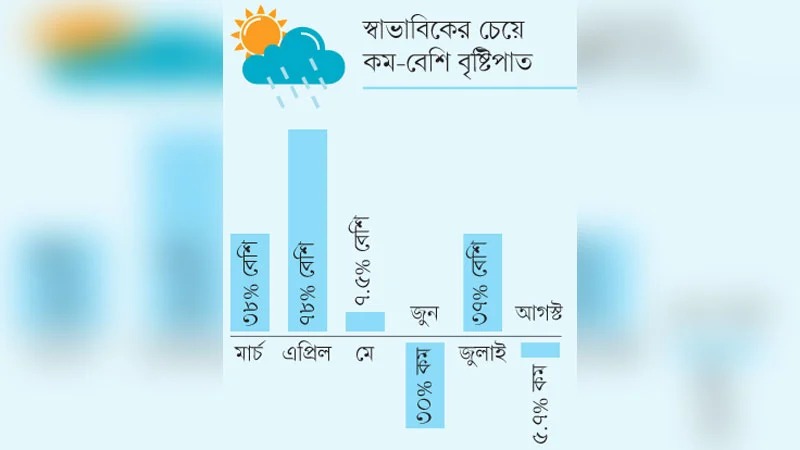
Bangladesh's weather this year has already been erratic. There was little significant rain from the second week of November 2025 to the first week of March; March then brought 38 percent more rain than normal, April 78 percent and May 7.5 percent more, but the monsoon month of June was 30 percent short, July 37 percent above normal and August 5.7 percent below. The Bangladesh Meteorological Department expects below-normal rain in September too, with two or three mild-to-moderate heatwaves and short-lived floods in some areas.
The experts' concern centres on the closing stage of the current Aman season, the winter crops and, most of all, the Boro. If monsoon rain weakens, Aman transplanting and growth could run short of water; higher temperatures drying the soil faster would raise irrigation demand for potato, onion, wheat, maize, mustard and winter vegetables, and a warm winter could hold those crops back. On preliminary Bangladesh Bureau of Statistics figures the country grew 21.3 million tonnes of rice in 2025-26, about 55 percent of it Boro — a dry-season crop, transplanted in December-January and harvested in April-May, that depends almost entirely on irrigation.
Sharif Ahmed, cropping systems agronomist at the International Rice Research Institute's Bangladesh office, said the biggest worry for Boro is a heatwave at flowering, especially from mid-April: when daytime temperatures exceed 35C and night temperatures 28C, rice flowers can become sterile, and prolonged heat disrupts flowering and grain filling, leaving many spikelets empty. Higher temperatures would also raise irrigation demand, he said, which is a particular concern in the north-west, where the water table has fallen sharply and rainfall patterns have changed.
The warning comes in a year when farming has already taken a heavy weather-related hit. Continuous rain from 26 April to 4 May, water from upstream and floods damaged crops in the seven haor districts: 49,073 hectares by the Ministry of Agriculture's count, about 213,000 tonnes of Boro lost and some 236,000 farmers affected, though the Centre for Policy Dialogue put the loss at about 339,000 tonnes. July floods then damaged about 82,000 hectares, according to the Department of Agricultural Extension (DAE). The WMO ranks the 2023-24 El Nino among the five strongest on record; meteorologist Bazlur Rashid recalled 35 consecutive days of heatwave in Bangladesh in 2024, with winter rain and prolonged cold also damaging crops.
Professor Abu Noman Faruq Ahmmed of the Department of Plant Pathology at Sher-e-Bangla Agricultural University said international agencies are forecasting a stronger effect this time but the government is not prepared to match it; he called for region-specific changes to planting dates, short-duration and heat-tolerant varieties, timely irrigation and alternate wetting and drying (AWD). Jamal Uddin, chief scientific officer at the Bangladesh Agricultural Research Institute, said reducing losses before a disaster is more effective than compensating afterwards, and Bangladesh needs to institutionalise that approach in farming.
Professor Jahangir Alam Khan, former president of the Bangladesh Agricultural Economists Association, said most farmers do not know what El Nino is but will bear its consequences; the Meteorological Department, the DAE, BARI and the Bangladesh Rice Research Institute need much stronger coordination so that farmers are told how much rain to expect where, which crops are at risk and when to irrigate, sow and harvest, with special attention to coastal, drought-prone and flood-prone areas. DAE director general Md Abdur Rahim said the climate cannot be controlled and the effort is to limit damage: farmers in the flood-prone haor are being encouraged to grow BRRI dhan118, an early-maturing variety that can be cut 10-15 days ahead of normal, and advice is being coordinated with the research institutes whenever a disaster threatens.
From a Chashabad report. Source: Chashabad
Comments
(0)