
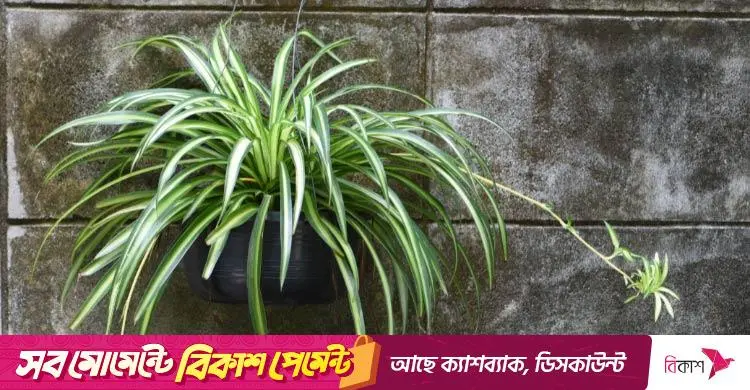
Demand for indoor plants is rising day by day, and the spider plant holds a special place among them. With its green leaves, easy care and ability to purify the air, it is ideal for homes and offices. Here are the spider plant's features and how to care for it.
Features
It is called the spider plant because its leaves are arranged like a spider. It is also known as spider ivy or ribbon plant. It is native to South Africa, and its scientific name is Chlorophytum comosum.
The spider plant is well known for its attractive leaves. Because it suits a balcony, desk or the corner of a study table, it is a favourite of many, and it also helps purify the air. Its slender, handsome green leaves grow about twelve to eighteen inches long depending on the variety, and small white flowers bloom in spring.
With proper care the plant can last for years. About 200 varieties of spider plant have been found so far, of which only a few are used as indoor or house plants.
Light and soil
The spider plant does well in gentle sunlight. Harsh midday sun can scorch the leaves, so morning or afternoon sun is better. It survives in very low light, but its leaves droop and lose freshness, so it should be put in a bright place at least one or two days a week. It looks good in hanging pots of various sizes, but when it is placed on a flat surface, take care that the leaves are not damaged.
Loose soil that lets excess water drain away easily suits the spider plant. You can prepare the soil with loam, coarse red sand and vermicompost.
Feeding and watering
Be careful with fertiliser. In the growing season, spring and summer, you can mix a little vermicompost into the soil every two weeks; in other months once a month is enough. You can also spray the plant every fifteen days with a teaspoon of Epsom salt mixed in two litres of water, which is good for the leaves, and the same solution poured on the soil helps root growth. It is better not to use chemical fertiliser, because too much can kill the plant.
The spider plant can grow with very little care. With the right light, water and fertiliser it flourishes and produces many small plantlets. Its soil should always be kept lightly moist, especially in the growing months, but never soggy, as the plant may then rot and die. Rather than watering all the time, water well once in the morning or afternoon, and make sure the water drains out of the bottom of the pot. Use clean, chemical-free water. Spraying the plant with water at least once a day also keeps the leaves fresh.
In winter the spider plant goes dormant. No new leaves grow and some dry leaves may appear, but that does not mean the plant has died. New leaves will grow once winter is over.
Small plantlets, known as baby plants, grow on the spider plant's runners. Once they have roots, they can be separated from the mother plant and planted in new pots.
Pests and problems
The spider plant is generally free of disease. With the right amount of light, water and fertiliser it stays healthy and grows well, but some problems need watching. If the leaves start to turn brown, simply cut them off. In summer, rising temperatures begin to damage the leaves, so keep the plant in the shade at that time.
Too much water risks root rot. To avoid it, use loose, well-drained soil and water only after the top inch of soil has dried. Gently loosening the top few inches of soil in the pot every so often is good: it encourages root growth and reveals any insects.
If fine spider webs appear on the leaves and they begin to spoil, wash the plant quickly with a strong jet of water. Spraying the plant once a week with the required dose of insecticide mixed in water is also effective.
Two more threats to the spider plant are mealybugs and root mealybugs. Mealybugs suck sap from the leaves and leave the plant lifeless, while root mealybugs weaken the roots in the same way. If you see white mealybugs on the leaves, spray soapy water as soon as possible; spraying a few days a week is enough.
If something white appears when you loosen the soil in the pot, the plant has root mealybugs. To treat them, apply the required dose of insecticide mixed in water to the soil once a week.
Source: Jagonews24. First published in Bengali on The Agro News.

Comments
(0)