
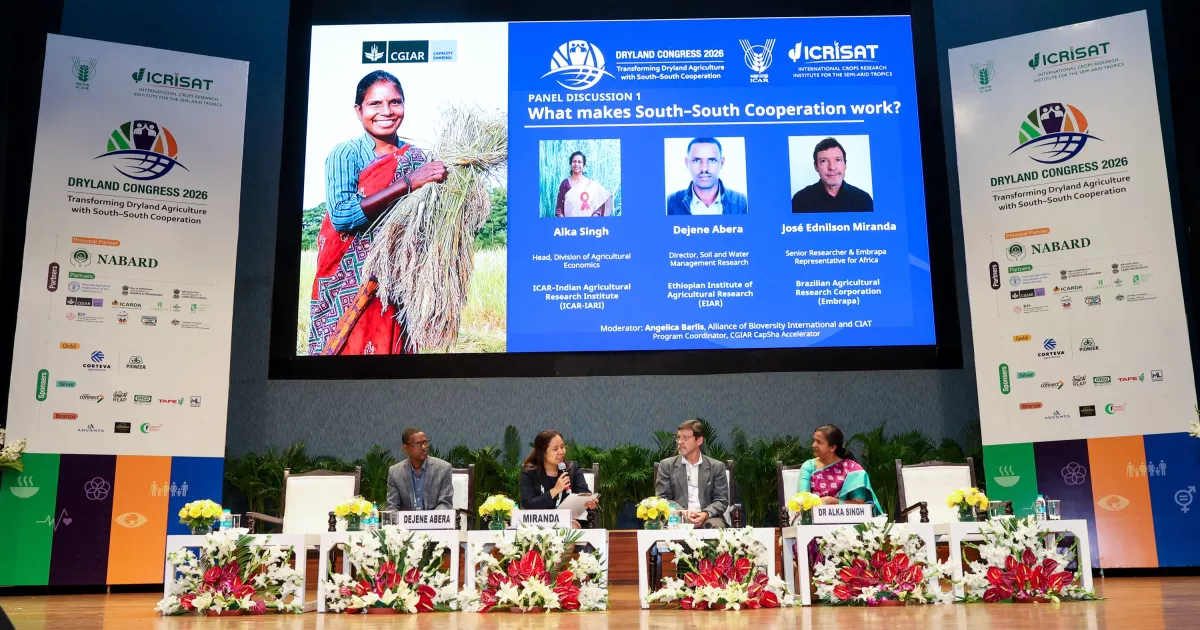
Cooperation between countries of the Global South on farming research lasts only when the receiving institutions adapt what they get, build it into their own systems and eventually pass it on, argues Angelica Barlis of the Alliance of Bioversity International and CIAT in a piece published by CGIAR. The views are the writer's own.
Barlis moderated a panel for the UN Day for South-South Cooperation at the 2026 Dryland Congress hosted by ICRISAT, with Dr José Ednilson Miranda of the Brazilian Agricultural Research Corporation (Embrapa), Dr Alka Singh of ICAR-IARI in India and Dr Dejene Abera of the Ethiopian Institute of Agricultural Research (EIAR). She asked them where cooperation had fallen short as well as where it had worked.
Miranda described Embrapa's Cotton 4 initiative with Mali, Benin, Chad and Burkina Faso. Shared tropical conditions made Brazil's cotton experience a useful start, but the work went further: cotton was integrated with staple crops, bio-inputs were introduced and local laboratories were strengthened. Farm tools given to women were redesigned because the original design did not suit women working with babies on their backs.
Abera said Ethiopia's work with CGIAR on digital, site-specific fertiliser advice began with co-design and was led by the national research system. Capacity later spread to regional institutes, and Ethiopia now gives technical support to a research institution in Rwanda, a progression Barlis calls a useful test of whether capacity has taken root.
Singh warned that counting people trained or workshops held shows activity, not change. The better measure is whether new skills are used inside national research systems and produce results such as joint variety releases, because staff move on and projects end. She and Abera also said policies, institutions and the social setting decide whether a technology that crosses a border is adopted at all.
For the CGIAR Capacity Sharing Accelerator, the panel suggested a role as a connector: mapping demand and supply of skills, linking institutions around shared problems and letting capacity flow in more than one direction, while avoiding top-down models that overlook local knowledge. Miranda added that Brazil also gains, by co-developing technology with its partners.
Source: CGIAR


Comments
(0)