
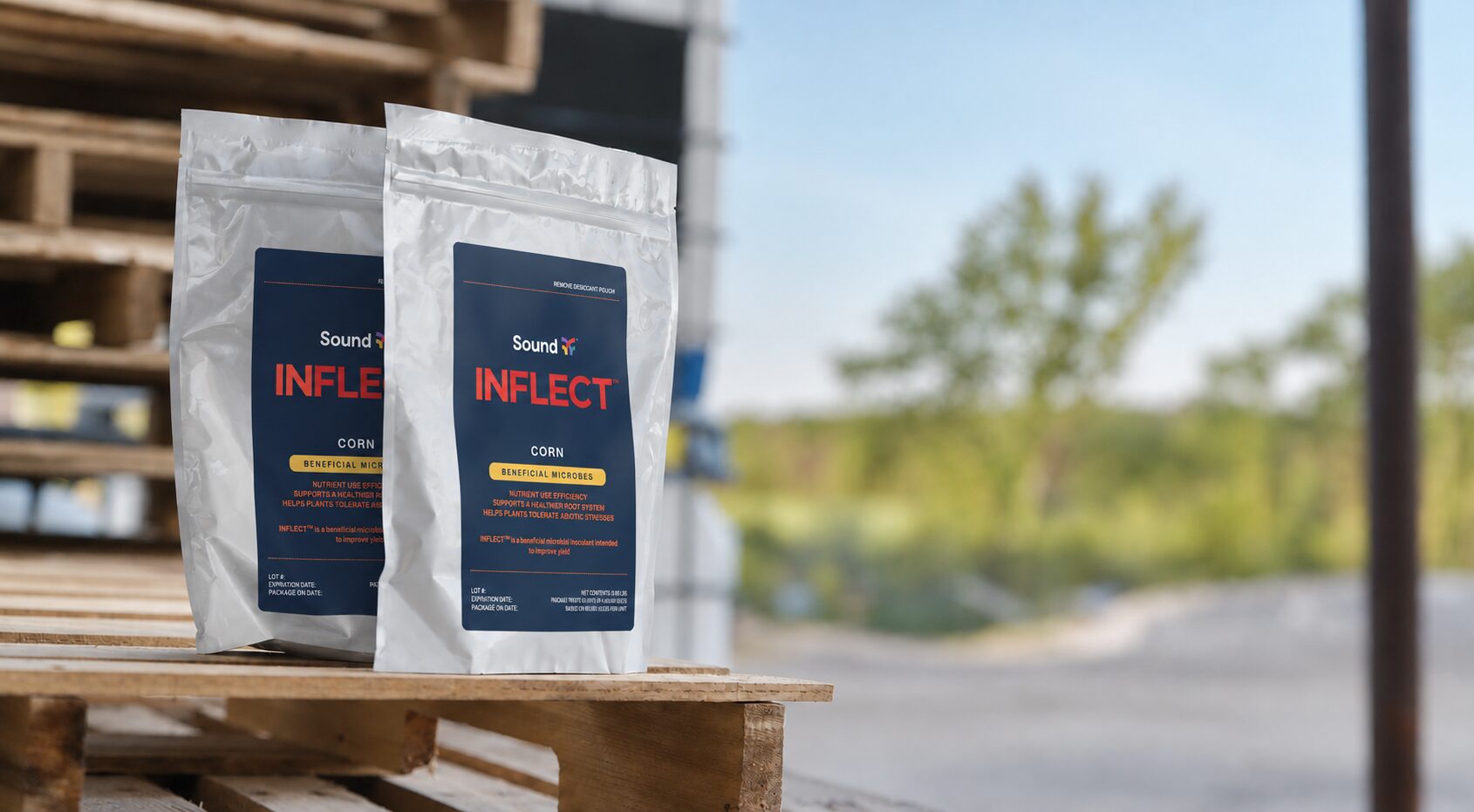
US-based Sound Agriculture has released INFLECT, a seed coating made of beneficial microbes and designed specifically for corn fields fertilised with anhydrous ammonia or heavy amounts of manure.
Ammonia and manure are two of the most effective ways to give corn nitrogen, but both carry a cost to the soil, said Jeff Divan, the company's vice-president of agronomy. Ammonia makes the soil more acidic and kills some helpful microbes where it is applied, while manure can hold its nitrogen in a form the plant cannot use until after the corn needs it most. "High ammonium creates a harsh environment for soil biology — it reduces microbial diversity, which leads to inconsistent root development and lower yields," Divan said.
INFLECT is a planter-box treatment applied as a powder to seed at planting. It carries two species of bacteria, Bacillus simplex and Bacillus subtilis, and one fungus, Coniochaeta nivea, strains the company selected for their ability to tolerate the high-salt, high-stress conditions that high-ammonium fertility creates.
According to Divan, the two bacteria create a buffer between the roots and the ammonia, stabilising pH in the root zone and promoting root growth, while the fungus breaks down manure and other complex compounds so that organic nitrogen and other nutrients can reach the plant.
The product has been several years in development, including a year of commercial-scale field trials at 12 sites across Illinois, Kansas and Missouri. Sound Agriculture did not disclose the total acreage, but says the treatment has raised corn yields by about six bushels per acre on average and improved yield at 92% of the sites.
Corn is the product's main focus for now; the company says it is exploring other crops. INFLECT is its third product after SOURCE, a signalling chemistry that helps crops get more from soil nitrogen and phosphorus, and BLUEPRINT, an arbuscular mycorrhizal fungi product for nutrient and water uptake.
The launch comes as most US corn growers say they are as concerned or more concerned about farm costs than a year ago, and as many look to reduce their dependence on synthetic fertiliser. Divan urged growers to build fertility plans around beneficial microbes rather than add them on top: "Let biology … be your first 25 pounds of fertility."
The report was written by Jennifer Marston for AgFunderNews.
Source: AgFunderNews



Comments
(0)