
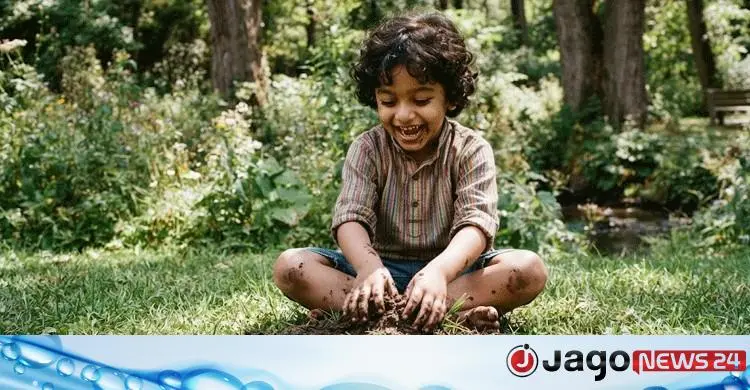
In city life the chance to get close to nature is shrinking. Many children grow up among concrete buildings, busy roads and four walls, and their regular contact with soil, grass, plants and forest is falling. But research shows that contact with nature is not only about feeling good or staying active. Contact with soil and plants may also increase the diversity of microbes living on the skin.
Children come into contact with various natural microbes through everyday activities such as getting soil on their hands while gardening, touching tree bark or playing on grass. Scientists are studying whether this contact affects the balance of microbes on the skin and whether it is linked to the immune system.
Twenty seconds of soil
In a study by researchers in Finland, participants were asked to rub soil, peat and moss on their hands for 20 seconds. The researchers then examined their skin and observed an increase in the number and diversity of microbes. Some of the change remained even after the hands were washed with tap water.
Finnish environmental specialist Grönroos said the change was not long-lasting. The study found that 20 seconds of contact with nature did not permanently change the skin's microbes, so the researchers believe regular, longer time close to nature may matter more than one brief contact.
The presence of bacteria or other microbes on the skin is not in itself a reason to think it harmful. Many kinds of microbes live on the skin naturally, and diversity among them can help maintain a balance, which may reduce the chance of potentially harmful bacteria taking over.
The daycare experiments
More research has been done in Finland on how nature affects children. At a daycare centre in central Finland, a forest-like environment was created where children spent several hours a day climbing trees, playing with soil and wood, building sandcastles and coming into contact with various plants.
The researchers collected samples of the children's skin, saliva and stool, as well as blood and hair, to see whether long contact with nature changed their microbiome and immune system.
In an earlier study in 2016 and 2017, forest-floor elements including peat and planting boxes were added to daycare playgrounds. After the children played there regularly for 28 days, the diversity of microbes on their skin, in their saliva and in their gut was higher than in children who played on paved or gravel playgrounds.
More importantly, when the children were tested again a year later, some difference in skin microbe diversity remained. Fewer potentially disease-causing microbes were also found on the skin of children who had played on forest soil.
Researchers say greater microbial diversity on the skin may reduce the chance of harmful bacteria dominating. But more research is needed before concluding that contact with nature definitely strengthens immunity.
Source: Jagonews24. First published in Bengali on The Agro News.
Comments
(0)