
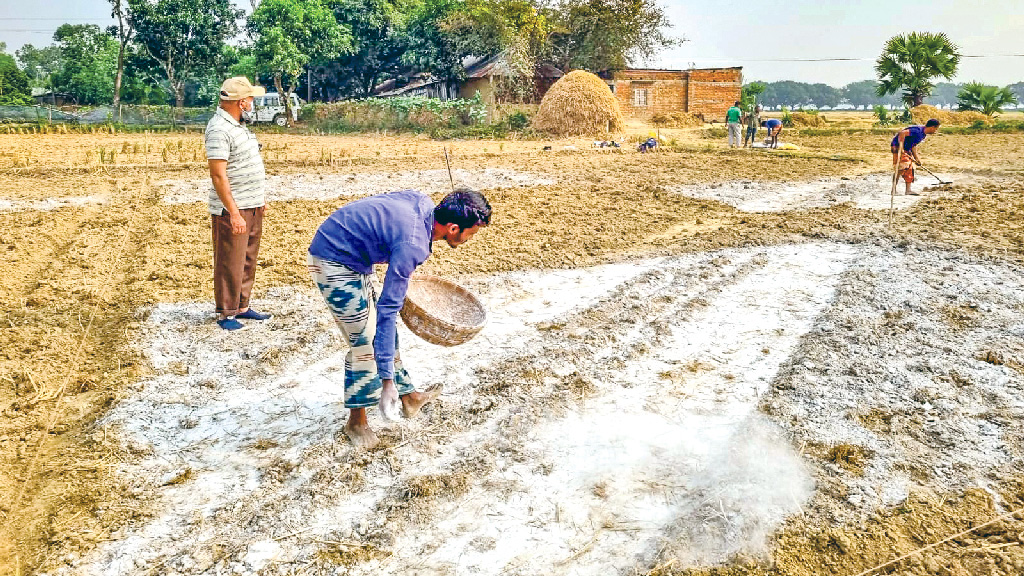
Acidity is increasing in the country's soil, and it is hurting crop production. Farmers are not getting the yields they want, while production costs are rising sharply. Soil experts warn that unless soil acidity is controlled, the crisis will deepen and threaten the country's food security. They issued the warning on the eve of World Soil Day, 5 December.
Md Nazmul Hasan, an acid soil management expert, told Ajker Patrika: "Acidity is rising in the soil of every region of the country except the Ganges basin. The higher the acidity, the lower the crop output. If soil acidity is high, wheat, maize, potato, vegetables, pulses and other Rabi crops will not give the expected yields."
Nearly half of cropland affected
The Soil Resource Development Institute (SRDI) researches soil quality. According to its acid soil management programme, acidity in the country's arable land is rising over time. In 1998, strongly to very strongly acidic land made up 28.23 per cent; in 2010 it was 41.23 per cent, and by 2020 it had risen to 45.67 per cent. The causes cited are climate change, heavy use of urea, depletion of calcium and other alkaline elements, intensive cropping on the same land, and using crop residues as fuel rather than letting them mix back into the soil.
Researchers say crop growth and yield depend largely on whether soil is acidic or alkaline. Acidity is measured by soil pH. Soil with a pH below 4.5 is called very strongly acidic, 4.5 to 5.5 strongly acidic, 5.6 to 6.5 slightly acidic, and 6.6 to 7.3 neutral. The ideal pH for crops is taken as 6.5.
According to SRDI research, as of 2020 Bangladesh had about 85.86 lakh hectares of cropland. Of this, soil on about 2.78 lakh hectares was very strongly acidic (pH below 4.5) and on about 36.44 lakh hectares strongly acidic (pH 4.5 to 5.5), meaning nearly half (45.67 per cent) of all cultivated land is strongly to very strongly acidic. In strongly acidic soil, shortages of phosphorus, calcium, magnesium and molybdenum and excess aluminium, iron and manganese hinder crop growth and reduce yields.
Dolomite lime as a remedy
Most soils in greater Rangpur, Dinajpur, the hill areas of Sylhet and Chattogram, and the Barind and Madhupur Tract regions are strongly to very strongly acidic, and farmland there is not giving the expected yields. Dr Md Nurul Islam, chief scientific officer at SRDI and director of the acid soil management programme, told Ajker Patrika that unless it is brought under control now, acidity will keep rising. Farmers' fertiliser costs will increase, but they will not get the yields they want.
The soil scientist said applying dolomite lime could be a good solution for reducing soil acidity, generally at 4 to 8 kg per decimal of land, though the rate may vary with soil texture. He said greater emphasis must also be placed on adding organic matter to the soil.
Source: Ajker Patrika. First published in Bengali on The Agro News.



Comments
(0)