
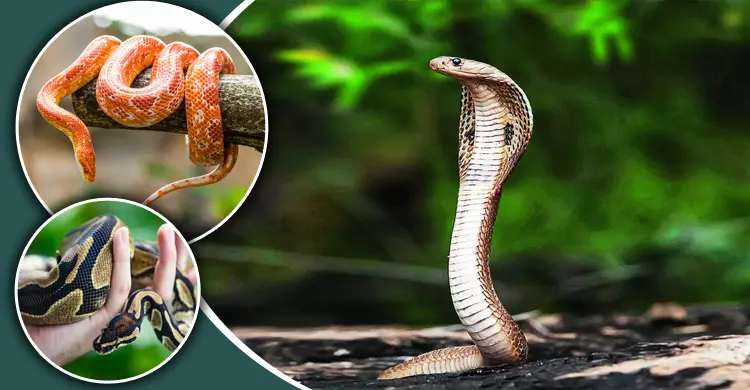
The snake, one of the world's most feared animals, does not look dangerous at all and could even be counted among harmless creatures. But some species are venomous, and their bite can kill a person almost at once, which is why people fear snakes and keep their distance. Did you know that today, 16 July, is World Snake Day?
Snakebites and deaths from them rise during the flood months of May, June and July. Snakes are seen less often in settlements at other times, but in the rains, with water all around, they appear more, so news of deaths from snakebite is often heard at this time.
A nationwide snakebite survey by the Non-Communicable Disease Control programme (NCDC) found that 4,03,317 people in the country are bitten by snakes every year and 7,511 die. Treatment costs each bitten person about Tk 2,000.
The snake is a harmless creature. Around 80 species of snake roam every corner of the country, and most deaths are caused by the bites of just seven or eight highly venomous species. Awareness can save people from venomous bites, but many people hold mistaken beliefs about snakes that put them in greater danger. Here are some common misconceptions.
Venom in the tail
Many believe the dhaman (rat snake) carries venom in its tail. In fact it is a non-venomous snake with no fangs at all, let alone venom in its tail. It eats rats and small birds, and even small venomous snakes are its main food.
Snakes are blind in one eye
Many think a snake is born with one eye blind. In fact snakes see poorly by day and so move slowly. In the dark of night a snake can see 10 times more clearly than modern night-vision glasses.
Snakes dance to the been
Snakes have no ears, and their eyesight is not sharp either. Those who play the been sway it in front of the snake's face, and the snake sways its head at the movement before its eyes, thinking an enemy is in front of it.
Snakes hear with their tongue
A snake flicks its tongue out again and again as it moves, but not to hear. At the tip of the tongue is a gland called the Jacobson's organ, with which the snake senses various substances in the air. This could also be called smelling.
Snakes drink milk
Snakes are cold-blooded carnivores, not mammals, so they find milk very hard to digest. Milk is very harmful to snakes and can even kill them. The snakes you see drinking milk are snake charmers' snakes: before Nag Panchami they are kept captive and given almost no water for about a month, then milk is held in front of their mouths, and they drink it because they have to.
Snakes chase people
Snakes are not people's enemies. But if you run or jump about when you come face to face with one, it may come at you in self-defence. Stand still and you will see the snake pass you by.
Snakes remember their enemies
Snakes have no memory or intelligence to speak of, so they cannot remember people. They come into settlements only in search of food to survive.
Snake's feet
A saying common among many uneducated people in rural areas is that seeing a snake's feet will make you a king. In fact snakes have no feet, so there is no chance of becoming a king by seeing them.
The ojha
The treatment given by ojhas (snakebite healers) is entirely unscientific. The only patients who recover under an ojha are those bitten by non-venomous snakes. So after a snakebite, do not look for an ojha; get the person to a doctor as quickly as possible.
The snake jewel
No such stony substance ever forms in a snake's head. Snake charmers say all sorts of flashy things to mislead people, and what they sometimes show as a jewel is a pearl or some other shiny stone.
Source: Jagonews24. First published in Bengali on The Agro News.


Comments
(0)