
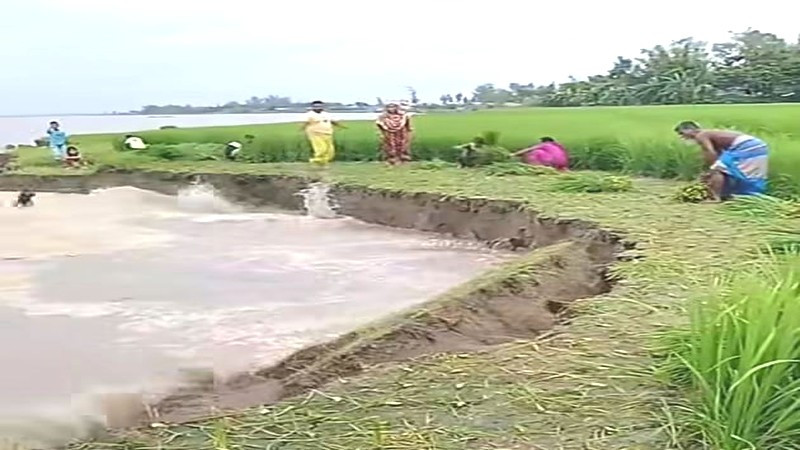
Erosion by the Jamuna has started again at the end of the monsoon in Kazipur upazila, Sirajganj. At least 50 bighas of cropland have already gone into the river, and schools, rural roads, bridges and homes are at risk. With the Jamuna on its east and the Ichhamati on its west, Kazipur shrinks on the map every year.
Erosion began in August and September at Chargirish, Bhetua and other areas. Daily Bangladesh's correspondent found erosion along about three kilometres of Chargirish union on 24 September; about 20 bighas of triple-crop land were lost in the past week alone. Villagers say the Water Development Board was informed but has not even dropped sand-filled geo-bags as a first step.
Locals say illegal sand extraction is shifting the river's course and worsening erosion, and no bank protection is done in the dry season. Ajibar Ali of Bhetua said digging for sand has left holes that pull their land into the river; he has lost seven pakhi of land and could not grow any crop this year.
Abdur Razzak of Notun Maijbari has lost 13 bighas to the river, two pakhi of it this year, and wants illegal sand mining stopped. Harun-or-Rashid of Bilchatal said cutting sand from below loosens the soil until the current carries it away; the char where they farm and graze cattle and goats is all they have left.
Erosion hits ten unions every year: Khasrajbari, Natuarpara, Tekani, Nishchintapur, Mansur Nagar, Chargirish, Maijbari, Kazipur, Gandhail and Shubhagachha. Sajjad Hossain, executive engineer of the Water Development Board in Sirajganj, said senior authorities have been asked for emergency measures in the risk areas and action will follow a site visit. The report is by Gazi Shahadat Hossain Firozi.
Source: Daily Bangladesh
Comments
(0)