
With the fifth parliamentary election in 1991, Bangladesh began a new journey of democracy. Begum Khaleda Zia was sworn in as prime minister, the first woman to hold the office in the country's history. The priority at the time was mainly developing an industrial economy, but her government gave agriculture equal importance.
Several initiatives were taken to move the agrarian society forward, and her government also took Bangladesh Television's "Mati O Manush" programme seriously, as I saw many times while making it. Between 1991 and 1995 I had the chance to interview her three times. I was young then, and being able to interview the prime minister was thrilling. Above all, the interviews were not arranged in advance: I stepped forward boldly, and she reassured me.
The 1993 poultry fair
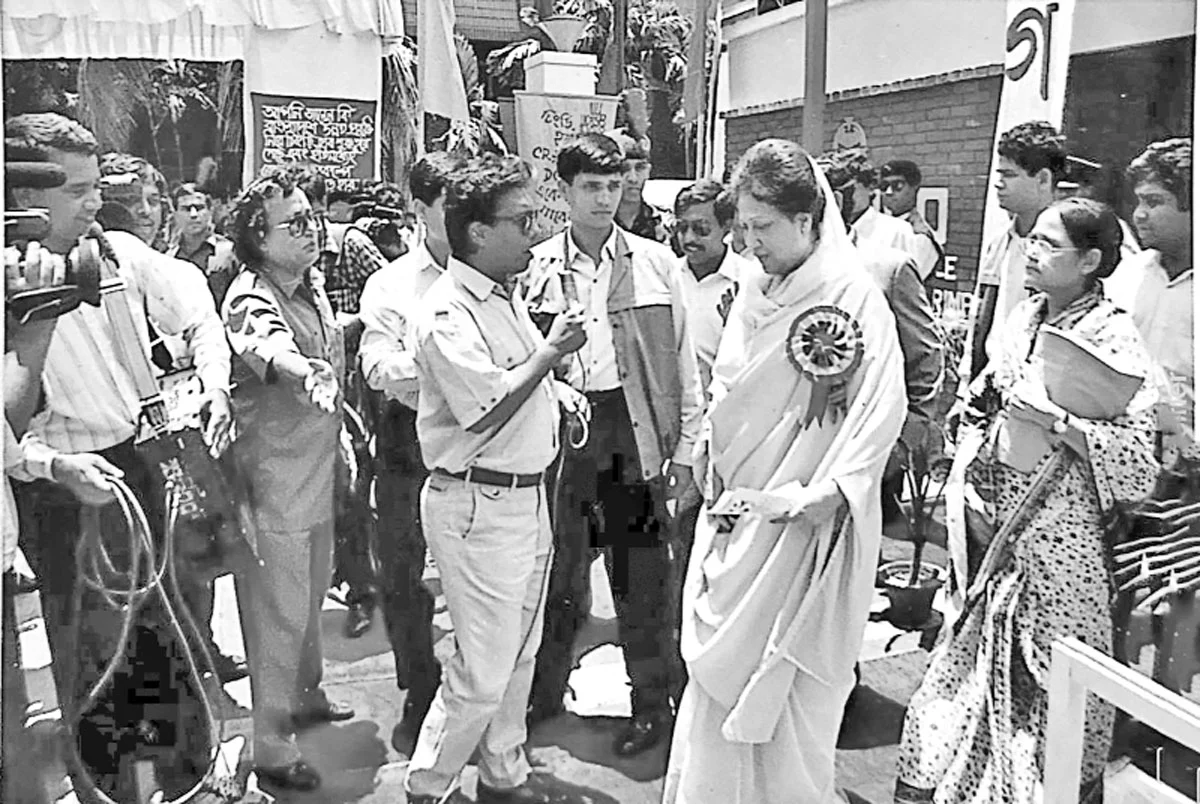
To take farming beyond rice and jute and make fisheries and livestock an important part of agriculture, events such as the fisheries fortnight, the poultry fair, the youth fair and tree-planting programmes were being made national activities. In 1993 a poultry fair was organised at Suhrawardy Udyan. The fisheries and livestock minister then was Abdullah Al Noman, a very gracious man.
He worked to bring young people into agriculture and livestock and to expand the sectors. He followed the episodes broadcast on "Mati O Manush" on Bangladesh Television, and he too wanted to spread enthusiasm for farming among educated young people. Then, as now, unemployment was one of the government's big challenges, and interesting young people in farming would reduce it.
My reports helped them understand the country's agriculture and livestock sector, so whenever something new was broadcast he would often call me in and ask for details. When he went to see the preparations for the poultry fair, Mr Noman took me along. Prime Minister Begum Khaleda Zia was to open the fair. In the afternoon her security team came to check everything at Suhrawardy Udyan.
For the first time I saw how careful one has to be about a prime minister's security: how many steps she would walk, which stalls she would visit, how long it would take, all calculated. The opening ceremony took place the next morning. Prime Minister Khaleda Zia was touring the stalls inside a security cordon. I felt that, as an agricultural journalist, I was standing on the threshold of a chance to interview the prime minister.
Stepping forward with the microphone
I had to get an interview with the prime minister somehow. I told the cameraman to get the camera ready. Normally one cannot interview the prime minister without prior permission. I summoned my courage and went forward holding the boom. I had never met or spoken to her before. As I moved forward I noticed a change in the faces of her security team and could tell they wanted to stop me. But the prime minister signalled to them, meaning "let him come".
I held the microphone out to her and asked my question. She answered in a very natural, soft voice and spoke about the government's various plans for agriculture. The most striking and pleasing thing was when she said the government alone could not solve every problem; young people had to come forward, and the work I was doing had also helped move the government's programmes forward.
As a development journalist, that recognition from her was a great reward. I had never imagined the prime minister would give me the chance to interview her. After that I interviewed her several more times, at the youth fair and at the fisheries fortnight in Khulna. Those were not pre-arranged either; I was able to go straight up to her with a microphone.
Her government's farm policy
While Begum Khaleda Zia was prime minister (1991–1996 and 2001–2006), her government's agriculture and rural development policy included approving farmer-friendly projects such as integrated farming, drainage and irrigation projects, installing deep tube wells, expanding farmer training and information services, setting up potato seed and maize research centres, developing livestock and fisheries, and coastal char afforestation and eco-parks.
Research institutions including BSRI and the National Horticulture Centre were strengthened, and productivity and employment were raised through the distribution of quality seed and improved irrigation and water management. Canal digging and canal restoration continued under her government, and the food-for-education programme supported the rural economy and farmers' food security.
At the same time, the national tree-planting programme helped maintain environmental balance, and the dairy and poultry sectors were advanced through livestock and poultry development policies. I have always put the work first. I wanted my reports to make not only farmers but everyone from government policymakers to researchers, farm organisations, businesspeople and ordinary people think about agriculture, and that continues today.
I got the chance to do this work my own way from Khaleda Zia while she was prime minister, and I received her affection and guidance. Her death will undoubtedly leave a great void in Bangladesh's politics, and in social life too. I pray for the peace of Begum Khaleda Zia's soul.
Courtesy: Bangladesh Pratidin.
Source: Shykh Seraj. First published in Bengali on The Agro News.
Comments
(0)