
In June 2025 a young man in Jajira upazila of Shariatpur was reported to have turned the roof of his family home into a garden of dragon fruit and passion fruit. According to a report by the Shariatpur district correspondent of Jagonews24, published on 25 June 2025, Himel Molla, 26, of Dubisaybar in Baro Kandi union had begun with two varieties of dragon fruit and by then had at least 60 varieties growing on the roof, at least 30 of which had borne fruit. He was also growing passion fruit, which the report called a hill fruit. The garden, built up bit by bit over several years, earned him Tk 30,000 a month, the report said.
The ripe red, green and yellow fruits hanging from the cactus stems were described as handsome to look at and very sweet to eat. An official of the Department of Agricultural Extension (DAE) in the district commended the young grower and said the department would stand by him with advice if he decided to farm commercially.
A garden begun during the pandemic
Himel Molla is the son of Haidar Molla and Hasia Begum. He finished higher secondary school and did not continue his studies. He had loved gardening since childhood, the report said, and decided to make a garden during the coronavirus period. There was little free land around the house, so he chose the roof. His father did not agree at first, but later, seeing how keen his son was, bought the saplings himself. Himel picked dragon fruit because he found it cheap to grow, easy to look after and little troubled by disease.
"I have loved planting trees since childhood," Himel told the correspondent. "From watching various videos I learned that dragon fruit farming is less trouble, so I started with two varieties. Gradually I managed to grow 60 varieties in my garden, and 30 have now borne fruit. I earn well selling dragon fruit. I also have passion fruit plants in the garden and sell their saplings at a good price. I want to farm commercially, and that is possible if I get government support."
His father, Haidar Molla, said: "When my son talked about planting trees on the roof, I did not agree. I thought the roof would be damaged. At one point I agreed to keep his wish. Now I see he is having great success with the rooftop garden. We eat the dragon fruit from his garden and give it to relatives. Instead of sitting around in idle company, he spends his time caring for the plants, and I am very glad to see it. Himel earns his own pocket money and sometimes helps us too."
Older and younger members of the family help look after the plants, and the report said that seeing the garden, many people had become interested in rooftop gardening. A local young man, Rakib Hasan, said: "Himel's thoughts, knowledge and love all revolve around this rooftop garden. Instead of wasting time in idle company, he has succeeded with it. I also want to make a rooftop garden like his."
Shariatpur and Jajira
Shariatpur is a district of Dhaka division covering 1,174.05 square kilometres, bounded by Munshiganj district to the north, Barisal to the south, Chandpur to the east and Madaripur to the west, according to Banglapedia, the national encyclopedia published by the Asiatic Society of Bangladesh. It became a district on 1 March 1984 and has six upazilas. Its main rivers are the Padma, the Meghna, the Palong and the Jayanti. The 2011 population census counted 1,155,824 people in the district, and Banglapedia gives agriculture as the main source of income for 61.66 per cent of them.
Jajira, spelled Zanjira in Banglapedia, lies on the Padma, bounded by Lohajang and Tongibari upazilas of Munshiganj to the north and Shariatpur Sadar and Naria upazilas to the south. It covers 246.21 square kilometres and has one municipality and 12 unions, Barakandi among them; the 2011 census counted 194,019 people there. Agriculture was the main source of income for 71.32 per cent of the upazila's people. The encyclopedia lists its main crops as paddy, jute, wheat, mustard, onion, garlic, kalijira (black cumin) and vegetables, and its main fruits as mango, blackberry, jackfruit, banana and wood apple. Neither dragon fruit nor passion fruit appears on that list, which draws on field reports from 2007 and the 2011 census.
The Padma Multipurpose Bridge links the south-west of Bangladesh with the centre of the country through the Mawa-Jajira point, Banglapedia notes, and the Jajira approach road and service area were among the five packages into which the bridge's physical work was divided.

Sixty varieties on one roof
Himel collected and planted dragon fruit saplings one variety at a time until he had 60. Among the varieties that had fruited, the report named Purple Haze, Big Pink, Pink Rose, Bruni Bari-1, Physical Graffiti, Vietnamese Red, Red Self, Yellow, Big White, Thai Red, Connie Mayer, Boulder, Red Velvet, Taiwan Red, Aussie Gold, Asunta-3 and Blackis Red. Each has its own taste, and the fruits are very juicy, the report said. The names are given here as the report spells them.
Bangladesh also has a variety of its own. The Bangladesh Agricultural Research Institute (BARI) has developed BARI Dragon Fruit-1, which Bangla Tribune described in December 2023 as a large fruit whose skin turns red when ripe, with deep pink, juicy flesh and small, soft black seeds, each fruit weighing 150 to 600 grams.
Growing many varieties side by side has a practical side as well as a collector's appeal. The University of Florida's extension guide to the crop, known there as pitaya, says some dragon fruit cultivars are self-incompatible and recommends planting two or three different genetic types so that cross-pollination gives better fruit set and size. The flowers open at night, so moths and bats are the natural pollinators; where these are scarce, the guide says, growers can pollinate by hand at night or in the early morning, carrying pollen from one flower to the stigma of another.
Prices, cuttings and saplings
Because his dragon fruit is grown organically, the report said, it is in great demand. Himel sold it at Tk 500 a kilogram and still could not keep up with buyers. He also sold cuttings of his plants, which brought in several lakh taka a year. Besides dragon fruit, the roof held six varieties of passion fruit, mulberry and several varieties of grape, and he earned good money selling their saplings as well. The report does not say whether the fruit carried any organic certification.
Prices reported elsewhere in the months before give a comparison. A Financial Express article of June 2023 put the suggested retail price of local dragon fruit at Tk 350 to 600 a kilogram depending on size and season, against Tk 500 to 800 for imported fruit. In October 2023 The Daily Star found wholesale prices of Tk 180 to 200 at the Gourinathpur dragon fruit market in Jhenaidah's Moheshpur upazila. Dhaka Tribune reported in December 2023 that local fruit of 150 to 600 grams sold for Tk 150 to 400 and imported fruit for Tk 500 to 800, with red varieties in higher demand.
In January 2024 Prothom Alo reported from Rajshahi that a grower in Godagari had sold 160 kilograms in Dhaka at Tk 260 a kilogram, after receiving Tk 600 early in the previous season and Tk 1,200 for off-season fruit at the end of that year. Another Godagari grower said wholesale prices had fallen from Tk 600 to 1,200 the year before to Tk 280.
Mohammad Riazur Rahman, additional deputy director (horticulture) of the DAE in the district, told Jagonews24: "We commend this young man named Himel. He is an entrepreneur who has brought in 60 varieties of dragon fruit. If he wants to farm commercially, the agriculture department will stand by him with all kinds of advice."
What dragon fruit is
Dragon fruit is the fruit of climbing cacti, chiefly Hylocereus undatus and related species and hybrids, of the family Cactaceae. The University of Florida guide gives its origin as tropical America, from southern Mexico through Central America to Venezuela, Colombia, Ecuador, Brazil and Uruguay, and its other English names as strawberry pear and night-blooming cereus. It notes that the fruit had become the most important export fruit of Vietnam.
The plants are fast-growing, perennial, vine-like cacti with green, fleshy, jointed stems that usually have three flat, wavy ribs. The stems put out aerial roots that cling to whatever the plant climbs on and can reach about 6.1 metres in length. The white, very fragrant, bell-shaped flowers open at night and may be up to 36 centimetres long. The fruit is a fleshy berry about 11 centimetres thick with a red or yellow, scaly peel; the pulp is white, red or magenta depending on the species, with many tiny black seeds.
A BARI press release quoted by The Financial Express in April 2018 described dragon fruit as a high-value cactus grown for its fruit or juice, originating in Mexico and South America, and rich in antioxidants and vitamins A, C and E.
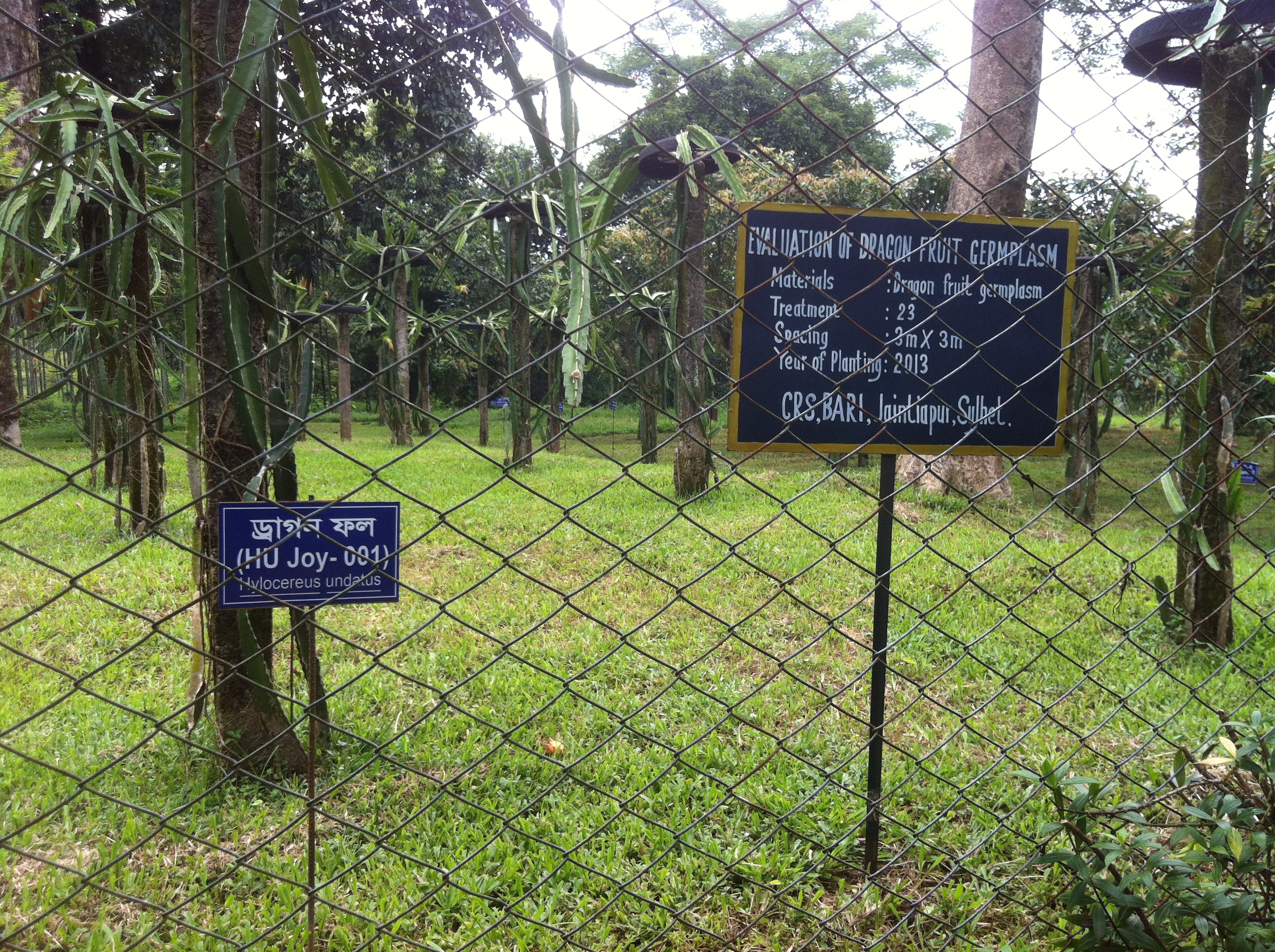
Stem cuttings are the usual way to multiply the plant, which explains the trade in cuttings that the report describes. According to the Florida guide, whole stem segments of 12 to 38 centimetres are used, and many cuttings produce fruit 6 to 9 months after planting, whereas plants raised from seed may take up to 7 years and do not come true to type. In Florida, plants three to four years old may produce about 100 kilograms of fruit a year, and a planting is estimated to last about 20 years.
In Bangladesh the plant normally flowers from April and bears flowers and fruit until November, The Financial Express reported in April 2018, when BARI presented, at a workshop at Pahartali in Khulshi, Chattogram, its success in producing dragon fruit year-round by combining artificial light with temperature control. A June 2023 article in the same paper, drawing on BARI's research, said a 100-watt incandescent bulb and a 20-watt warm LED gave the most buds and fruits per pillar and the largest fruit. In Rajshahi only 7 hectares used the lighting method, mainly for December to March, Prothom Alo reported in January 2024, and growers there said main-season fruit ripened in 25 to 28 days against 38 to 42 days for off-season fruit.
How dragon fruit spread in Bangladesh
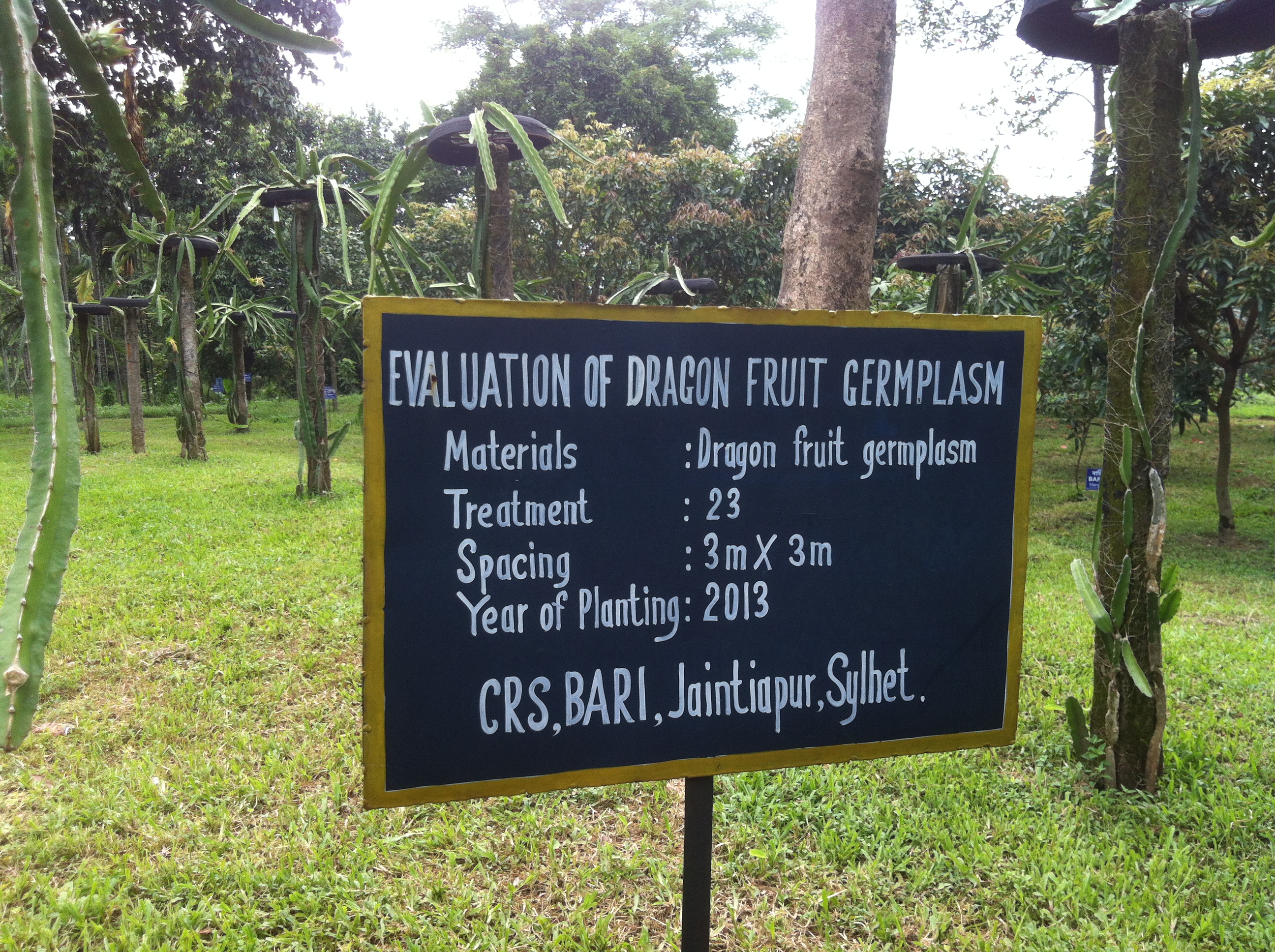
In May 2013 The Daily Star reported that the Bangladesh Agricultural University (BAU) Germplasm Centre in Mymensingh had released four foreign fruit varieties to farmers, among them dragon fruit from Vietnam, and had begun producing saplings in 2007. The fruit is harvested between May and November, when local fruit is scarce, and grows well in saline soil, the report said.
Production grew quickly. The Daily Star reported in December 2022 that output had been 851 tonnes in fiscal 2017-18 and had since risen to 13,872 tonnes, with about one-fifth coming from the hill districts of Khagrachari, Rangamati and Bandarban. It said a Natore grower had cultivated the fruit since 2012, and that the DAE put a farmer's earnings at Tk 4 to 5 lakh an acre and was introducing high-density planting that it said could raise this to Tk 10 lakh on the same land.
A Financial Express article of June 2023, citing the DAE's Horticulture Wing, gave the area under the crop as 38 hectares in 2015-16 and 1,115 hectares in 2021-22, and annual production as 277 tonnes and 13,872 tonnes in those years.
In Jhenaidah, The Daily Star reported in October 2023, citing the district DAE, that the area there had grown from 151 hectares in 2021 and 203 hectares in 2022 to 842 hectares across all six upazilas in 2023, and that a wholesale dragon fruit market had opened at Gourinathpur in Moheshpur in July 2023, where traders claimed sales of nearly Tk 1 crore a day. In Rajshahi about 224 hectares were under the crop, with a target of 4,620 tonnes, Prothom Alo reported in January 2024, citing the DAE there.
By December 2023, Dhaka Tribune listed commercial gardens in Dhaka, Mymensingh, Gazipur, Tangail, Pabna, Bogura, Rajshahi, Natore, Nilphamari, Narsingdi, Chattogram and the Chittagong Hill Tracts. Shariatpur was not among them, and Himel's rooftop garden is a household-scale planting rather than an orchard.
The 2023 debate over large fruit
The fruit's rapid spread was followed by a dispute over the size of some fruit in the market. By December 2023, videos on social media were claiming that large dragon fruit had been enlarged with a harmful "tonic". Dhaka Tribune and Bangla Tribune reported in December 2023 that many commercial farms used plant growth regulators, the most common being gibberellic acid, to increase the size of red dragon fruit.
Md Mehdi Masud, director of the DAE's Year Round Fruit Production project, told the papers that the claims circulating about dragon fruit were wrong and that the use of these phytohormones carried no health risk, citing research from Malaysia in 2014. The reports added that a BARI laboratory had tested dragon fruit for pesticides in July that year and found no harmful residues.
Other voices disagreed. In January 2024 Prothom Alo quoted M. Manjur Hossain, a former professor of botany at Rajshahi University, as saying the hormone used to enlarge the fruit was harmful to human health and that people should eat normal-sized fruit. Mozdar Hossain, deputy director of the DAE in Rajshahi, blamed some YouTubers for the fall in prices and said there was no reason to assume a tonic had been used simply because a fruit was large. Growers interviewed by the paper denied using any hormone and said fruit grown naturally is evenly red with a thin skin.
Passion fruit, the hill fruit
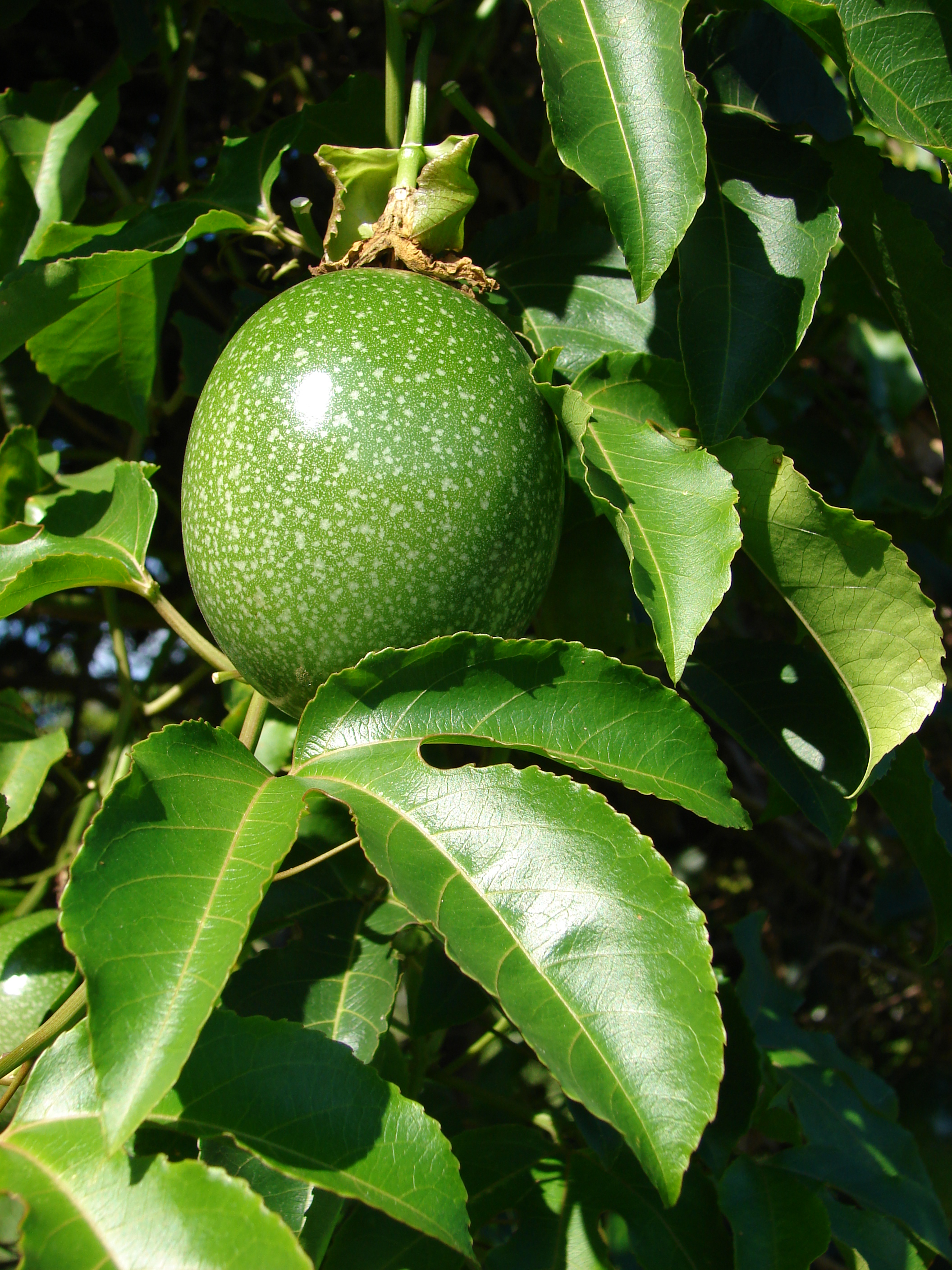
Passion fruit is a climbing vine of South American origin. The Daily Star, reporting in April 2012 on a planting in Panchagarh, identified the variety grown there as Passiflora edulis var. flavicarpa, native to Brazil, Paraguay and northern Argentina, and said it was known locally as "tang phal" because its yellowish juice resembled a powdered drink sold in shops. It had been grown in the hill areas of Chattogram for some years, and BARI had developed a local variety, BARI Passion Fruit-1, in 2003, the report said, in line with the Jagonews24 report's description of it as a hill fruit.
The vines need the support of a tree or a bamboo frame and can bear for several years, the 2012 report said. The Panchagarh plants flowered when about two years old and bore through the year, with June and July the main season. The round to oval fruit is green, turns yellowish after three to four months and weighs about 150 to 200 grams. It was described as an excellent source of vitamins A and C, and is eaten fresh or made into juice and desserts. A local agriculture official told the paper the crop needs little space and labour.
Himel's roof held six varieties of passion fruit, and he told Jagonews24 that he sold their saplings at a good price.
Growing fruit on a roof: official guidance
His father's first worry, that the plants would damage the roof, is one the government's own advice addresses. Writing in Krishikotha, the monthly of the Agriculture Information Service (AIS), in the Bengali month of Ashar 1425 (mid-2018), M. Enamul Haque, a former director general of the DAE, listed dragon fruit among the fruit trees suited to rooftop gardens. He noted that dragon fruit is one of the plants that likes plenty of sun and one of those that take more water.
His article advised:
- deciding at the start how many and which plants a roof of a given size can take, bearing in mind sunlight, wind and the height of nearby buildings and trees;
- avoiding tall trees on very high roofs, where storms are stronger, and keeping fruit trees pruned so that they spread sideways rather than upwards;
- building beds along the edges of the roof, 2 to 3 feet wide and 2 to 3 feet high, or leaving a gap of 8 to 12 inches beneath them, so that roots can spread without harming the roof;
- filling beds in layers for drainage, with brick chips, charcoal, coconut husk and coarse sand beneath 2 to 2.5 feet of good potting mix;
- standing pots on a row of bricks rather than directly on the roof, so that excess water drains away;
- fitting a 50 to 70 per cent shade net 7 to 8 feet above the garden where the heat on the roof is too strong;
- watering only when the soil at the base has dried, preferably in the morning.
A later Krishikotha article, in Ashar 1428 (mid-2021), by Md Shamim Sekh, monitoring officer of the Urban Agriculture Production Support (Pilot) Project, said a rooftop garden should begin by checking whether the roof is strong enough to carry the weight of the plants and whether its drainage is good. It recommended dwarf, shallow-rooted varieties that bear through the year, listed a dragon fruit variety among those suited to roofs, described drip irrigation as well suited to rooftop gardens, and told readers to contact the local agriculture office with any problem. Before using fertiliser or pesticide, growers are best advised to consult the upazila agriculture officer or the government's Krishi Call Centre (16123).
Rooftop farming had by then become a policy interest in the cities. In December 2022 the UN Food and Agriculture Organization (FAO), working under the Netherlands-funded Dhaka Food System project, told a workshop for Dhaka North City Corporation councillors that rooftop agriculture was needed for sustainable food in Bangladesh's cities. Dhaka Tribune reported that, according to the AIS, about 450,000 roofs covering 4,500 hectares were under-used in Dhaka city, and that a drone survey by the city corporation had found gardens on only 2 per cent of rooftops in its area.
On 14 June 2023 The Financial Express reported that the Local Government Minister had announced a 10 per cent holding-tax discount for property owners with rooftop gardens, to apply in city corporation and municipal areas across the country. BARI, for its part, had studied growing media and soil mixes for rooftop gardening and stem pruning of dragon fruit in its 2021-22 research year, the June 2023 Financial Express article on dragon fruit noted.
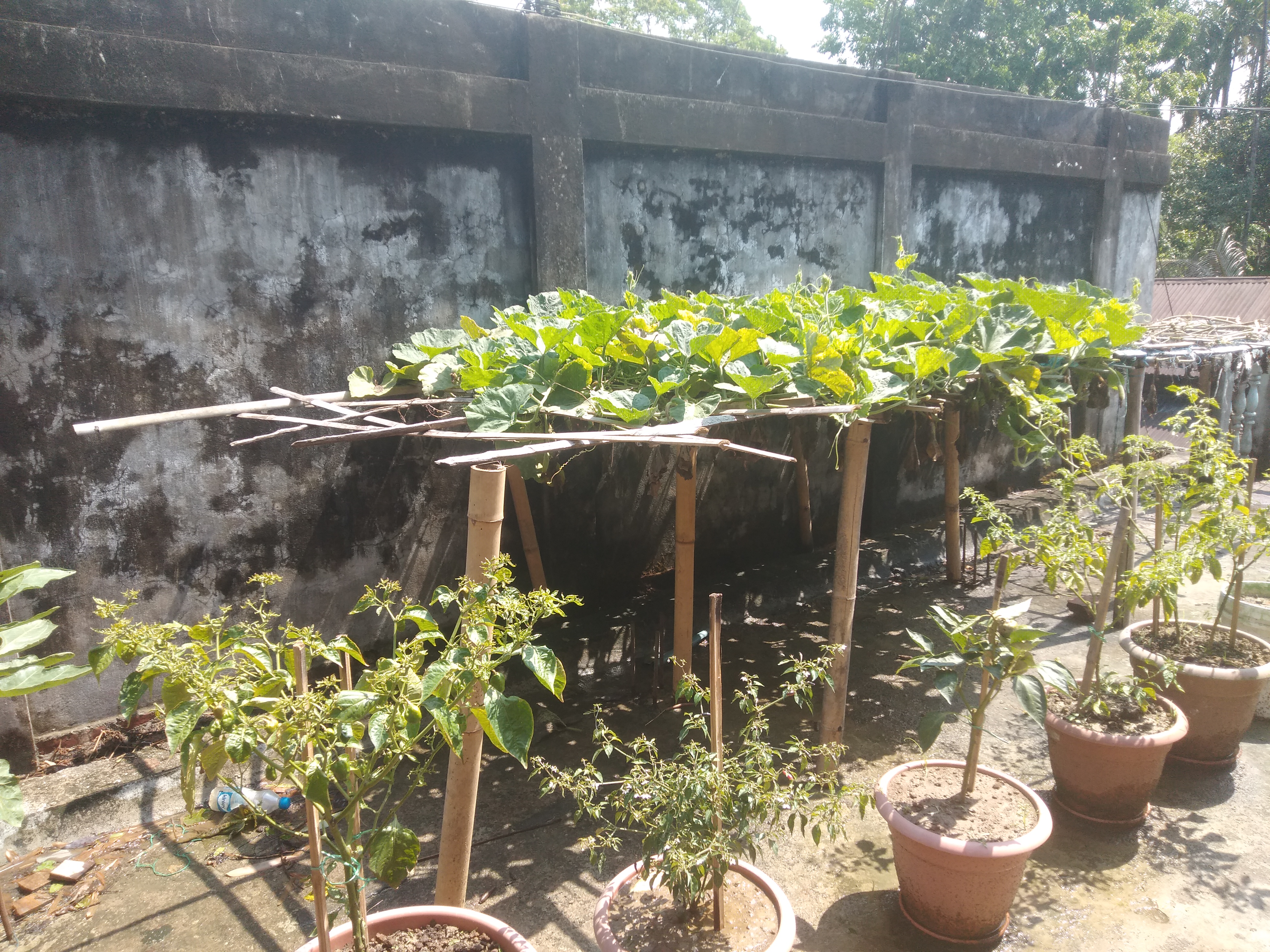
Photo: Abu Sayeed / Wikimedia Commons (CC BY-SA 4.0)
Sources: Jagonews24, Banglapedia, The Daily Star, The Financial Express, Dhaka Tribune, Bangla Tribune, Prothom Alo, Agriculture Information Service (Krishikotha), University of Florida IFAS Extension
Comments
(0)