
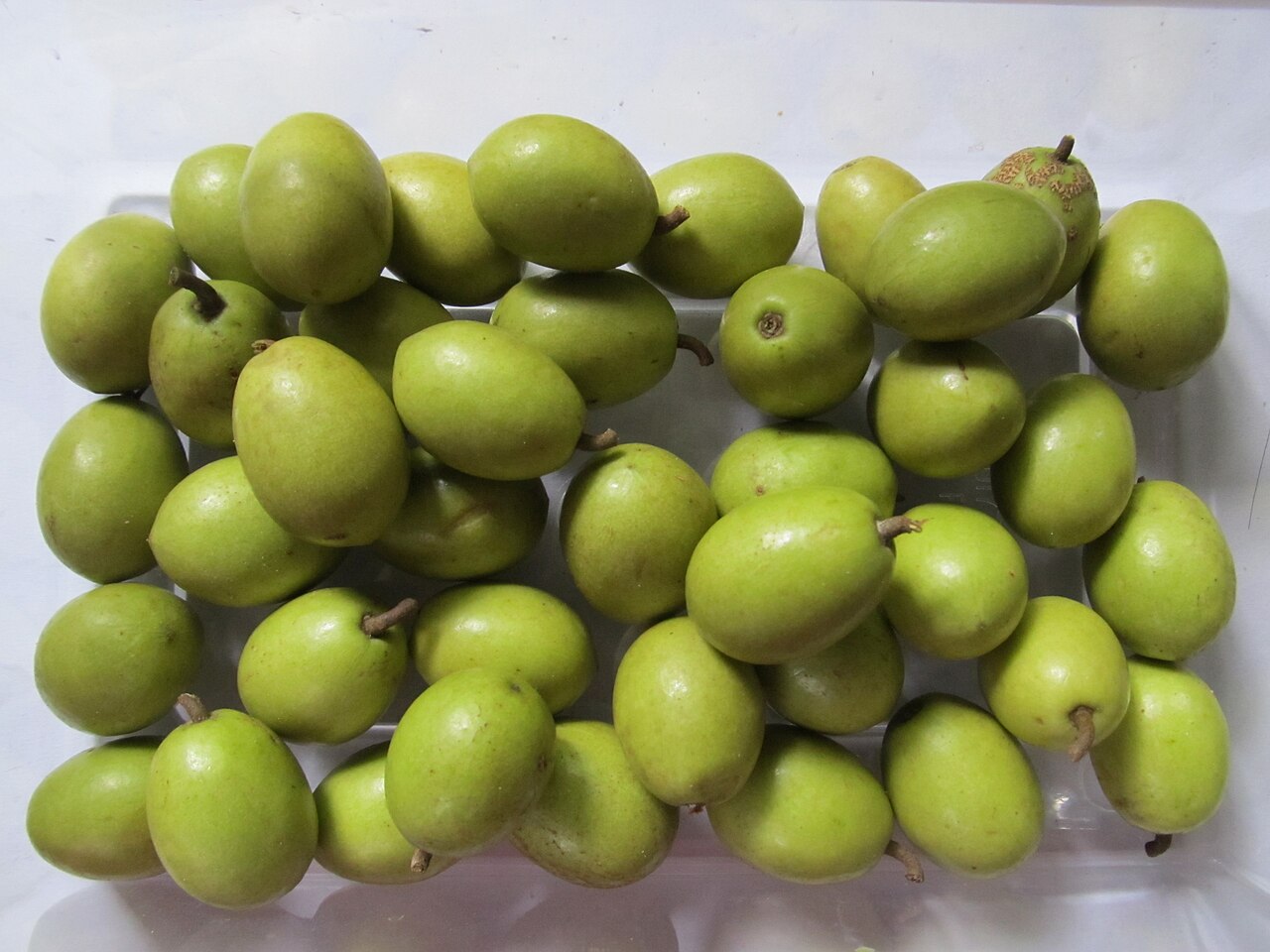
The olive market at Bagbati in Sirajganj Sadar upazila has been busy since the start of the season. Large quantities of olives are arriving and farmers are getting good prices, and traders carry the fruit on to markets across the country.
Olives used to come from a few trees in farmers' homesteads. Because the fruit pays, orchards have spread from homesteads onto fallow land, and many growers now farm it commercially. According to the agriculture department, the upazila has 101 hectares under olive, with a production target of 905 tonnes.
Sellers bring olives from Ghorachara, Kangati, Harina Bagbati, Khaga, Subarnagati, Phulkocha and Bakhrambag villages of Bagbati union. Wholesalers come from other upazilas of the district and from Pabna, Natore, Tangail, Bogura and Dhaka. Trading runs from morning to evening.
Every morning growers arrive with sacks of olives on auto-rickshaws, vans and pickups. Small traders heap them on polythene sheets spread on the ground, and wholesalers weigh and buy from there. At least 30 to 35 tonnes are sold a day, worth about Tk 4 lakh to 5 lakh.
Aminul Islam, a trader at the market, said wholesalers buy the trees from their owners as soon as they flower. Depending on its size, a tree bears 10 to 15 maunds of olives. Wholesalers pay Tk 700 to 900 a maund, and the fruit sells at Tk 1,000 to 1,200 a maund in the market. By his count, Tk 4.5 lakh to 5 lakh worth of olives changes hands at the market each day.
Ashraf Ali, a small local trader, said the Bagbati market normally meets on Sundays and Thursdays, but now that the season has begun the olive market sits every day. Farmers say the weather has been kind and yields are good this year. Olive trees need little care and no pesticide, which is why more farmers are planting them.
Md Anwar Sadat, additional director of the Department of Agricultural Extension in Sirajganj, said the olive season runs through the three Bengali months of Ashwin, Kartik and Agrahayan. The sour fruit can be eaten fresh but is most popular as pickle. He said it gives farmers extra income, and the agriculture department advises growers on raising production in the district.
This report is based on a dispatch from Krishi Shomoy's Sirajganj correspondent.
Photo: Gregorvitch / Wikimedia Commons (CC BY-SA 3.0)
Source: Krishi Shomoy


Comments
(0)