
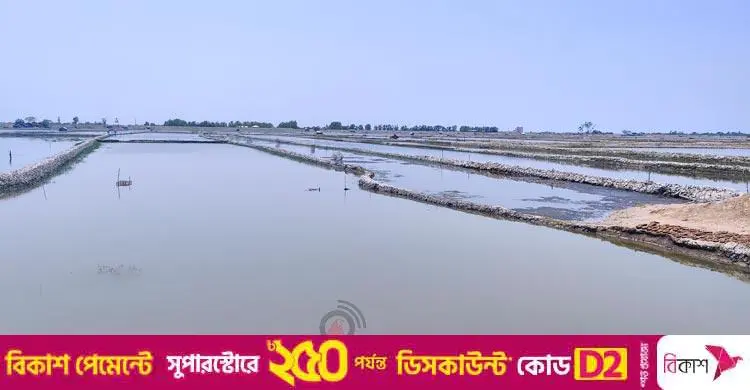
Arable land is shrinking; salt is rising for lack of freshwater flow; salt stays up to a metre deep in the soil all year; farmers are leaving farming for other work; women labourers are losing jobs and falling into debt; and experts advise salt-tolerant rice, vegetables and alternative cultivation.
Crops no longer grow from the soil. Seeds are sown but seedlings do not come up, and if they do, they burn and die in the salt. This is now daily reality in Shyamnagar, Assasuni and Kaliganj, the coastal areas of Satkhira. Land that once yielded rice, jute, pulses and vegetables over three seasons now lies fallow for months because of salinity.
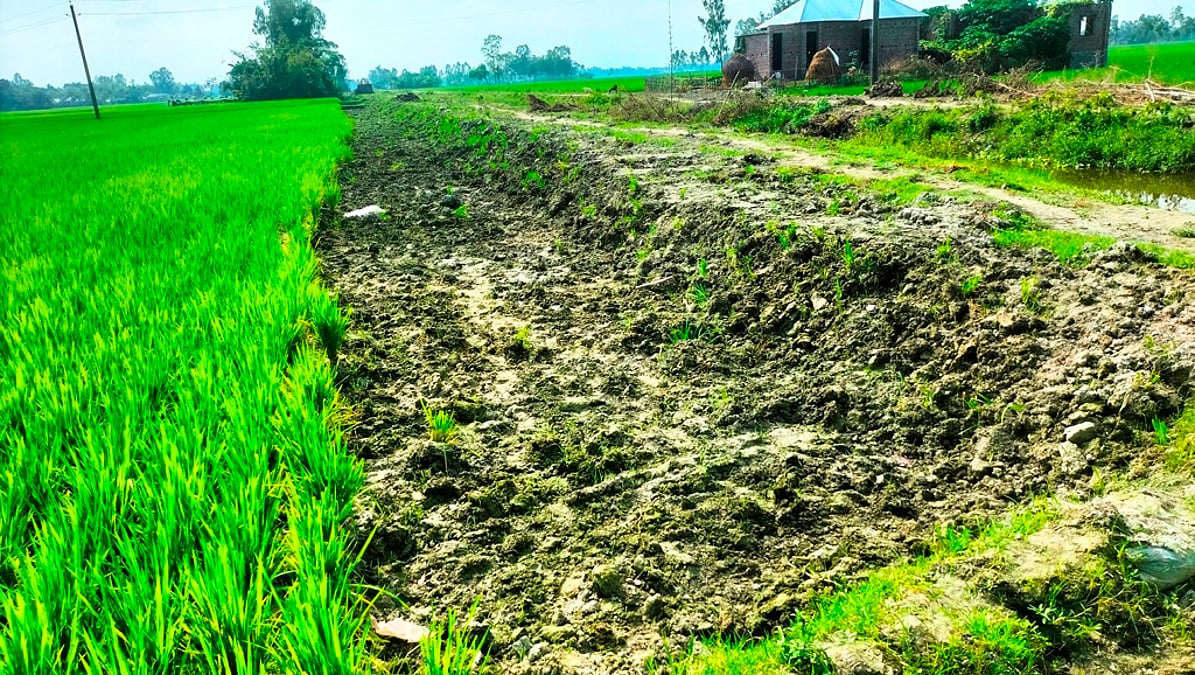
Climate change, cyclones, river erosion, broken and weak embankments and repeated saltwater intrusion are raising salt levels in the soil. Even when the land dries, a white layer of salt stays on the surface, the main barrier to growing crops. After recent cyclones such as Aila, Amphan, Bulbul and Yaas in particular, long-standing salinity has made farming on coastal land an almost impossible task.
In many areas farmers' incomes have stopped because they cannot grow crops. Some have turned from farming to shrimp culture; others have changed occupation to survive, making the future of farming even more uncertain. Many are under pressure from NGO loans, and some are being forced to sell their land. Some farmers are trying salt-tolerant rice varieties, but with little training or support their success is limited.
Agricultural and soil scientists say the crisis can be partly tackled with the right information, training and tolerant varieties. Experts advise using the period after the monsoon, when salinity falls somewhat, to grow salt-tolerant rice such as BRRI dhan67, 92, 93 and 99 or BINA dhan8 and 10. Land washing, organic fertiliser and mulching with water hyacinth and straw can also reduce salinity. Those involved advise farmers to get their soil salinity tested and to seek advice on which varieties to grow from the Department of Agricultural Extension (DAE), the Soil Resource Development Institute (SRDI) and local NGOs.
Shrinking farmland and rising salt
According to the latest figures from the Satkhira statistics office, the district now has 514,366 farm households owning 271,470 acres of arable land. The 2008 agricultural census found 436,178 farm households with 280,730 acres. The report says that over 12 years farm households in Satkhira rose by 164,708 while arable land fell by 9,260 acres.
According to the agriculture department, Satkhira district covers about 3,750 square kilometres, with 229,607 hectares of cultivable land. Of this, 153,110 hectares are already affected by salinity. The worst-hit upazilas are Shyamnagar, Kaliganj, Assasuni and Debhata. Every year in March, April and May, soil salinity rises to 15 to 25.4 dS; after the monsoon, in July, August and September, it falls to 2 to 5.6 dS/m. But salt remains up to one metre deep in the soil all year round, a major obstacle to cultivation.
According to a 2024 survey by the SRDI, the highest salinity recorded in the water of the Kholpetua river in coastal Satkhira in May was 42.52 dS. At the same time, soil collected from a crop field in Ishwaripur union of Shyamnagar upazila had a salinity of 12.29 decisiemens (dS/m).
A recent study by the Bangladesh Rice Research Institute (BRRI) found salinity of up to 25 dS in boro fields, a level considered a serious threat to normal farming and freshwater biodiversity.
Experts say that unless area-specific salt-tolerant varieties, better embankments and drainage, and farmer training and seed support are increased now, much of the area will be impossible to farm within the next five to ten years.
Villages under salt water
A few months ago, a breach in the Kholpetua river embankment flooded Bichhat, Nayakhali, Basudebpur, Ballabhpur, Anulia, Chechua, Kakbashia, Cheotia and Kopsanda villages in Anulia union of Assasuni upazila with salt water. Crop land in these villages was submerged. Salt water entered fields it had never reached before, destroying rice, vegetables and fruit. The local administration quickly repaired the embankment after the crop losses, but the land's fertility has not returned. There is still a layer of salt on the surface and trapped saline water beneath, so farmers have not been able to restart cultivation anywhere on that land. They are waiting for monsoon water to wash away some of the salt, when they may dare to plant boro rice.
"Salt water destroyed the crops on my 6 bighas," Rafiqul Islam, a farmer of Kakbashia village, told Jago News. "After the embankment was repaired the water stopped coming in, but white salt has built up on the land. I still have not been able to start growing crops."
The hardship is not limited to Bichhat. Some years ago, during cyclones Amphan and Yaas, embankments broke in the same way and salt water flooded most of Pratapnagar union in Assasuni upazila. The water stood in the fields for months and destroyed the crops of the time completely. Worse still, the long-term effect is that crops are no longer grown on that land at all.
"I had four bighas of farmland," said Masum Billah, a farmer in Pratapnagar. "Since salt water came in during Cyclone Amphan, no crop can be grown there. Nothing grows. I have been forced to turn the land into a saltwater fish enclosure."
Since Cyclone Aila in 2009, large areas of Gabura, Padmapukur, Atulia and Burigoalini unions in neighbouring Shyamnagar upazila have borne the curse of salinity. The tidal surge then broke river embankments and flooded the whole of Gabura union and most surrounding areas with salt water. Sixteen years on, a large part of the land there is still not cultivable, and fresh saltwater intrusion during every monsoon or cyclone makes things worse. In some areas so much salt has built up that farmers say you can smell salt on a handful of soil.
Farmers leaving the land
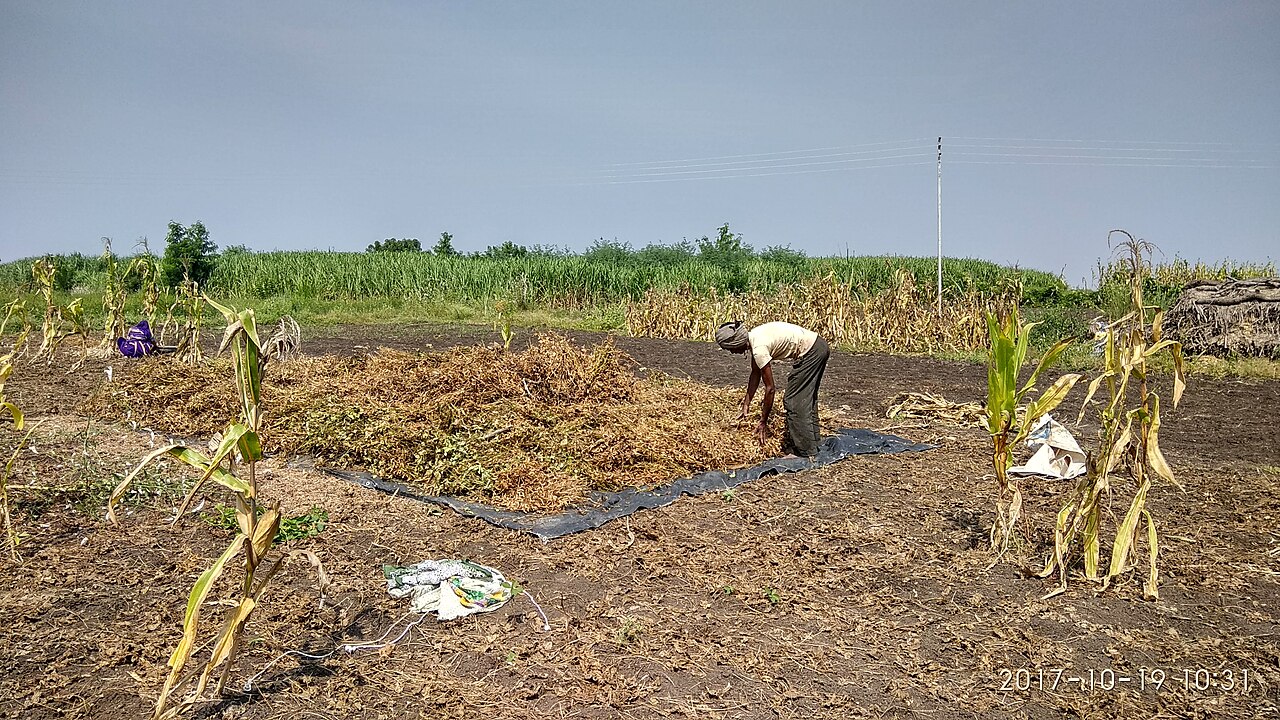
After repeated failures on saline land, many coastal farmers in Satkhira are changing occupation. Some have turned to shrimp or crab farming; others have become masons, day labourers or small traders; many are heading to towns as seasonal workers. Some who took NGO loans to build fish enclosures have fallen into debt when they made no profit.
Abandoned land becomes overgrown with water hyacinth and weeds and becomes even less cultivable. Some try salt-tolerant rice after the monsoon washes the soil, but without adequate training and support the results fall short.
Women farm labourers are hit hardest as land becomes unfit for cultivation. Those who used to transplant, weed and harvest rice have lost work and face deep uncertainty. With their income gone, the economic pressure on families has doubled. Many are forced to sell dry food at local markets or look for work as domestic helpers elsewhere, and some are under pressure from NGO loans. Locals say idleness at home has also increased family conflict, marital strain and violence against women.
Many farming families hit by salinity are leaving for towns or nearby areas in search of a safer livelihood, creating a kind of "internal climate migration" in rural society. Men go to towns to pull rickshaws or work on construction sites, leaving women and children behind. In many families, the parents are in town and the children stay in the village with their grandmother.
Causes: embankments, shrimp and upstream flow
Principal Ashek-e-Elahi, convenor of the Satkhira Climate Council, believes the salinity problem in the coastal region is long-standing and structural. He said Satkhira has historically been an area of salt and brackish water, but the construction of coastal embankments in the 1960s and interference with water flow in the name of the green revolution destroyed the natural balance of fresh and salt water. The environmental disaster became clear from the 1970s. Then in the 1980s, commercial shrimp farming began by pumping salt water onto farmland, and the ecosystem collapsed. With freshwater flow from upstream now almost stopped, river salinity has risen and farming and daily life are under serious threat.
He said salt levels in soil, water and the environment have risen so much that people are being forced to leave the area. Jobs are shrinking and homesteads are emptying. As a solution, he stressed ensuring upstream freshwater flow into the rivers and restoring the balance between fresh and salt water.
Ramkrishna Joarder, regional coordinator of the non-government organisation BARCIK, which works on coastal agriculture, and a researcher of life and nature, told Jago News that the effects of climate change are most visible in the coastal areas through salinity. As the sea level rises, more salt water than fresh water now enters the rivers. Cyclones are becoming more frequent and intense, and during these disasters broken embankments let salt water into villages and farmland. Rainwater used to wash away much of the salt, but the monsoon is now irregular, so that natural cleansing has also declined. With little freshwater flow from upstream, the whole river system has become saline, and agriculture in coastal areas like Satkhira now faces an existential crisis.
District environment officer Sardar Shariful Islam described salinity as a very difficult and multi-dimensional problem that depends not on one cause but on many related factors. He identified the lack of upstream freshwater flow as one of the main causes: such flow is essential, but it is now almost non-existent because all the upstream rivers and canals have filled up or silted. Referring directly to the Farakka Barrage, he said the problems began after Farakka, which has had a major negative effect on freshwater flow in the region.
What scientists advise
Agricultural and soil experts say the crisis can be tackled with the right information services. Coastal farmers have options in salt-tolerant rice such as BINA dhan8 and 10 and BRRI dhan67, 92, 93 and 99, salt-tolerant vegetables and alternative cultivation. Farming can begin after the monsoon, when some of the salt has been washed out. Soil salinity testing, drainage techniques, organic fertiliser and water hyacinth, and straw mulching can reduce salinity. The DAE, the SRDI, local NGOs and information centres are helping farmers with these.
Dr Md Sajjadur Rahman, chief scientific officer at the BRRI Satkhira regional office, said the highest salinity recorded on farmland in Satkhira district was 25 decisiemens per metre, found in Kaliganj upazila. This is extremely high salinity at which most conventional rice varieties cannot survive.
He said BRRI's latest salt-tolerant variety, BRRI dhan99, can tolerate salinity of up to 10 decisiemens, so it can be grown on land where salinity is 10 decisiemens or less.
"Salinity is highest in the boro season," Dr Sajjadur Rahman said. "But heavy monsoon rain washes out much of the salt, so salinity falls significantly in the aman season. For example, if a field has 25 decisiemens in the boro season, it drops to 1 to 2 decisiemens after the monsoon, and normal rice can be grown there." He added that BRRI's work is limited mainly to rice varieties, but research continues on more area-specific salt-tolerant varieties.
Shamsun Nahar Ratna, senior scientific officer at the SRDI Satkhira regional office, said salinity in soil and water in the Satkhira region is rising day by day. "We can see the amount of salt in coastal areas steadily increasing. It has become a major threat to agriculture."
She said the Satkhira office still has no modern soil-testing laboratory of its own. Soil samples collected by farmers, NGOs or research organisations are sent to the divisional laboratory at Daulatpur in Khulna. Based on the reports, farmers are advised on fertiliser amounts and management, and recommendation cards are supplied as needed.
Citing the SRDI's latest survey, she said soil salinity in Satkhira's seven upazilas (Shyamnagar, Assasuni, Kaliganj, Debhata, Tala, Kalaroa and Sadar) has been divided into five classes, coded S-1 to S-5. Under this classification, 620 hectares are very slightly saline, 2,630 hectares slightly saline, 7,380 hectares moderately saline, 12,360 hectares strongly saline and 13,920 hectares very strongly saline. She said this shows nearly half of Satkhira's cultivable land is now moderately to extremely saline, and that raising farmers' awareness and providing information and technical support are urgent.
Babul Akter, senior scientific officer at the Bangladesh Institute of Nuclear Agriculture (BINA), said climate change is driving a dangerous rise in salinity in coastal Satkhira. Temperatures are rising and the water table is falling. As rivers dry up, broken embankments let salt water into new land.
Washing salt out of the fields
Saiful Islam, deputy director of the district DAE, gave advice on tackling salinity and on crop strategies. If an embankment breaks and farmland is flooded, especially with salt water, the best course for farmers is to cut the field ridges or small embankments when the tide begins to ebb and drain the flood water quickly. This reduces the amount of saline water on the land.
After draining the salt water, if it rains, the land should be flushed with the fresh rainwater. This fresh water helps push the salt deep in the soil down to lower layers, or helps carry some salt water out. Only after the land has been washed well can farmers prepare it for crops. He described this as a proven method of overcoming the effects of salinity.
The situation is somewhat different on high land, he said. There, heavy monsoon rain washes the salt down into the lower soil layers, so salinity causes relatively fewer problems in the rainy season and crops are easier to grow.
Outlook
The report says that unless effective action is taken quickly, large areas of farmland in coastal Satkhira could become completely uncultivable within the next five to ten years.
According to observations by the SRDI and BRRI, soil salinity is rising by an average of 1 to 2 dS a year in summer and winter. The Sixth Assessment Report of the Intergovernmental Panel on Climate Change (IPCC) also warns that if the sea level keeps rising, the spread of salinity in coastal Bangladesh could double by 2050.
Several environmental studies say annual crop production in parts of Satkhira, Khulna and Barguna could fall by 30 to 40 per cent by 2035, with severe effects on food security, internal migration and the local economy.
Experts fear that if area-specific salt-tolerant varieties and water management strategies are not adopted in time, Satkhira will one day be known only as a shrimp region, where farming survives only in records and memories.
Source: Jagonews24. First published in Bengali on The Agro News.

Comments
(0)