
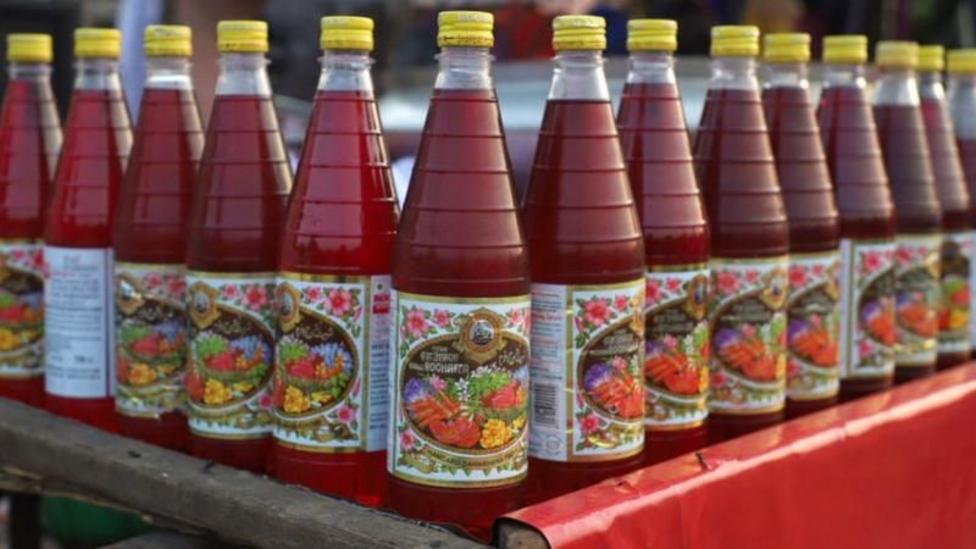
When Ramadan arrives, a thick red sharbat takes its place beside the piyaju, beguni and chola-muri on iftar tables in Bangladesh, Pakistan and India. Rooh Afza began in Delhi in 1906, which makes the brand 120 years old, a witness to Partition and to several wars. In Urdu rooh means soul and afza that which refreshes, so the name means a drink that refreshes the soul. Last Ramadan a Facebook trend in Bangladesh ran: as a child I thought drinking Rooh Afza earned religious merit.
According to the history magazine Heritage Times, Rooh Afza was created by Hakim Hafiz Abdul Majeed, a Unani physician whose clinic in Lal Kuan bazaar in old Delhi was called Hamdard Dawakhana, hamdard meaning a companion in suffering. The journalist Sanam Maher has recounted how, on a hot day, the scent of roses drifting from the clinic drew a crowd and the first batch sold out before evening. Made to refresh patients suffering in the heat, the alcohol-free medicinal drink went into commercial production around 1907 and later into mass production at a factory in Ghaziabad. The name came from a princess called Rooh Afza in the poet Pandit Daya Shankar Nasim's Masnavi Gulzar-e-Nasim.
By 1920 the bottles were packed and labelled by hand; the glass bottle and the traditional label were designed by the Delhi artist Mirza Noor Ahmad. When the hakim died in 1922, Hamdard passed to his elder son Abdul Hameed, then 14. At Partition in 1947 Abdul Hameed stayed in Delhi and the younger son, Hakim Mohammed Said, moved to Pakistan, producing Hamdard India and Hamdard Pakistan. Expansion in 1953 and 1956 brought sales outlets to Chittagong and Dhaka in what was then East Pakistan, and after 1971 Hamdard Pakistan's operation became Hamdard Laboratories (Waqf) Bangladesh, where Yousuf Harun Bhuiyan joined and began making and selling Rooh Afza. The original recipe remains a closely guarded secret and almost unchanged.
The attachment to the drink shows up in unexpected places. During the Soviet-Afghan war Rooh Afza was sent as relief to Afghan refugee camps, and officials were baffled by how many bottles were needed each day until an inquiry found the Afghans were drinking it neat, without water or milk. In 2019, when a shortage of some herbal ingredients made Rooh Afza scarce in India, Indian users vented their frustration on Twitter and Pakistani users offered to send some across as a gift.
It has also been to court. In 2022 the Delhi High Court, hearing a complaint about counterfeit sales, ordered Amazon India to remove Pakistani-made Rooh Afza from its Indian listings. In Bangladesh a pure food court in Dhaka fined Rooh Afza 400,000 taka in 2018 for making food with unapproved ingredients and misleading advertising; Hamdard pleaded guilty and apologised, but on appeal in 2022 the verdict and the fine were set aside.
Not everyone is a devotee. The drink's sugar content, colouring and preservatives draw criticism, and many people consider home-made sharbats healthier. Whether to mix it with milk or with water is a running argument online. Still, that a herb-and-rose product has held its place in the food markets of three countries for a century makes it a rare case study in the subcontinent's food industry.
Source: BBC Bangla

Comments
(0)