
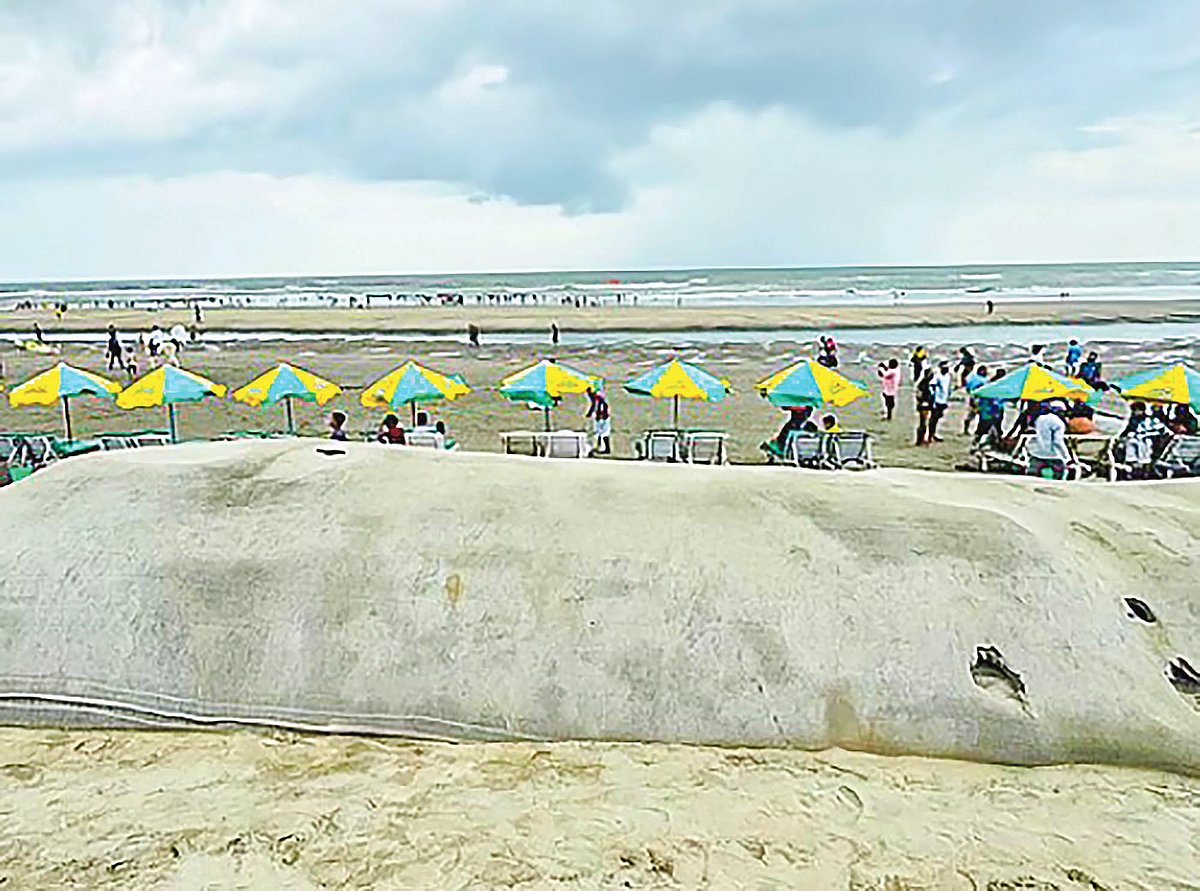
Cox's Bazar, the world's longest unbroken sandy beach, is eroding fast, and the natural defence against it lies in the sand dunes known locally as 'deil', writes the author, researcher and environmental activist Pavel Partha in a column in Prothom Alo. The views are the writer's own.
Citing a study by Rashid and others (2025) in the Journal of Sea Research, he writes that 1,085 hectares of Cox's Bazar were lost to the sea between 1989 and 2024. Walking from Nazirartek to Inani in the last week of August, he counted more than 20 eroding stretches, with torn geo-bags, unprotected dunes and no plant cover. He blames unplanned drainage, pollution, encroachment, hill cutting and haphazard tourist building.
He criticises a 1.2 km four-lane road and a concrete 'town protection embankment' built from Sugandha to Kolatoli over the dunes, a JICA-funded project of Tk 63.50 crore that the High Court stayed for eight weeks on 2 September. Some 10,465 hectares of the Cox's Bazar-Teknaf coast were declared an Ecologically Critical Area in 1999, yet most dunes have been damaged.
The Rakhine divide the coast into six layers from sea to hills: sea, beach, dune, low land, high land and hill. Elders remember that only the low land was farmed and the high land settled, while the dunes were used only to gather fish, herbs, wild food and firewood. Local rice varieties such as Lombru, Hemata, Kadamoni and Bini were once grown on those fields. Dunes 20 to 30 feet high hold freshwater beneath them.
Creepers and shrubs such as beach morning glory, nutgrass, screwpine and Nishinda once covered the dunes, their roots trapping sand, and the dunes are also home ground for endangered olive ridley turtles and red crabs. The casuarina planted in 1972-73 is not native to Cox's Bazar. Drawing on research in Coastal Engineering and other journals, the writer argues that vegetated dunes are a nature-based solution for coastal protection.
He calls for legal recognition of the dunes, regular health checks, a ban on permanent structures on living dunes, 'dune insurance' to pay for restoration, and active climate diplomacy to win global climate funds to protect the beach. Had local knowledge been part of mainstream development, he writes, the erosion would not be this severe.
Source: Prothom Alo
Comments
(0)