
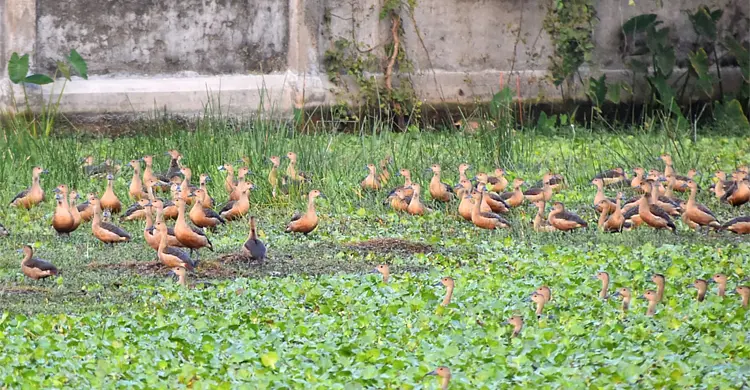
Stepping onto the green grass, you feel the touch of dew, and the feeling takes shape in words: winter is coming. At Narikelbaria, known as the second campus of Rajshahi University (RU), it is migratory birds on the wetland that have brought this message. As afternoon falls, flocks of them are busy at play.
Practical classes for the university's veterinary and animal science and crop science departments are held on the Narikelbaria campus. With few people around, the site has become a bird sanctuary. A barbed-wire fence has been put up to protect the birds, and public entry has been banned.
A small kingdom of birds
A visit found a small campus covered in green trees on all sides, with a large pond and, opposite it, a small wetland full of water hyacinth. That is where the birds gather, the whole area alive with their chirping, their movement in flocks and their play in the water.
It is like a little kingdom of birds. Some dive and swim, some fly up into the sky, move from branch to branch and come back down to the pond. Others circle in the sky before landing on the wetland again, some bask in the sun with their heads tucked into their feathers, and some compete to catch fish. The most commonly seen is the lesser whistling duck. There are also fulvous whistling ducks, northern pintails, northern shovelers, ferruginous ducks and tufted ducks.
Animal experts say severe cold sets in north of the Himalayas in September and October, with heavy snowfall in Siberia, Mongolia, China, Nepal and India. Unable to bear the cold, the birds travel to temperate regions in search of warmth, and RU's Narikelbaria campus is one of the places in Bangladesh they come to.
Birds gone from the main campus
Jaber, a student of the university's mass communication and journalism department who was visiting, said: "I had heard that Rajshahi University has a second campus called Narikelbaria. Today I came and saw it with my own eyes: a quiet patch of land surrounded by trees. The main attraction here is the winter migratory birds. Migratory birds used to come to the main campus, but now they do not come at all. Ponds were filled in to build infrastructure, so the birds left. Now they come to the Narikelbaria campus."
Dr Md Hemayatul Islam, deputy chief veterinary officer at the Narikelbaria campus, told Jago News that migratory birds have been seen on the wetland every winter since 2016. Heavy snowfall in the Himalayas in winter brings the birds to temperate areas to breed, and because few people come here they can move about freely.
"The land on this campus has been unprotected for a long time," he said. "To protect the birds we have blocked the path to the wetland with barbed wire, and public entry has been banned. A gang used to hunt birds secretly on the wetland; we caught them and had them punished. The university administration needs to take steps to protect the migratory birds."
Asked about this on the morning of Saturday 26 November, the university's pro-vice-chancellor, Professor Md Sultan-ul-Islam, told Jago News: "I heard about it only yesterday and have already been in touch with people there. Even if it takes extra volunteers, we can make it an attractive place, keeping the environment there sound while drawing more visitors. We will take steps to protect the birds. I will go there."
Source: Jagonews24. First published in Bengali on The Agro News.
Comments
(0)