
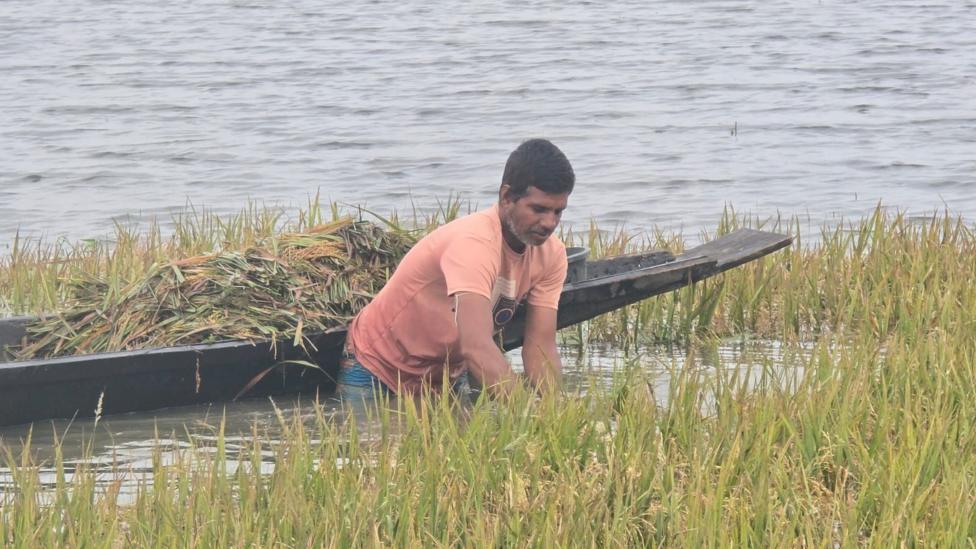
At the height of the boro harvest in Bangladesh's haor wetlands, continuous rain is pushing more paddy under water every day, and grain cut in haste is rotting because there is no sun to dry it. Agricultural officials say 18,000 hectares in Sunamganj are still submerged, about 9,500 hectares went under in Netrokona by Friday, and in Kishoreganj the flooded area was expected to pass 7,000 acres by Saturday. The Flood Forecasting and Warning Centre says flooding has already set in across Netrokona and Habiganj and may deepen, with new low-lying areas at risk.
Anwar Hossain, a farmer at Haluargaon in Sunamganj Sadar, planted paddy on one and a half kani (about 60 decimals) and has harvested none of it. "Everything is under water. I got nothing. I borrowed to buy fertiliser, seed and pesticide. I don't know how I will repay it or what I will do," he said. Mohammad Jasim of Gayeshpur village in Ashtagram, Kishoreganj, says his paddy had turned orange and ready; he left the field in the morning and returned at noon to find water on it, and by the next day it had all gone under.
Dr Md Sadiqur Rahman, deputy director of the Department of Agricultural Extension in Kishoreganj, said intermittent rain through Saturday was rapidly expanding the flooded area and that farmers could not dry what they had cut, so harvested paddy was rotting; the department is still urging farmers to cut wherever they can. Sunshine on Thursday had brought some relief and many harvested ripe paddy through Friday, but rain and lightning returned on Friday night, leaving both those who had not cut and those who had stacked their grain in trouble.
Sajjad Hossain, executive engineer of the Kishoreganj Water Development Board, said all the district's rivers except the Meghna at Bhairab had risen, though they remained below danger level, and embankments were being cut in places to release water. In Sunamganj, executive engineer Mamun Howlader said the embankments were secure but were being opened where the harvest was already in, because some areas had flooded; more rain is forecast in the coming days.
Mohammad Omar Faruk, deputy director of the Sunamganj agriculture office, says 71 percent of the haor paddy has been harvested and 60 percent on average across haor and non-haor land, leaving 40 percent in the field. "The farmer's food for the whole year is in the field. The rain has stopped the harvest being done on time," he said, adding that cutting could continue if the rain was not heavy. In Netrokona the Kangsa and Ubdakhali are above danger level after heavy rain and hill runoff and the Someshwari is rising; district agriculture officer Md Amirul Islam says boro has suffered extensive damage from rain since mid-March, two spells of hail and then days of steady rain, though the district administration expects no further deterioration if the rain holds off.
The haors grow a single crop a year, boro, harvested between 15 April and 15 May. This year rain prevented harvesting from the second week of April, and agriculture offices say rain, hail and very heavy falls from mid-March had already disrupted preparations. In parliament Prime Minister Tarique Rahman has promised support for haor farmers hit by the downpours. The fate of the 40 percent still standing now depends on sunshine in the next few days.
Source: BBC Bangla

Comments
(0)