
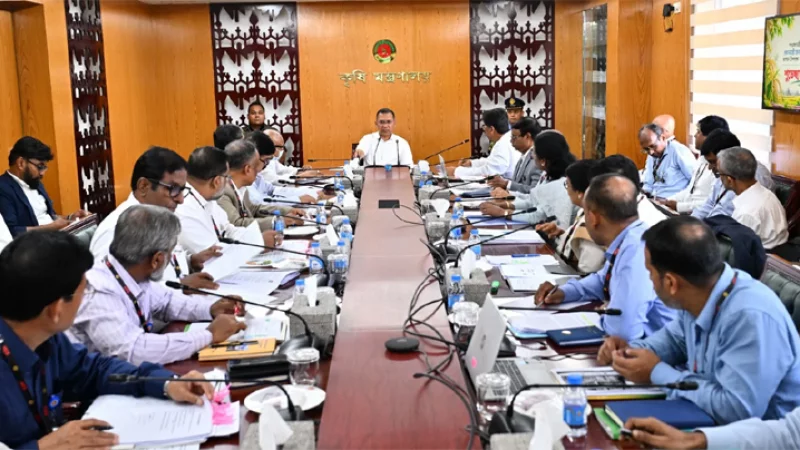
Prime Minister Tarique Rahman has pressed the Ministry of Agriculture to reduce Bangladesh's dependence on imported farm and food products by raising domestic output, telling officials to take effective steps to expand production of every crop the country is able to grow. Along with securing the nation's food supply, he said, agriculture must be made more productive and more profitable.
On Sunday afternoon (13 September) the prime minister walked from his own office at the Secretariat to the ministry and met officials in its conference room, where the state of the sector, ongoing programmes and future plans were presented. To reduce dependence on imported cooking oil, the ministry said, mustard production is being expanded: from 824,000 tonnes in fiscal 2021-22 to 1.534 million tonnes in 2024-25 and 1.541 million tonnes in 2025-26.
Officials also reported moves to lift onion production and storage — air-flow storage technology at farm level and the spread of summer onion varieties — and a programme to take new salinity-, drought- and waterlogging-tolerant varieties to the field. In all, 1,090 crop varieties have been developed, 155 of them rice, along with more than a thousand agricultural technologies.
Mechanisation featured as a way to cut labour and cost while raising productivity, with plans to expand domestic design and manufacture of farm machinery and to put combine harvesters, reapers and rice transplanters within farmers' reach at affordable prices. The country now has 2,617 solar irrigation systems; expanding renewable-powered irrigation, the meeting heard, would cut farmers' irrigation costs and their reliance on conventional fuel.
The farmer-card programme, meant to deliver government support directly, was another priority: the ministry aims to bring 4.3 million farmers under cards in fiscal 2026-27, with about 110,000 to receive cards in the first phase. Canal re-excavation, tree planting, and storage and marketing of farm produce were also discussed. The prime minister asked the ministry to lower farmers' production costs and ensure fair prices for what they grow, alongside raising productivity.
Based on an Ekattor online desk report. Source: Ekattor TV
Comments
(0)