
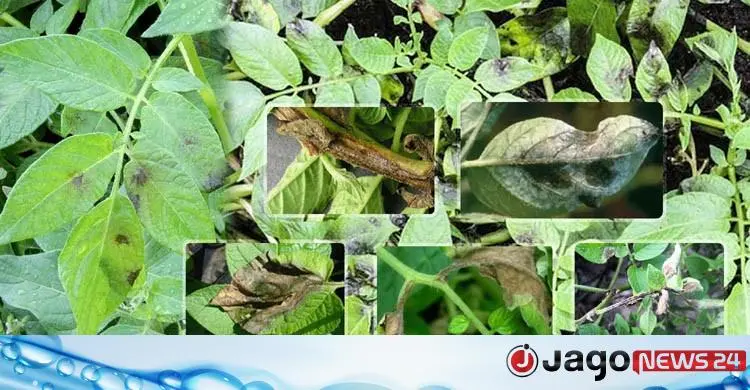
Late blight is one of the most damaging diseases of potatoes. It first surrounds parts of the leaves, tips and stems. When relative humidity is high, most of the crop in a field can be infected within 2-3 days. In the early morning, a white, powder-like fungus can be seen under infected leaves. Infected fields give off a burnt smell and look as if the crop has been scorched. The extent of damage depends on the potato variety, the age of the plants, the time of attack and the weather. Without preventive measures, the disease can destroy the potato yield completely.
The Department of Agricultural Extension (DAE) recently issued an advance warning to farmers on preventing potato late blight. A warning from the DAE's plant protection wing said late blight could reach epidemic proportions this winter season, and farmers were instructed to take precautions in advance to protect their crop.
Weather that spreads the disease
The DAE notice said November to February is a highly susceptible period for late blight. The disease spreads at any time in low temperatures (10-16 degrees Celsius at night and 16-23 degrees Celsius by day) and foggy, humid weather (humidity above 90 percent). If foggy weather comes with drizzle, the disease can become an epidemic within 2-3 days. Wind, rain and irrigation water rapidly carry the pathogen from infected plants to healthy ones.
Symptoms
Late blight first appears as patchy, wet, light green round or irregular spots on leaves near the base of the plant, which quickly turn black as the leaves rot. In the morning, white powder-like pathogen can be seen under infected leaves. In cold, foggy weather infected plants rot fast, and all the plants in a field can die within 2-3 days. Potatoes from infected plants develop brown to blackish spots and become inedible.
Control measures
Before the disease appears, farmers are advised that as soon as a forecast of weather favourable to the disease is received, they should spray an approved fungicide at 2 grams per litre of water every 7 days, soaking the plants well.
If the crop is already infected, the DAE advises farmers to stop irrigating the field and spray an approved fungicide at the correct dose every 4-5 days.
In addition, as soon as the disease is seen in one's own or a neighbouring field, farmers should spray every 7 days, in rotation, 2 grams of an approved fungicide from any one of these groups mixed in water, soaking the plants well: (mancozeb 60% + dimethomorph 9%), (mancozeb 50% + fenamidone 10%), (propineb 70% + iprovalicarb) or (carbendazim 50%). If the outbreak is very severe, the fungicide mixture should be sprayed every 3-4 days.
Safety while spraying
Gloves, sunglasses, a mask and an apron must be worn when spraying fungicide. Always spray with the wind. Fungicide bottles, packets and other waste should be buried in the ground. After spraying, clean the equipment and your body thoroughly, washing body, hands and feet well with soap.
The writer, Ziaul Haque, is a diploma agriculturist and entrepreneur at Chashi Seba.
Source: Jagonews24. First published in Bengali on The Agro News.
Comments
(0)