
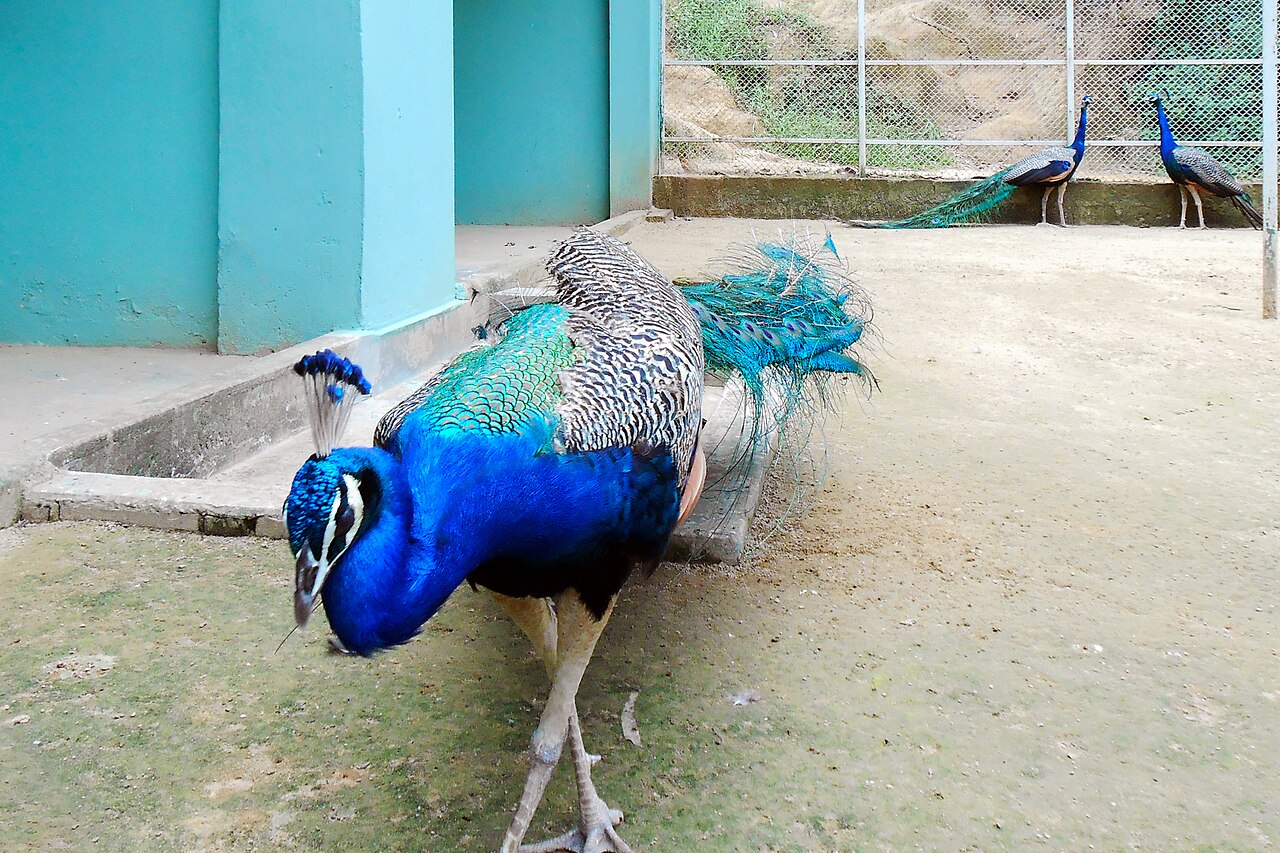
Peafowl are among the best loved attractions at the Bangladesh National Zoo in Mirpur, Dhaka, and on Friday, 26 June 2026 they put on a show. Three male blue peacocks raised and fanned their shimmering tails at the same time, and crowds of visitors pressed up to the enclosure to photograph the sight. A male peacock spreads his long, colourful train to court a mate and as a natural part of his behaviour, and the display delighted visitors of every age that afternoon.
A display that drew the crowds
Peacocks are often said to spread their trains most in cloudy weather or when rain is on the way, but their feathers shine just as brightly in full sun, and visitors find them no less striking. On this Friday afternoon the three males displayed together under a fierce sun, their fanned trains catching the light while a ring of onlookers held up phones and cameras.
A woman visiting from Uttara said she had come to the zoo many times but had never managed to photograph a peacock with its tail spread, and that it was lovely to see several displaying together in one place. A companion said she had always heard that peacocks only fan their tails when it rains, yet here they were doing it in scorching heat.
Friday is a weekly holiday in Bangladesh, and the zoo is a favourite family outing, so the crowd thickened after midday. Ignoring the heat, families moved from one enclosure to the next, while others rested in the shade of the big trees or sat along the edge of the zoo's lake. Just inside the main gate, monkeys drew a small audience of their own as they peeled and ate bananas, guavas and other fruit handed in by visitors.
Why a peacock fans his train
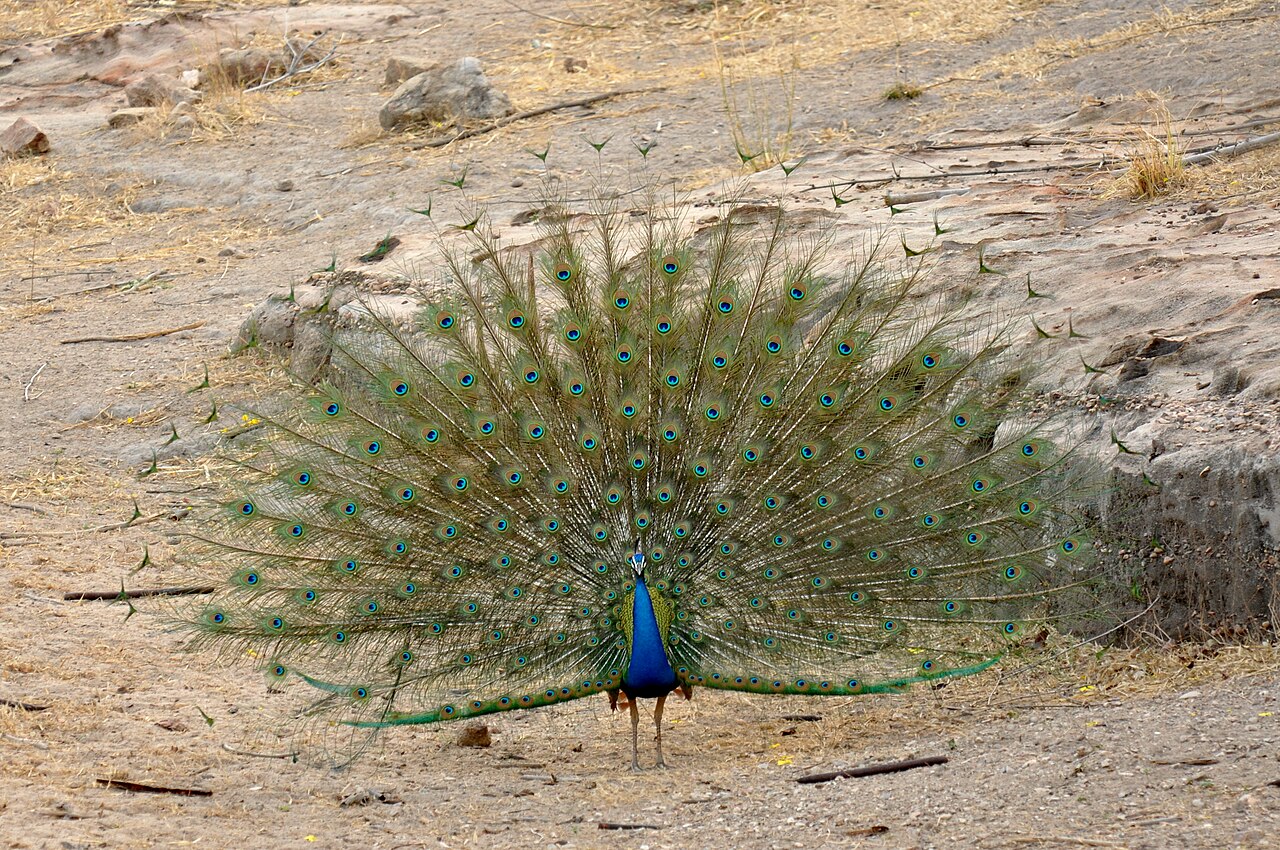
The great fan that a peacock raises is not, strictly speaking, its tail. The long, jewelled feathers are elongated upper tail coverts, feathers that in most birds simply cover the base of the tail; in the peacock they have grown into a train that can make up more than half the bird's total length.
Each of the longest feathers ends in an eyespot, a dark, heart shaped centre ringed by bands of blue, bronze and coppery green. When the bird displays, it lifts the whole train into a tall, quivering arch, holds its true wing feathers half open and drooped, and shivers the feathers so that they rustle and the eyespots seem to shimmer and float.
A displaying male usually turns first to face a female, then swings round to present the broad back of the fan. The females, or peahens, often go on feeding or preening while the males perform, choosing among them at their own pace. During courtship a male will sometimes freeze over a scrap of food and call a hen across to it, a gesture naturalists call courtship feeding, and the dry rustle of the shaken train carries well beyond the circle of the display.
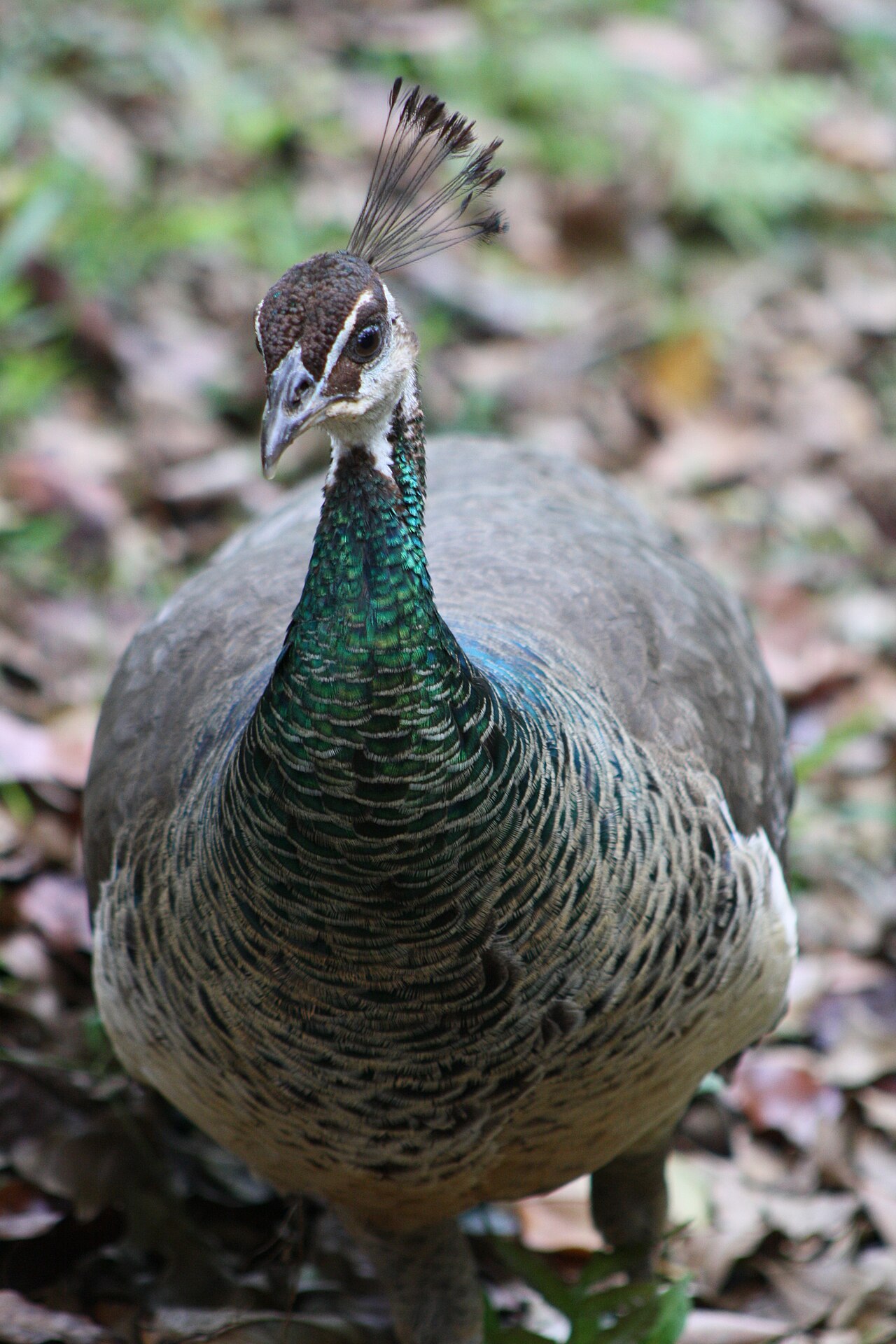
A young peacock does not grow his full train until he is about four years old, and the train is not kept all year round: the long feathers are moulted after the breeding season, from around August or September, and grow back by the following February or March, ready for the next display season. Both the peacock and the peahen carry a small fan shaped crest of feathers on the crown, though in the plain brown female it is about the only ornament she has.
The Indian peafowl, bird of the subcontinent
The blue peacocks at Mirpur are Indian peafowl, Pavo cristatus, the species first described by Carl Linnaeus in 1758. In the wild the bird ranges across most of the Indian subcontinent, from the Indus valley east to Assam and from the foothills of the Himalayas down to the far south, and through the drier lowlands of Sri Lanka.
It is a ground feeding omnivore, taking grass, seeds, flower buds, fruit, insects and even small snakes and lizards, and on farmland it will feed on paddy, chilli, tomato, groundnut and banana. By night it roosts high in tall trees, flying up to a branch at dusk and down again at first light. Its loud, far carrying call, a repeated keening note, is one of the most familiar sounds of the Indian countryside and often the first sign that a peacock is near.
Despite the heavy trade in its feathers and its fame as an ornamental bird, the Indian peafowl is not a threatened species.
The International Union for Conservation of Nature lists it as Least Concern, its most recent assessment estimating a world population of well over 100,000 birds that is not thought to be in decline. It is the national bird of India and is woven through the mythology of the region. In captivity a peafowl may live for more than twenty years, and about fifteen years in the wild.
Green and Congo: the peacock's relatives
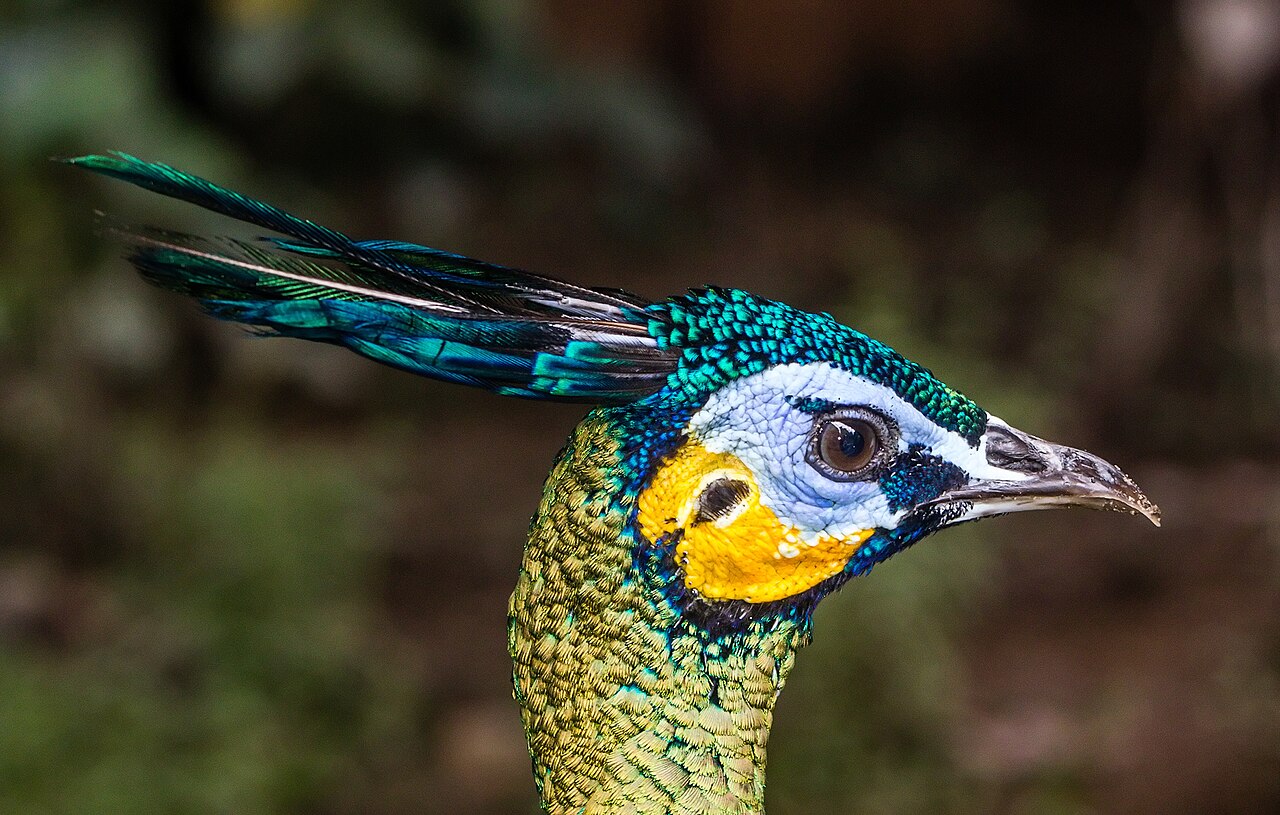
The Indian peafowl is one of three birds commonly called peafowl. The second Asian species is the green peafowl, Pavo muticus, named by Linnaeus in 1766, a larger and, for many, more spectacular bird whose males and females both wear green, scaly looking plumage, so that the two sexes look much alike.
It once ranged widely from southern China through Myanmar, Thailand, Laos, Vietnam, Cambodia, Malaysia and Java, but today survives mainly in Cambodia and neighbouring Vietnam, in three recognised subspecies from Java, the Indo Chinese mainland and Myanmar. The IUCN has listed the green peafowl as Endangered since 2009, and around the mid 1990s its wild population was put at only about 5,000 to 10,000 birds; it is also protected under Appendix II of the CITES trade convention. A male green peafowl can measure between about 1.8 and 3 metres from bill to tail tip, of which the train alone accounts for roughly 1.4 to 1.6 metres, while a female is about a metre long, roughly half the size of a big male, with a wingspan of around 1.2 metres.
The largest surviving stronghold of the green peafowl is in Cambodia; one protected area there, the Keo Seima Wildlife Sanctuary, was found to hold on the order of 745 birds in a survey reported for 2020. Where the Indian peafowl has been introduced into the green bird's range the two can interbreed, and because the hybrids are fertile this is counted among the threats to the wild green peafowl, from which the Indian species is thought to have diverged roughly three million years ago.
The third member of the group, the Congo peafowl, lives in the rainforests of central Africa and is the only one found outside Asia. Visitors who see peafowl at a zoo almost always meet the Indian species, which is by far the most widely kept and bred.
Rain, cloud and the peacock's dance
The belief that a peacock dances to call down the rain, or only in the rains, is old and widespread, and one of the visitors at Mirpur repeated it that day. There is a kernel of truth in it. In the wild the Indian peafowl breeds with the coming of the monsoon, and the males call more and more often as the rains approach, so the height of their display really does fall in the humid weeks of early summer. Late June, when these birds were photographed, is the start of the monsoon in Bangladesh.
But the display itself is courtship, not weather forecasting, and a healthy male in breeding condition will fan his train on a bright, dry day as readily as on a grey one, exactly as the Mirpur peacocks did under a hard sun. The cloud and the rain set the season; the hen, not the sky, is the audience the peacock is dancing for.
The National Zoo at Mirpur
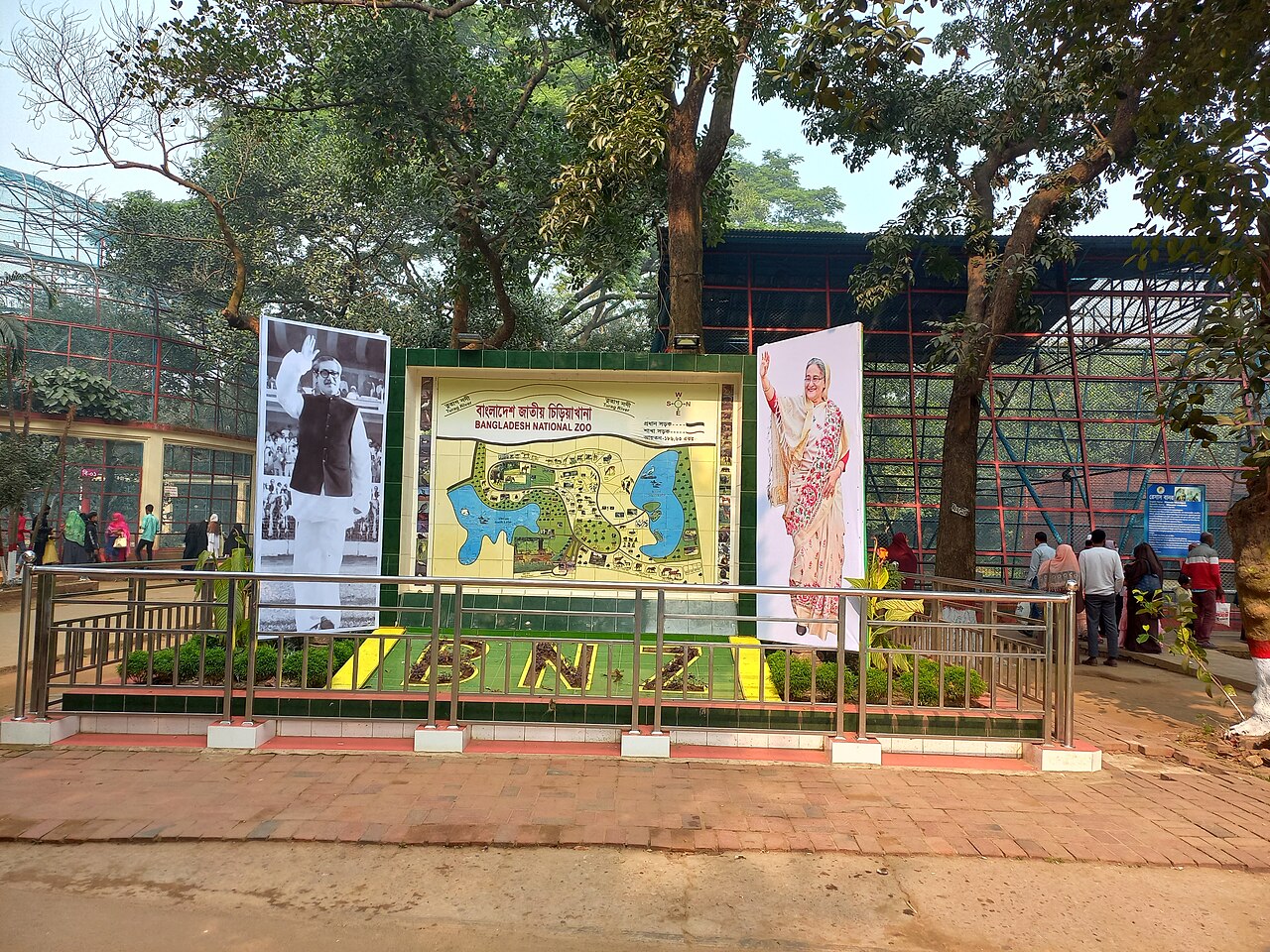
The Bangladesh National Zoo, where these peacocks live, is the country's largest and sits at Mirpur, about sixteen kilometres from the centre of Dhaka, under the Ministry of Fisheries and Livestock. It began in 1964 as a small menagerie on the High Court premises in the city, and moved to its present grounds at Mirpur in 1974, opening to the public on 23 June that year. The site covers about seventy five hectares, roughly 185 acres, including two lakes of some thirteen hectares that draw thousands of wild waterfowl each winter.
According to the figures recorded for the zoo, it holds in the order of 2,150 animals of about 191 species, among them around 551 mammals of 64 species, more than 1,500 birds of about 90 species, over 70 reptiles and a collection of aquarium fish. Its better known residents include around fifteen tigers, twenty one lions, nine hippopotamuses, some two hundred monkeys and more than thirty pythons, alongside rarer animals such as zebra, tapir and chimpanzee.
The zoo runs a captive breeding programme that has bred Royal Bengal tigers, lions, leopards, deer and birds, and it draws about three million visitors a year, a large share of them students and children. It is closed on Sundays, and it keeps longer hours in summer than in winter, opening from eight in the morning until five in the evening between October and March and until six between April and September. An advisory committee headed by the Minister of Fisheries and Livestock oversees its running.
The zoo takes part in animal exchange programmes with zoos abroad, and over the years the government has sent about 300 animals from its collection as gifts to Saudi Arabia, Kuwait, Bahrain and Iraq. Mirpur is the largest but not the only zoo in the country: there are smaller zoos at Rangpur, Chittagong, Rajshahi, Comilla and Khulna. The Rangpur zoo, like the national zoo, is run by the Ministry of Fisheries and Livestock, the Khulna zoo is looked after by the armed forces, and the others are run by local government authorities.
A day among the enclosures
Away from the peacocks, the Friday crowd spread through the rest of the grounds, gathering thickest in front of the tiger, deer, lion, giraffe and hippopotamus enclosures. At the entrance gate, zoo staff were selling jackfruit, the large ones fetching between 250 and 400 taka; haggling over one, a woman joked that birds eat the zoo's jackfruit anyway, so why was it so dear.
Late June is the heart of the jackfruit season in Bangladesh, where the trees flower from December to March and the fruit ripens from May to August; the jackfruit is the national fruit. Banglapedia records it as the country's third largest fruit crop by the area planted and its second largest by production, grown on around 25,000 hectares and making up roughly a fifth of all the fruit the country produces. Its ripe flesh is eaten fresh or preserved, its seeds are boiled or roasted and its unripe pulp is cooked as a vegetable, while the leaves are fed to cattle and the timber is valued for building, so a basket of fruit at the zoo gate in that week was entirely in season.
The buffalo that moved to Savar
One animal many visitors came looking for was missing. The zoo's much talked about buffalo, nicknamed Donald Trump, had been moved the week before to the Bangladesh Livestock Research Institute at Savar, and newcomers were still asking after it. The zoo authorities said that on Sunday, 21 June 2026, on the instructions of the livestock ministry, the buffalo had been formally handed over to the institute.
A thirteen member committee, led by the head of the institute's buffalo production research division and chief scientific officer, had been formed to watch over the animal's health, care for it and carry out research.
The institute that received the buffalo, the Bangladesh Livestock Research Institute, or BLRI, was set up in 1984 and is the country's main autonomous body for livestock research, based at Savar near Dhaka and working, like the zoo, under the Ministry of Fisheries and Livestock. It is led by a director general under a board of management chaired by the Minister of Fisheries and Livestock. Its scientists work on cattle, buffalo, goats, sheep and poultry, and on animal feed and breeding, so a research buffalo passed into its care joins a programme built around exactly that kind of animal.
Among the results BLRI has reported are a layer chicken variety, developed in 2014, whose sex can be told on the first day after hatching, and cattle feed made from moringa leaves and vegetable waste. For a zoo buffalo that had become a public favourite, a move to a research institute meant closer veterinary watch and a place in that wider work on the country's livestock.
Photo: Moheen Reeyad / Wikimedia Commons (CC BY-SA 4.0)
Sources: Jagonews24; Banglapedia; English Wikipedia (Indian peafowl, green peafowl, Bangladesh National Zoo, Bangladesh Livestock Research Institute).
Comments
(0)