
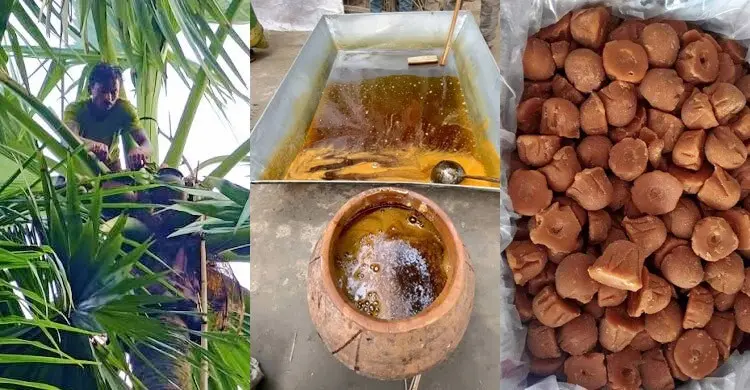
Palmyra palm trees play a large role in the rural economy, employment, poverty reduction and the environment. They grow uncared for all over Bangladesh. The tree can survive a long time without water, and does not die easily even when water stands at its base. Palms are seen scattered along roadsides, around homes, on field ridges, pond banks, railway lines and other unused land. Palms are not grown commercially in a planned way in the country.
Male and female flowers grow on separate palm trees, and male and female trees cannot be told apart until they flower. Sap is usually collected from male trees, though in some areas it is collected from female trees too.
Collecting sap and making jaggery
For sap collection, choose healthy trees at least 10-12 years old. Choosing trees that look healthy and strong yields more sap.
Equipment needed: a sharp dao (machete), earthen pots, an iron or steel wok, a stove, fuel, a ladle, a strainer, a bamboo with notches and rope.
How to collect the sap
Sap can be collected from both male and female trees. In the last week of March (the second week of Chaitra) the flower clusters of male palms grow large. For the first 3 days, hold the soft flower cluster with one hand and gently stroke it from top to bottom with the palm of the other hand, about 45-50 times, morning and afternoon, for half an hour a day. Do not strike it hard. Once the cluster becomes a little firmer, press it between two bamboo strips and draw them from top to bottom 20-25 times, morning and afternoon, for 2-3 days. Then cut the tip of the cluster straight across with a sharp dao.
Sweet sap begins to flow from the cut. Tie a pot below the cut end of the stalk to collect it. To keep the sap fresh, collect it 3 times a day: at 6am, noon and 6pm. Cover the flower cluster and pot with jute sacking or thick cotton cloth during collection.
Six or seven pots can be attached to a male palm. Keep 4-5 flower clusters for each pot and cut the rest. Sap can be collected from March to mid-July (the month of Asharh). A mature male palm can give 25-30 litres of sap a day.
Female trees
In May, when the fruiting stalk emerges, it is cut with a sharp dao. Sweet sap drips from the cut, and an earthen pot is fixed below the cut end to collect it.
Making palm jaggery
To make jaggery hygienically, strain the collected sap through clean cloth and pour it into an iron or steel wok set on the stove. Make sure there is no gap between the wok and the stove, and that ash carried out of the chimney with the flue gas cannot fall into the sap. In the first stage of boiling, remove the scum or froth that rises to the surface as quickly as possible with a strainer or ladle.
If the scum is not removed quickly, it mixes with the sap and cannot be refined, making good-quality jaggery impossible. When the sap thickens to a syrup, stir the boiling syrup continuously with the ladle and quickly lower the heat. Some scum forms around the edges of the wok at this stage and must be removed continuously.
To check whether the jaggery is ready, drop a pinch of it into 200 ml of cold water. If it sets quickly in the water, it is ready, and the wok should be taken off the stove at once.
Growing palm seedlings, collecting and selling sap, and making, transporting, marketing and using jaggery can create jobs for a large rural population, reduce poverty and save foreign currency. Palms can also help with disaster prevention in the south, improve the environment of the drought-prone Barind area and improve the country's environment as a whole.
Source: Jagonews24. First published in Bengali on The Agro News.
Comments
(0)