
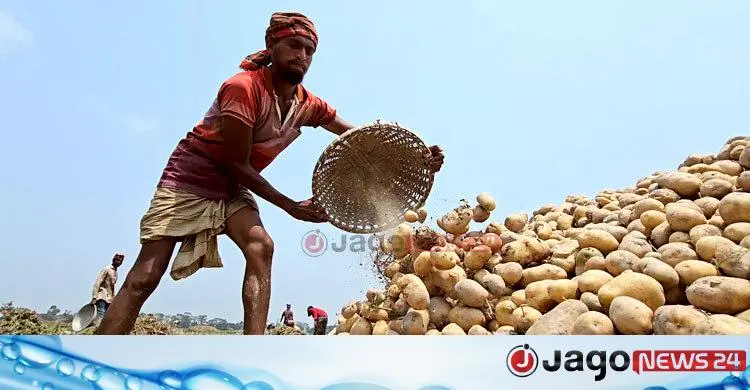
The fortunes of Munshiganj's potato farmers are caught between rising and falling market prices. To make up for several years of continuous losses, several lakh farmers in the district took the risk of planting potatoes this season, but they are still not getting the price they hoped for. With prices falling several times since lifting began, the future of potato farmers is heading towards an uncertain destination. In this situation, the district Department of Agricultural Extension (DAE) is thinking of alternatives for next season.
In villages of Sirajdikhan and Sadar upazilas, farmers are busy lifting potatoes. The crop, earned by marginal farmers' long sweat and labour, is being bagged and sent to cold stores.
If prices do not rise over time, farmers come back from the cold stores empty-handed. Continuous losses in recent years have added to their debts. To overcome past losses, potato farmers have made three demands: include potatoes in TCB sales, reduce dependence on imports and increase potato exports abroad.
Area and output figures
According to the district DAE, potatoes were grown on 34,660 hectares in the district this season, with a production target of 11.5 lakh to almost 12 lakh tonnes.
The department's information says that "because more potatoes are produced than demand, misfortune seems to follow farmers; with prices low again this year, several lakh potato farmers face big losses".
This season, more potatoes are moving by river than by road to cut storage and transport costs. After lifting, farmers are carrying bagged potatoes home by bicycle. Still, the question is why a crop won at such sacrifice is not properly valued.
Costs above prices
Potato farmers complain that with the prices of fertiliser, pesticides and seed plus labour wages, growing potatoes this year cost them Tk 600 to Tk 650 a maund. The highest wholesale price now is Tk 450, so farmers selling from the field are losing Tk 200 to Tk 250 a maund.
Farmers are worried about the future of the huge crop and are pressing for quick exports. Yet there is no hopeful message from the local DAE.
According to a survey by the district agricultural extension and marketing departments, many marginal potato farmers have been ruined after failing to get the prices they wanted over the past five years.
Although farmers have raised various demands to cut their losses, including making government TCB purchases of potatoes mandatory, those demands have never seen the light of day.
Local potato farmers and marginal growers said Munshiganj, a district well known for potatoes, has had a good yield this year. The quality and yield brought smiles to farmers' faces, but the smiles faded when they could not get the price they wanted. Selling at the current market price, farmers are losing at least Tk 200 a maund, and still wholesale buyers are not appearing in the fields, leaving growers deeply frustrated.
Frustration has grown further because no government incentive was paid on potatoes stored in cold stores last season. So farmers want the agriculture department to promote wider use of potatoes by training entrepreneurs to make potato-based foods and by supplying superstores.
According to the Munshiganj district DAE, the target this year was to grow potatoes on 34,655 hectares, with an expected output of 10,97,147 tonnes. So far potatoes have been lifted from 80 per cent of the planted land in the field. This year the district produced 42 to 43 tonnes a hectare.
Last year, potatoes were grown on 35,796 hectares in the district's six upazilas.
Farmers say potatoes grown on borrowed money, on top of last season's heavy losses, have now become a thorn in their throats. On one side retail prices are falling; on the other, wholesale buyers are not appearing in the fields. So the government must quickly decide to export potatoes.
What farmers say
Jamal Mondal, a potato farmer of Champatala village in Munshiganj Sadar upazila, said 4,500 kg of potatoes were produced on his 49 decimals of land. Good-quality potatoes are now selling at Tk 480 to Tk 500 a maund, while producing a maund cost Tk 550, he said.
Mohammad Ali, a farmer of Keoar Nuraitoli in Mohakali union, said this year the Sanshai variety has looked good and yielded well, so farmers have moved away from the Diamond and Vanilla varieties.
In his view, those who planted "box potatoes" (Holland Diamond) in a second round, or planted BRAC, ACI or BADC seed, did not get good yields.
Farmers Ramjan Matbor and Sabur Ali of the Mohakali and Ronchho areas said favourable weather, no insect attacks on the plants and no natural disasters helped raise potato yields this year.
They added that there is no alternative to exports if farmers are to be saved from losses year after year. Farmers would also get better prices if the district's potato flakes factories were brought back into operation.
Meanwhile, the district agriculture department is thinking of wider uses for potatoes and some alternatives for next season to save farmers.
The DAE's response
Dr Habibur Rahman, deputy director of the district DAE, told Jago News that production costs can be cut by protecting soil health, following scientific methods and applying the right doses of fertiliser.
He said potato yields had been badly hit by excessive rain in the Joypurhat-Bogura-Rajshahi region, so he hoped Munshiganj farmers would get the prices they wanted this time for potatoes, the district's main crop.
Under a pilot project, training in making potato-based foods has already been completed in Tongibari upazila and will be held in other upazilas too, he said.
Answering another question, Dr Habibur Rahman said potato seed from BADC, BRAC, ACI and other companies comes with specific technical instructions for planting, and farmers can suffer if they do not follow them. The incentive payment is being processed, he said.
Still, the department has no real message of hope about the uncertain future of this year's huge potato output. Its information says potatoes were grown on 34,660 hectares in Munshiganj district this season, and output could be 10.5 lakh to 11 lakh tonnes.
Source: Jagonews24. First published in Bengali on The Agro News.

Comments
(0)