
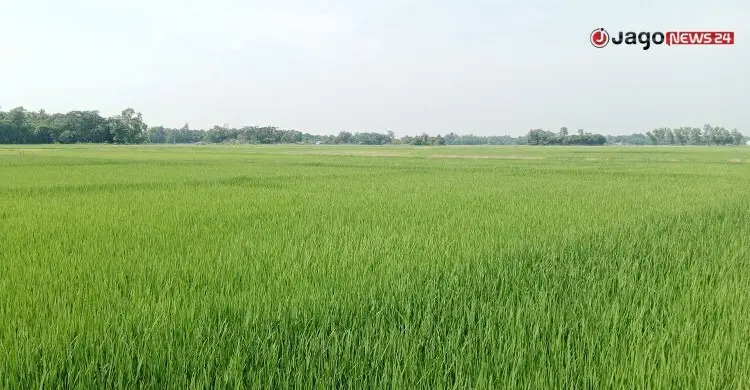
As the country's demand for food grows, so does the cultivation of high-yielding varieties (HYV) of rice. Hoping for bigger harvests, farmers are gradually moving away from local and traditional varieties. HYV rice is spreading while local rice varieties are being lost.
In Moulvibazar, a district of haors, baors and farmland, aman is the most widely grown rice, though boro and aus cultivation has also grown over time. In all three seasons, farmers are showing more interest in HYV than local varieties, and this year too HYV rice dominated the boro, aus and aman seasons.
Agriculturists say these varieties yield more but are reducing soil fertility in the long run, while local varieties are being lost for want of conservation and government research.
Why farmers have switched
Farmers in the district say almost all of them now grow HYV rice in the hope of bigger harvests. The cost of growing rice has nearly doubled in recent years, so they have turned to the varieties that yield most, and the government also supplies HYV seed. A decade ago, farmers grew a lot of local rice. Local rice yields less but tastes much better, while HYV and hybrid rice yield about twice as much. The government, they say, should convert local varieties into high-yielding ones through research.
Visits to the district's aman fields show the plants have turned a dark green thanks to favourable weather so far this season. Across the fields, farmers are growing HYV rice for greater profit, most with seed bought from a shop called Krishighar in the market. Only a handful grow local varieties on small plots to keep the tradition alive. Local rice gives 35-40 maunds an acre, against 70-80 maunds for HYV or hybrid rice.
Farmers Sadikur Rahman and Rezwan Mia said that a decade ago they grew hundreds of local varieties widely, including Chinigura, Kalijira, Binni, Shali, Phul Balam, Lakshmibilas, Lohajang, Paijam and Lalchollish. They saved seed each year for the next season, but gradually everything was lost.
Now, they said, only a handful of farmers grow Binni or Kalijira as a hobby, perhaps on just a few decimals. Everyone grows high-yielding varieties for bigger harvests and profits, and farmers have lost interest in local rice. Hybrid or HYV seed is what is available in the market or supplied by the government.
Mizan Ahmed, a farmer in Rajnagar upazila, said: "I've tried hard myself to grow local rice, but I couldn't save the seed. Now, as a hobby, I grow fragrant Kalijira, known locally as ni dhan, on 15 decimals. It yields one and a half to two maunds, and the rice sells for Tk 100 to Tk 120 a kg locally. We want at least some local varieties to be converted and the seed given to farmers."
Farmer Adil Ahmed said: "We grow aman, boro and aus every year on about 40 acres. Farming costs have risen a lot, so local rice doesn't pay; HYV yields twice as much. We grow Kalijira and Binni on some land for our own food, and no other local variety. We'd like to grow local rice, but low yields and costs stop us. If local seed could be converted into high-yielding varieties, we might be interested again."
Experts call for research and seed banks
Professor Dr Mohammad Nur Hossain Mia of the Department of Agronomy and Haor Agriculture at Sylhet Agricultural University told Jagonews24 that the local rice grown 15 to 20 years ago in haor and non-haor areas is no longer found. Foreigners have conserved these varieties, but the country has not fully done so, though some rice is held at a gene research centre.
He said he had seen several thousand of Bangladesh's local rice varieties conserved in Germany, where they are regularly researched, while research on them in Bangladesh is limited. Local rice is richer in nutrition and taste and can withstand the climate, but HYV and hybrid rice produce twice as much per acre, which benefits farmers.
Dr Mia said local varieties are disappearing because of a lack of registration numbers and seed conservation. Developed countries conserve seed through research at germplasm centres. Production of local rice could be increased through research. There were several thousand local varieties; they are no longer there.
Agriculturist Shaker Ahmed said wide research on local rice varieties is needed. If research could raise yields a little, farmers would grow them with interest. Large and medium farmers in villages grow rice on hundreds of bighas, and if given local seed they would grow it on at least some land. Growing high-yielding or hybrid rice also reduces soil fertility, so the government should research widely to make sure local varieties are not lost altogether.
According to the Department of Agricultural Extension (DAE) in Moulvibazar, aman has been grown on 98,030 hectares this season, including 1,295 hectares of local varieties and 175 hectares of hybrid, with HYV on the rest. HYV costs a little more than local rice but yields several times more. Farmers are mostly growing high-yielding BRRI dhan122, BRRI dhan98, BRRI dhan28, BRRI dhan29 and other varieties, and are profiting.
Md Jalal Uddin, deputy director of the DAE in Moulvibazar, said high-yielding rice is the most widely grown in the district and farmers grow it willingly. They feel that if they spend money on cultivation, they must get a higher yield, which is why they have lost interest in local rice.
He said the population keeps growing, and production must rise to prevent food shortages. When the population was smaller, people grew local rice; now increasing production is essential.
Source: Jagonews24. First published in Bengali on The Agro News.

Comments
(0)