
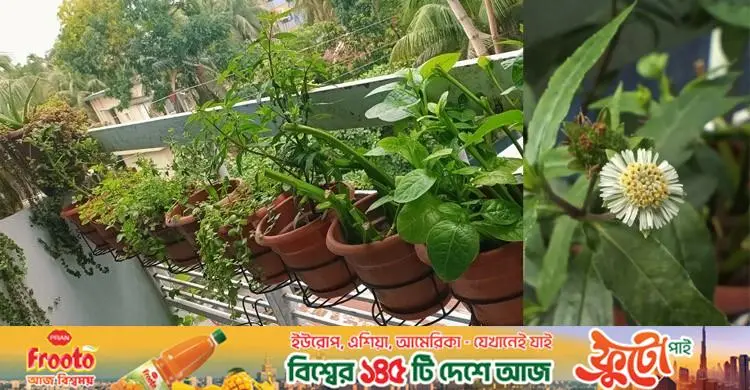
The importance of planting trees hardly needs repeating. Many people garden as a hobby and plant different kinds of trees, and many plant fruit and timber trees with the future in mind. The full monsoon of the Bengali months of Asharh and Shraban is the best time for tree planting in Bangladesh. Trees are friends of the environment, and of people too.
Trees soothe the mind and supply the oxygen we need to live. Any home, whether in a village or a city, feels incomplete without green trees; their leaves are like nature's own canvas. Whether in a village courtyard or amid busy city life, the best time of year to fill our surroundings with green is now. When the monsoon rain pours down in Asharh and Shraban, the soil comes back to life and the scorched earth cools. Nature itself offers a loving lap for saplings at this time, and nature-loving, aware people never miss the chance.
It is said that the rainy season is the right season for tree planting, and the ideal time is now: the months of Asharh, Shraban and Bhadra are the right time to plant saplings. So nature lovers should not delay in planting a favourite fruit, flower or timber tree in their yard or on their balcony. Those with enough space and means should plant environment-friendly trees without delay.
Why the monsoon helps
The biggest advantage of planting in the rainy season is nature's own irrigation. Trees planted now have most of their care met naturally. Humidity is high and enough water reaches the lower layers of soil, so the roots of new saplings can spread easily deep into the ground. The hassle of watering by hand is reduced, and there is almost no risk of saplings drying out and dying in strong sun. In short, these favourable conditions play an important role in helping a new life grow quickly.
The right tree in the right place
The most important thing is to choose the right sapling for the right place. Around the homestead, near the house, or behind it if the house is large, fruit trees such as mango, jamun, jackfruit, guava, malta or lemon are an excellent choice. They meet the family's nutritional needs and give shade too. Medicinal trees such as amla, arjun or neem can also find a place in the yard. Trees can be planted on boundaries or fallow land as well: long-term timber trees such as debdaru, rain tree or mahogany should be planted along the boundary of the home or beside roads, but not too close to the main structure of the village house or building.
Trees can also be grown on rooftops or balconies. For city dwellers without a yard, the roof or balcony is the answer. All kinds of plants can be grown there, from fruit trees, flowers and vegetables to coriander and mint. Nazrul Islam, head gardener of the Mirpur Botanical Garden, said: "Seasonal and perennial flowering plants can be planted in the rainy season." Seasonal monsoon flowers include torunika, cosmos, puttalika, zinnia, botam, dopati (balsam), nayantara (periwinkle), moragkadam and amaranthus. Perennial flowers include cherry, kamini, marigold, mussaenda, allamanda, tuberose, frangipani (kathgolap), galphimia, dolonchapa, gladiolus and lily. Choose from these to fill your own hobby garden this monsoon.
Timber and medicinal trees
Few people dislike flowering and fruit trees, but some of us are lazy about planting timber and medicinal trees. Yet these trees not only beautify the home but also secure future income. Timber trees provide valuable wood; they include garjan, mahogany, karoi, segun (teak), shishu (sissoo), shirish and gamari. A timber sapling costs roughly Tk 20-50, and wood of significant value can usually be obtained 10-15 years after planting. So, to secure future savings, buy saplings from a nursery and plant your favourite timber trees in your yard.
You can also plant year-round varieties of mango, guava, pomegranate or various foreign fruit trees in drums on the roof of your city home; growing such year-round fruit is now very popular. In the low light and shade of a balcony, money plant, calathea or other indoor plants can be grown.
Caring for saplings
Planting alone is not enough. After planting, make sure water does not collect at the base of the tree. Waterlogging is one of the main problems of the monsoon, and standing water at the base of a sapling can rot its roots and kill it. So the soil around the base should be raised a little above the surrounding soil and sloped so water drains away easily. Stormy winds or continuous rain can make a young sapling lean, so it is important to tie it upright to a strong stick or bamboo stake straight after planting. A cage or fence around it is also needed to protect it from livestock and small children.
In this critical time of climate change, there is no alternative to tree planting to protect our environment. Planting a tree is not just raising a green shape; it can be a guarantee of a green and healthy world for future generations. Answering nature's generous call, let each of us plant at least one sapling. Tree fairs are being held across the country by government and private organisations, and nurseries are stocked with many kinds of quality saplings. May a tree grown by your hand become a home for birds, a store of oxygen and a natural resource and saving for future generations.
Source: Jagonews24. First published in Bengali on The Agro News.


Comments
(0)