
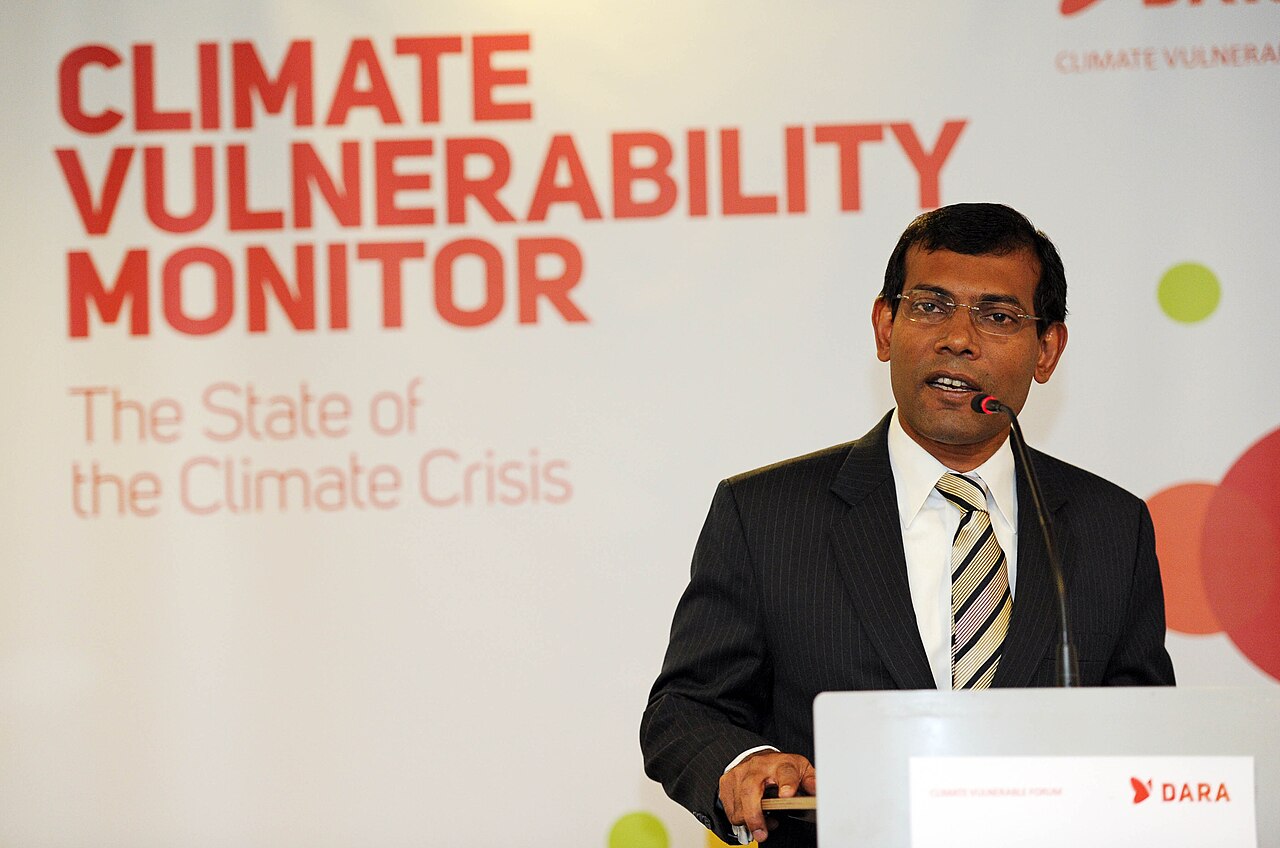
Twenty-five of the world's most climate-vulnerable countries are on the brink of bankruptcy because of debt taken on to cope with climate change, former Maldives president Mohamed Nasheed said in Dhaka on Monday, 5 October. He was speaking on the closing day of the three-day "Bay of Bengal Conversation 2026", organised by the Centre for Governance Studies (CGS) at the Sonargaon Hotel.
Although the Maldives did not cause climate change, Nasheed said, it spends about 30 per cent of its national income each year on adaptation such as embankments, protection against coastal erosion and rainwater harvesting. Debt is rising as a result: about 25 per cent of the budget now goes on debt repayment, squeezing spending on education and health.
The problem is not only rising seas, he said. Warmer oceans are destroying coral reefs, coasts are eroding and islands are at risk of disappearing. The loss of coral disrupts the breeding of sea fish, which hits the livelihoods of fishing communities directly.
Arguing for nature-based adaptation over concrete, Nasheed said restoring a metre of coral reef costs about 20 dollars and planting mangroves about 5 dollars, while artificial sea walls cost thousands. He called for rapid coral restoration using science and technology.
Vulnerable countries are not asking for charity, Nasheed said, but for a fair price for the environmental services they provide to the planet. The people of Nepal did nothing to cause its devastating floods and the people of the Maldives did nothing to raise the sea, so someone has to bear the cost.
He warned that rising seas will also raise questions about maritime boundaries and economic zones, which are drawn from coastlines. The Maldives has an exclusive economic zone of about 200 nautical miles and resource rights to 350 nautical miles, both threatened if its coastline goes under, and he urged the international community to revisit the UN Convention on the Law of the Sea (UNCLOS).
Photo: Camadrilena / Wikimedia Commons (CC BY-SA 3.0) (Mohamed Nasheed in London, 2010)
Source: samakal


Comments
(0)