
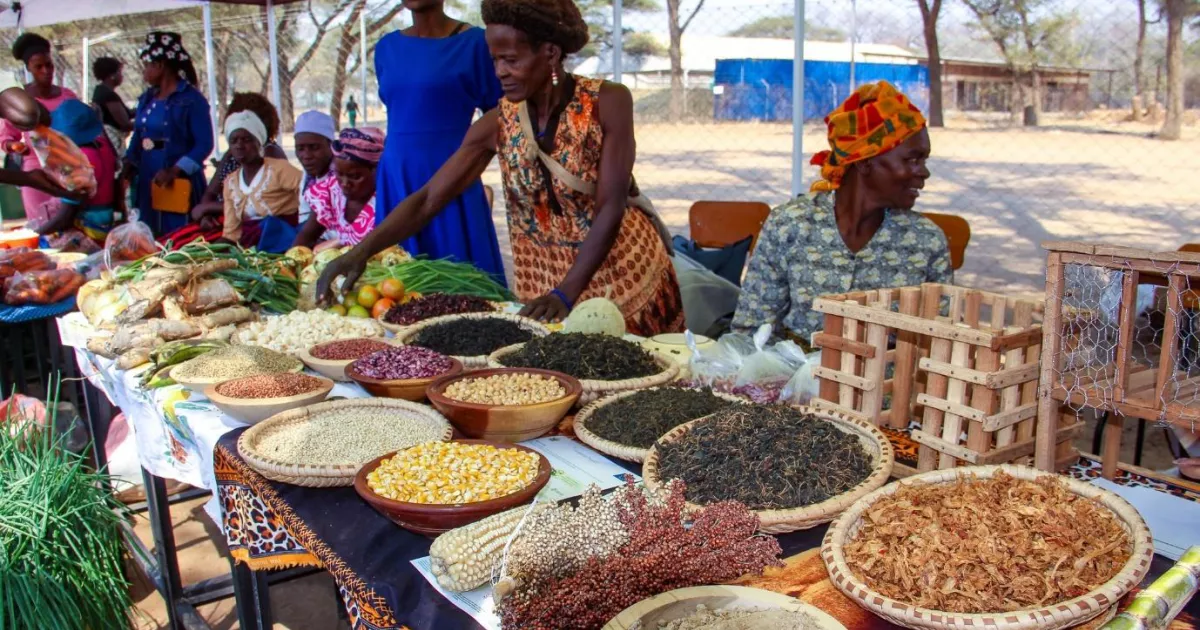
More than 500 people from 17 wards of Mbire district in Zimbabwe gathered on 6-7 August 2026 for the Mbire Good Food and Seed Festival, a two-day celebration of indigenous and locally adapted seeds and the dishes made from them. The festival was convened under the theme "It's Our Life: Safeguarding Indigenous Seeds and Food Diversity" by the Ushingi Project of the Zimbabwe Resilience Building Fund II (ZRBF II) and CIMMYT, with local partners.
Farmers, women's cooking groups, consumers, researchers, government departments, development partners, seed actors and private-sector exhibitors displayed, exchanged and sold seed of more than twenty indigenous, traditional and locally adapted crop varieties, each with its own traits and uses. Agricultural technologies on show pointed to what is needed to carry a crop from planting to harvest.
Cooking groups prepared traditional dishes alongside the seed displays and explained the ingredients, preparation methods and health benefits. At the CIMMYT tent, locally available ingredients were turned into a range of dishes. "The only cooking we know is boiling foods. We would love to have training on how to transform the crops we have into a variety of dishes," said Petronella Phiri, a farmer from ward 3.
The variety on the plates, however, did not match the variety in the fields. Participants spoke of landraces that have been lost and of a growing reliance on fewer crop types and species. Communities have adapted by becoming creative with the crops they still grow, but the reflections pointed to declining diversity both between and within crop species.
The concern matters in Mbire, where annual rainfall averages 450-650 mm and a single failed season can wipe out a harvest. A narrower crop base leaves farmers with fewer options when drought comes. For CIMMYT, whose work rests on crop diversity and the safeguarding of genetic resources, the festival's message was a direct one: diversity carries choices from the past into the future, and knowledge decides how those choices become food and income.
The event reflects the approach of the CGIAR Science Program on Multifunctional Landscapes, which works alongside DanChurchAid and the Fambidzanai Permaculture Centre under the Ushingi project of ZRBF II. Rather than treating seed and food as separate, the programme sees the chain from choosing a seed to tending a crop, processing the harvest and preparing a meal as the foundation of a community's resilience.
Source: CGIAR
Comments
(0)