
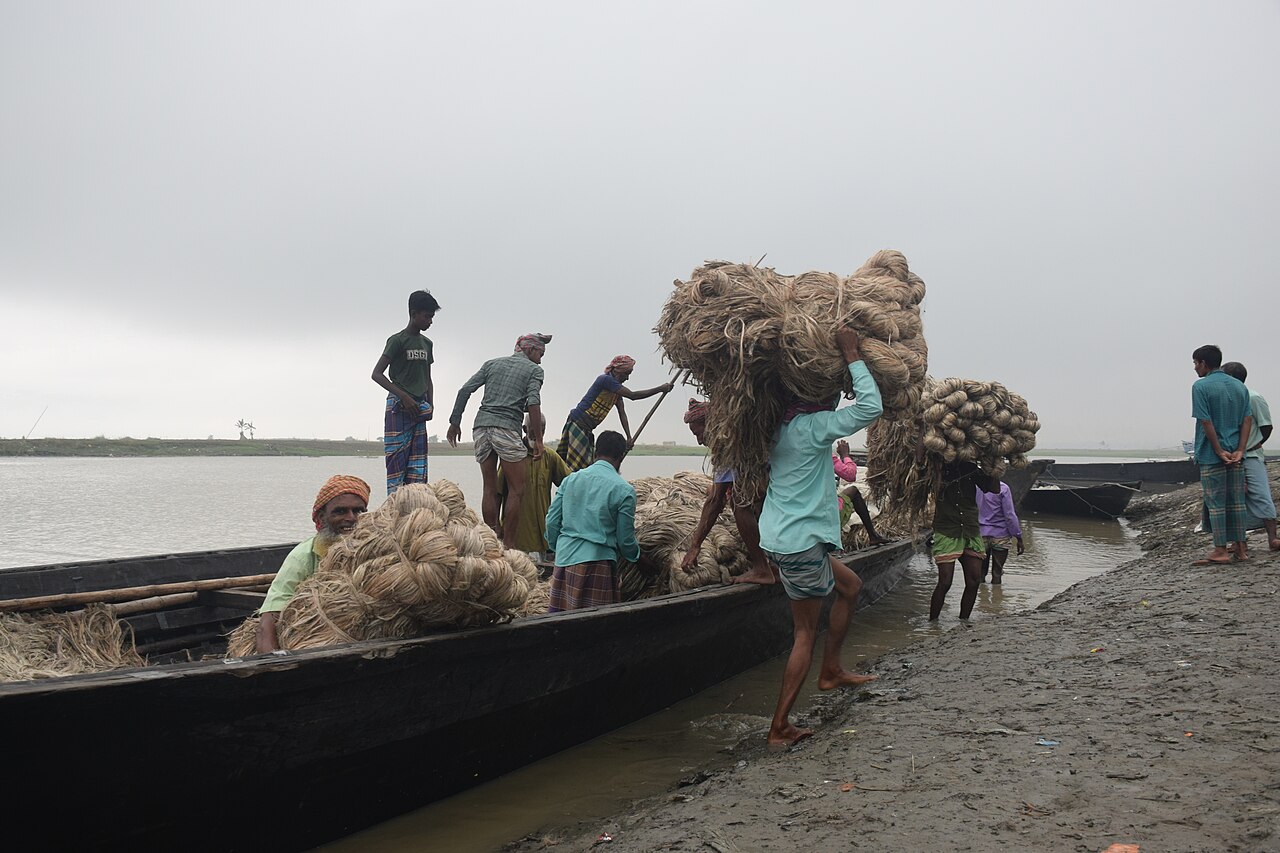
The jute market at Ghior in Manikganj, held for about 300 years, sees crores of taka change hands every Wednesday. Thousands of maunds of jute arrive at the market, which has met since British times, and wholesalers send it on to jute mills in Narayanganj, Khulna and Jashore. Growers are getting good prices this year, but the market is losing its old glory.
Built near the Dhaleshwari and Ichhamati rivers, the market once had a small river port beside it, and big boats brought jute from Faridpur, Rajbari, Tangail, Dhaka and Pabna as well as Manikganj. As roads and trading changed and new markets grew up elsewhere, supply here fell, and river erosion is eating into the market's land.
Wholesaler Ashim Roy said tossa and white jute are the main types in the area. About 80 tonnes changed hands at the last market, and a maund now sells for Tk 4,600 to Tk 5,300 depending on quality; last year good jute fetched at most Tk 4,500. Uttam Aich, in the trade since 1986, said traders once bought 700 to 1,000 maunds by boat; with less jute grown that is no longer possible, but 5,000 to 6,000 maunds still come in on an average Wednesday.
Jamal Uddin of Bachamara village, Daulatpur, grew jute on six bighas this year but the quality was not good. A month ago he sold at Tk 3,700 a maund; this time he brought 10 maunds and asked Tk 5,000, but traders would not go above Tk 4,700, and he sold at that. Lal Chan, a farmer from Nagarpur in Tangail, said he has come to Ghior to sell paddy, jute and mustard since before independence; in the monsoon several farmers share a boat to cut costs.
Growers said low rainfall and too little monsoon water made retting difficult this year, so much of the fibre did not turn the golden colour that fetches the best price. The market also lacks basic facilities. Traders say that keeping it alive needs more supply, a solution to the retting problem and action against river erosion.
Shahjahan Siraj, deputy director of the Department of Agricultural Extension in the district, said jute was grown on 4,530 hectares in Manikganj this year, 250 hectares more than last year, producing 13,750 tonnes. Favourable weather, better seed and government support are drawing farmers to jute, he said. The report is by Krishi Shomoy's Manikganj correspondent.
Photo: Frameofashik / Wikimedia Commons (CC BY-SA 4.0)
Source: Krishi Shomoy

Comments
(0)