
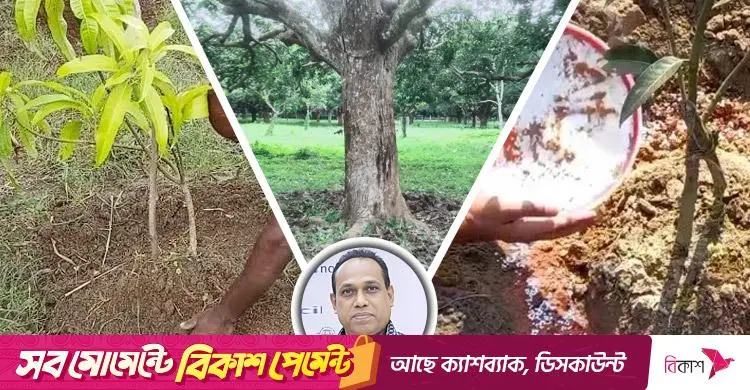
Mango is one of Bangladesh's most important fruit trees, valuable for nutrition and for its economic and commercial worth. With proper care and management, a mango tree's production and yield rise many times over, and one important part of that is balanced fertiliser use. The nutrients naturally in the soil are often not enough for a mango tree, especially as it needs different amounts at different stages of growth and fruiting. When nutrients are lacking, the tree weakens, fruit drops, fruitlets stay small and disease increases. Adequate fertiliser in the right proportions is essential to solve these problems.
Fertiliser helps ensure a mango tree's growth, flowering, yield and fruit quality. But timing, the tree's age, soil type and local weather must be taken into account. Scientific fertiliser management is an essential strategy for supplying the nutrients a tree needs for sustainable mango production.
To fertilise a mango tree, first dig the soil 1–1.5 metres from the base of the trunk and apply the fertiliser there. Then mix it well into the soil and water lightly. The article gives the right time for application as the Bengali months of Joishtho to Asharh (May–July) and from the last week of September to the first week of October.
Method
Dig holes 1–1.5 metres from the base of the tree and apply the fertiliser, taking care not to damage the roots. For a three-year-old tree, organic fertiliser such as 25 kg of cow dung, and chemical fertilisers such as 600 g of urea, 750 g of TSP and 450 g of MoP, can be used. The amount depends on the tree's age and the soil type. Water lightly after applying.
Schedule
The article also sets out this schedule:
- Before bud formation and flowering (December–January): mix all the TSP, half the MoP and half the cow dung into the soil.
- After fruit set, as the fruit begins to grow (March–April): half the urea and half the MoP.
- After harvest (June–July): the remaining half of the urea and the rest of the cow dung.
- If needed, micronutrients such as zinc, boron or sulphur can be given.
Types of fertiliser and use
- Organic fertiliser: for good growth and yield, apply twice a year, before the monsoon and before winter.
- Chemical fertiliser: apply according to the tree's age and yield; urea, TSP and MoP are generally used.
- Amount: set according to the tree's age and soil type.
- Instalments: fertiliser is generally applied twice a year.
Other tips
Water lightly after fertilising and keep weeds cleared from around the base of the tree. The article also advises that fertiliser should not be applied before flowering or after fruiting, and that only urea may be applied after fruit set. Too much fertiliser should not be used, as it can harm the tree. Applying the right amount gives better yields and less disease.
Timely, balanced fertiliser is vital for proper growth, flowering, fruit set and fruit quality. The dose and timing should be set according to the tree's age, the soil and the weather, and care is needed at every stage of the tree's life, from sapling to fruiting.
Organic fertilisers such as cow dung, compost or vermicompost, together with urea, TSP, MoP, boron and zinc fertilisers in the right proportions, keep the tree healthy and raise yields. Following scientific guidance, testing the soil and acting at the right time are therefore the key to better yields and profitable mango farming.
Source: Jagonews24. First published in Bengali on The Agro News.

Comments
(0)