
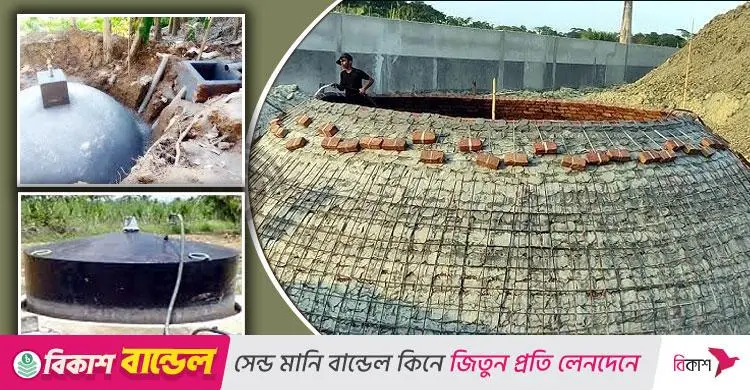
Biogas is mainly methane, a flammable gas that is easy to produce. It can be used for cooking, lighting lamps and even running engines to generate electricity. In villages, cow dung, poultry droppings, other animal or human waste, leaves and water hyacinth can be digested, alone or mixed, in a plant to produce biogas easily.
Jobs and fuel
Neighbouring countries started long ago, and biogas plants are popular in India, Thailand, Nepal and China, while research on better, cheaper plants continues in developed countries. With public and private support for appropriate technology in Bangladesh, biogas could partly solve the fuel problem, and hundreds of thousands of trained young people could be employed building plants, the writer argues.
Polybag plants
Low-cost plants made from polythene bags come in a small and a large size. A boat-shaped pit with a gentle 8-inch slope is dug on raised ground where rainwater does not collect. A polybag folded in three layers is fitted with 3-inch PVC pipes at each end, sealed airtight with tape and solution, and a strong gas outlet pipe is fixed on top. For three or four users, 8 to 10 maunds of dung mixed with an equal amount of water or cattle urine is poured in until the bag is half full, then left closed for 10 to 12 days while it ferments and gas forms. A larger version serves 8 to 10 people.
After that, 10 to 12 kg of dung mixed with water or urine is added every morning; urine raises gas output. The overflow slurry can be used as fish feed or fertiliser. The bag holds both digester and gas store; it is temporary, but thicker or multi-layered bags last longer and can later be replaced with a permanent structure.
Floating-dome plants
The floating-dome plant is better and costlier. It has a masonry digester tank and a metal gas holder that floats on the slurry and rises as gas collects, keeping gas pressure constant, an advantage the polybag types lack. The article describes the construction in detail: a circular pit, brick soling and RCC base, a central guide pipe, inlet pipe, four outlet openings 12 to 15 inches below the rim and a covered compost pit for the slurry. Plants above 110 cubic feet, or for more than 20 users, need 10-inch walls.
Fixed-dome plants
The fixed-dome plant is built underground of brick, sand and cement, so the land above can be used for other work. A hemispherical base is laid on rammed soil, walls are built around a central guide pipe, and an umbrella-shaped reinforced or ferro-cement dome is added, with a galvanised gas pipe and control valve leading to the kitchen stove and, if needed, lamps. Costs vary with the distance to the kitchen and whether mantle lamps are fitted.
The writer, Dr Forkan Ali, is a researcher and former college principal.
Source: Jagonews24. First published in Bengali on The Agro News.

Comments
(0)