
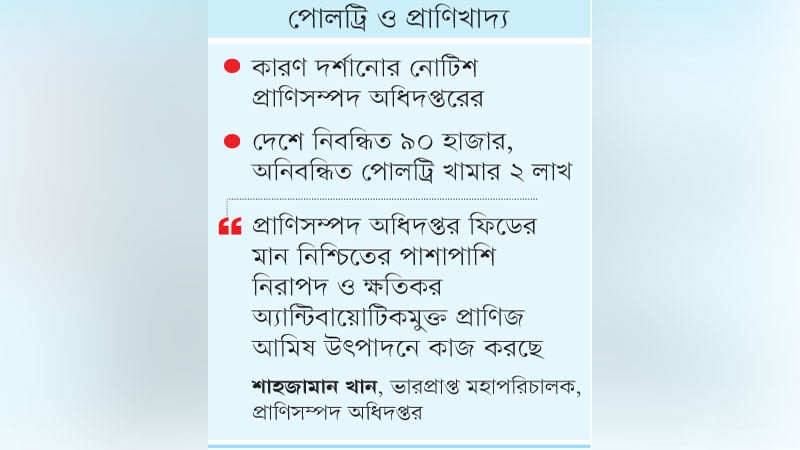
The Department of Livestock Services (DLS) has identified 117 illegal establishments producing substandard animal and poultry feed and has served them with show-cause notices. Acting Director General Md Shahjaman Khan disclosed the action on Saturday, 19 September, at the seminar "Feed for Growth: Supporting Bangladesh's Protein Demand", organised in a Dhaka hotel by the Feed Industries Association Bangladesh (FIAB) and the US Soybean Export Council (USSEC).
Bangladesh's poultry and animal feed market is growing fast. According to a 2025 report of the US Department of Agriculture, the country's 150 registered feed companies produce about 7.5 million tonnes of commercial feed a year, roughly 70 per cent of it poultry feed, with fish and cattle feed making up much of the rest. Egg and chicken production is rising, and feed demand with it, but quality control has lagged.
Khan said recent raids had identified the 117 firms and notices had been issued. Farmers' foremost demand is that feed prices stay affordable, which is hard to achieve without the cooperation of manufacturers, he said; at the same time, feed quality must be guaranteed so that animal protein is safe and free of harmful antibiotics.
In June the government adopted the National Poultry Development Policy 2026, the first new policy in about 18 years. Besides raising egg and meat output, it aims at self-sufficiency in feed, removing harmful feed ingredients, strengthening animal health services and vaccine supply, cutting excessive antibiotic use and making the sector export-oriented. The country has about 90,000 registered poultry farms and some 200,000 unregistered ones, with around six million people directly or indirectly dependent on the sector.
Chief guest Md Delwar Hossain, secretary of the Ministry of Fisheries and Livestock, said the poultry sector had to become export-oriented and that instructions had been given to produce the vaccines it needs at home. FIAB general secretary Md Anwarul Haque said that amid shifting world markets and volatile raw-material prices the feed industry must become more technology-driven and efficient, using modern formulation and better raw materials.
USSEC's Bangladesh market lead Khabibur Rahman, East Asia aquaculture lead Lukas Manomaitis, Zhou Enhua and Siang Pin Lan Shan spoke on soybean use, feed technology and nutrition management; Quality Feeds Limited managing director Ehtesham B Shahjahan chaired, and ACI Godrej Agrovet associate vice president Mohammad Nazrul Islam closed the seminar. Feed is the largest single cost on a poultry or fish farm, so scrutiny of its quality and price bears directly on farm margins. The report is by Samakal.
Source: Samakal
Comments
(0)