
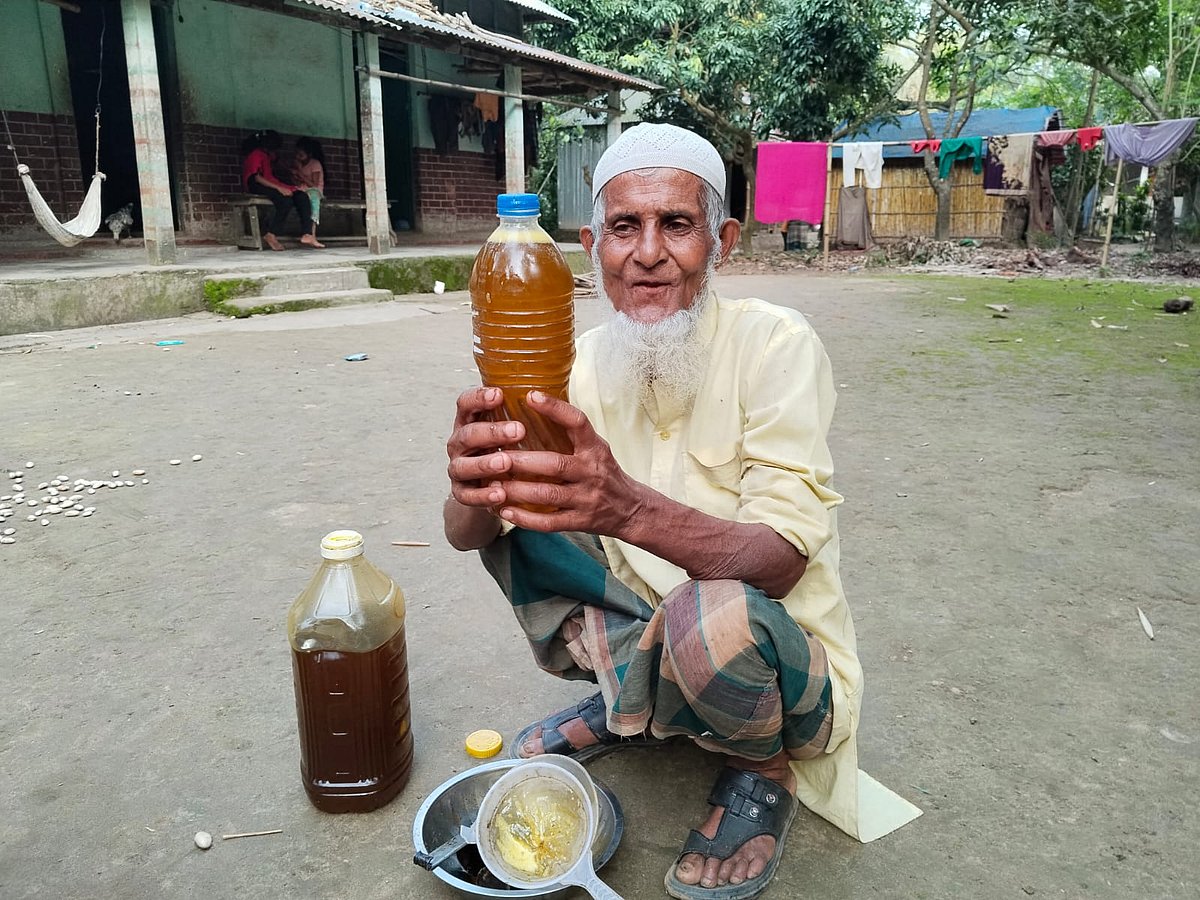
Md. Laskar Ali, 71, of Narayantala village in Sunamganj Sadar upazila has been pressing mustard oil in a horse-drawn wooden ghani for 45 years, and has never once broken the promise he made at the start: no adulteration. The village lies 19 kilometres from the district town, hard against the border, yet town customers now buy his oil as regularly as his neighbours do. The trade has given his family a comfortable living, and on 31 December last year the Sunamganj Sadar upazila administration honoured him for it.
His family were farmers who moved from Narsingdi to the Sunamganj border area soon after independence, when he was 14. In 1980 he married Fuljan Bibi of the same village, whose family pressed mustard in a ghani pulled by cattle, and sometimes by people. Hardship set in the year of the marriage, and it was Fuljan Bibi who suggested her husband take up the ghani. He did not know the work; she did. Because some of the other village presses were accused of mixing their oil, her one condition was that theirs would stay pure.
From then on the couple did everything together: growing the mustard, harvesting and threshing it, drying and processing it, while Laskar Ali sold the oil from market to market. He no longer needs to go to market; buyers collect from the house, and he delivers himself to regular customers in the district town. Fuljan Bibi died in 2019. Their only son, Helal Miah, 32, now works alongside his father in the ghani shed.
The press runs twice a day, from 7 to 10 in the morning and from 3 to 6 in the afternoon. Ten kilograms of mustard over the two sessions yield six kilograms of oil, which is strained and sold at Tk 300 to 350 a kilogram. Besides his own crop he buys mustard from Chhatak in Sunamganj and Companiganj in Sylhet, stocking Tk 3 to 3.5 lakh worth a year; the seed now costs Tk 75 to 80 a kilogram. "It takes capital, labour and patience. Hard work. A person has to give three hours at the ghani alongside the horse," Laskar Ali said.
He says the business still clears Tk 30,000 to 40,000 a month after costs. On that income he built a house, bought land, married off four daughters and put his son through school. He also farms, selling his paddy to buy mustard seed and growing groundnuts and potatoes, and he retired last year after 29 years as a union parishad dafadar. The 75-decimal homestead is planted with mango, jam, jackfruit, litchi, guava, pomelo and star fruit; in its western corner stands the 15-by-15-foot tin-roofed ghani shed.
Villager Abdus Salam notes that sesame could be mixed into the mustard without anyone noticing, and that Laskar Ali has never done it. Grocer Mohammad Musa Miah, 50, and neighbour Abdul Quddus, 45, say the same. Mohammad Jewel Miah, senior vice-president of the Sunamganj Chamber of Commerce and Industry, has bought his oil for several years and says he has a steady clientele in town.
On 31 December last year the upazila administration honoured six entrepreneurs for their contribution to social development; Laskar Ali received a crest and a cash award for producing and marketing pure mustard oil by clean and safe methods. Sultana Zerin, then the upazila nirbahi officer, said at the ceremony that success comes from long years of honesty, dedication and hard work, and that Laskar Ali's sense of responsibility was an example for the next generation. At a time when complaints of adulterated edible oil are routine, a village ghani is showing that a pure product still commands both a market and a price.
Source: Prothom Alo
Comments
(0)