
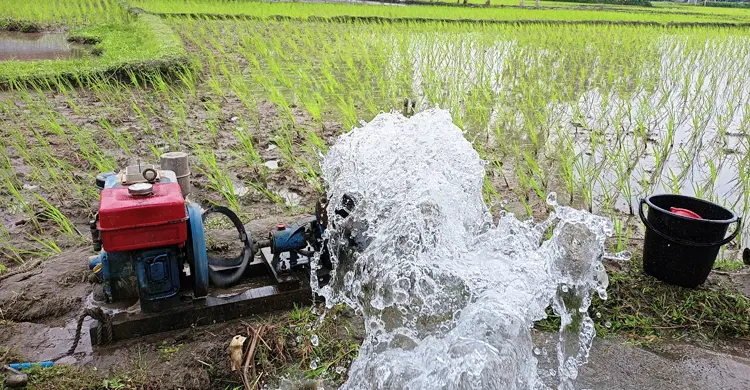
There has been no rain in Lalmonirhat for five months, and rivers, canals and beels are dry. This threatens maize, Boro rice and various vegetables, and farmers are having to pay extra to irrigate. More than a lakh farmers in the district's five upazilas are frustrated at the prospect of losses because the rain has not come.
Rainfall in the region has been close to zero from November and December last year through January, February and the second week of March this year. The drought could seriously harm agriculture, and farmers are suffering extreme hardship as well as extra costs.
Pressure on groundwater
With no rain across the district, Boro rice, maize and various vegetables have become dependent on irrigation, increasing pressure on groundwater. Several lakh farmers in the district are pumping groundwater with irrigation machines in an unplanned way, lowering the water table. Farm production is under threat, and cropland is facing an irrigation crisis.
The Teesta, Dharla, Saniajan and Ratnai rivers have also dried up. Climate change has brought major changes to the region's landscape.
Farmers count the cost
Anwar Hossain, a farmer on the Teesta chars, said, "As every year, I have planted maize on two acres of the newly risen char of the Teesta. With no rain, I am struggling to irrigate the maize. Diesel prices have gone up, so irrigation costs more. I don't know what price I will get for maize this year."
Mohsin Ali, a farmer in Khuniagachh union of Lalmonirhat Sadar upazila, said, "With no rain for several months, we are in trouble with maize, chillies and vegetables. In the dry weather I am irrigating the land heavily and spending a lot of money. The Boro season is also under way. We are frustrated because there is no rain."
Raju Mia, a farmer of Fakirpara in Hatibandha upazila, said, "This year I have grown maize on five acres. Because there is no rain, I have to irrigate the land at extra cost. The Boro season is also going on now."
Agriculturist Hamidur Rahman, deputy director of the Lalmonirhat Department of Agricultural Extension (DAE), told Jago News that there is a tendency towards drought throughout March every year. As there has been no rain for several months, farmers have been advised to keep their irrigation machines running, and a storm is also possible this month. However, no crops have been damaged by the drought across the district, and no such reports have been received, he said.
Source: Jagonews24. First published in Bengali on The Agro News.
Comments
(0)