
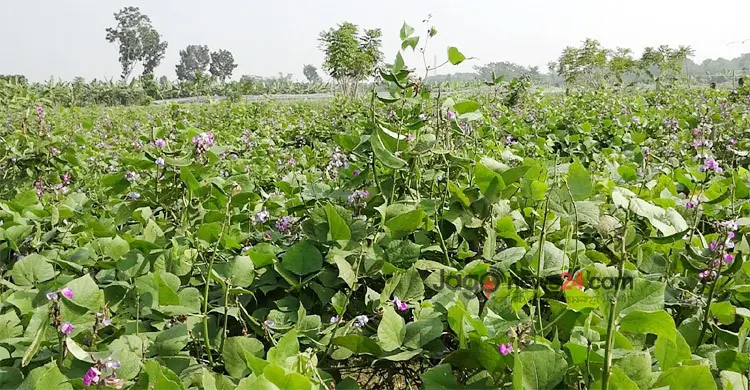
Interest in growing pesticide-free vegetables is rising among farmers in Kushtia. With integrated pest management (IPM) producing more at lower cost, farmers are making a profit from vegetables. They say that using bio-pesticides and sex pheromone traps instead of chemical pesticides, protecting beneficial insects and keeping fields clean gives higher output at lower cost.
According to the Kushtia Department of Agricultural Extension (DAE), pesticide-free vegetables are being grown on about 100 acres in several villages of Ujangram union in Sadar upazila. With the department's technical support and advice, about 15 kinds of vegetables are being grown without pesticides, including tomato, brinjal, bean, bottle gourd, pointed gourd and red amaranth.
Farmers' experience
Asaduzzaman, a farmer of Baruipara village in Ujangram union, said he is growing pesticide-free tomatoes on 46 decimals using IPM, without chemical pesticides. Production costs are comparatively low under this method, and with strong market demand for pesticide-free vegetables, farmers are making a profit.
"I never thought growing tomatoes would bring so much profit. Next season I will grow tomatoes on more land. These tomatoes are free of poison; no pesticide was used on the field. Tomato plants usually need the most spraying because of the fruit and shoot borer. Because I used bio-pesticides and sex pheromone traps instead, I did not have to apply any poison. Before, I had to spend Tk 2,500 to Tk 3,000 a week on pesticide," Asaduzzaman said.
If the weather stays favourable, he expects a profit of at least Tk 1 lakh after costs from his 46 decimals of tomatoes.
Abdus Sattar, a farmer in the same area, said: "I am growing pointed gourd on 25 decimals. Using the IPM method, my costs are lower than before, so the profit is higher."
Officials' view
Saidur Rahman, sub-assistant agriculture officer for Ujangram union, said: "Various vegetables are being grown using bio-pesticides through environment-friendly techniques. About 15 kinds of vegetables are being produced here entirely with IPM. Alongside motivating farmers to grow these vegetables safely, we are informing them about modern bio-technology through farmer rallies and making the public aware too."
Sufi Md Rafiquzzaman, deputy director of the Kushtia DAE, said: "The pesticides used to control insects in vegetable fields are extremely harmful to the human body. So farmers are being discouraged from using pesticides and advised to grow safe, healthy vegetables. Various non-government organisations are also advising farmers alongside the agriculture department. At first it was hard to get farmers interested in this method, but seeing the success in production, farmers in the upazila are increasingly taking it up."
Source: Jagonews24. First published in Bengali on The Agro News.
Comments
(0)