
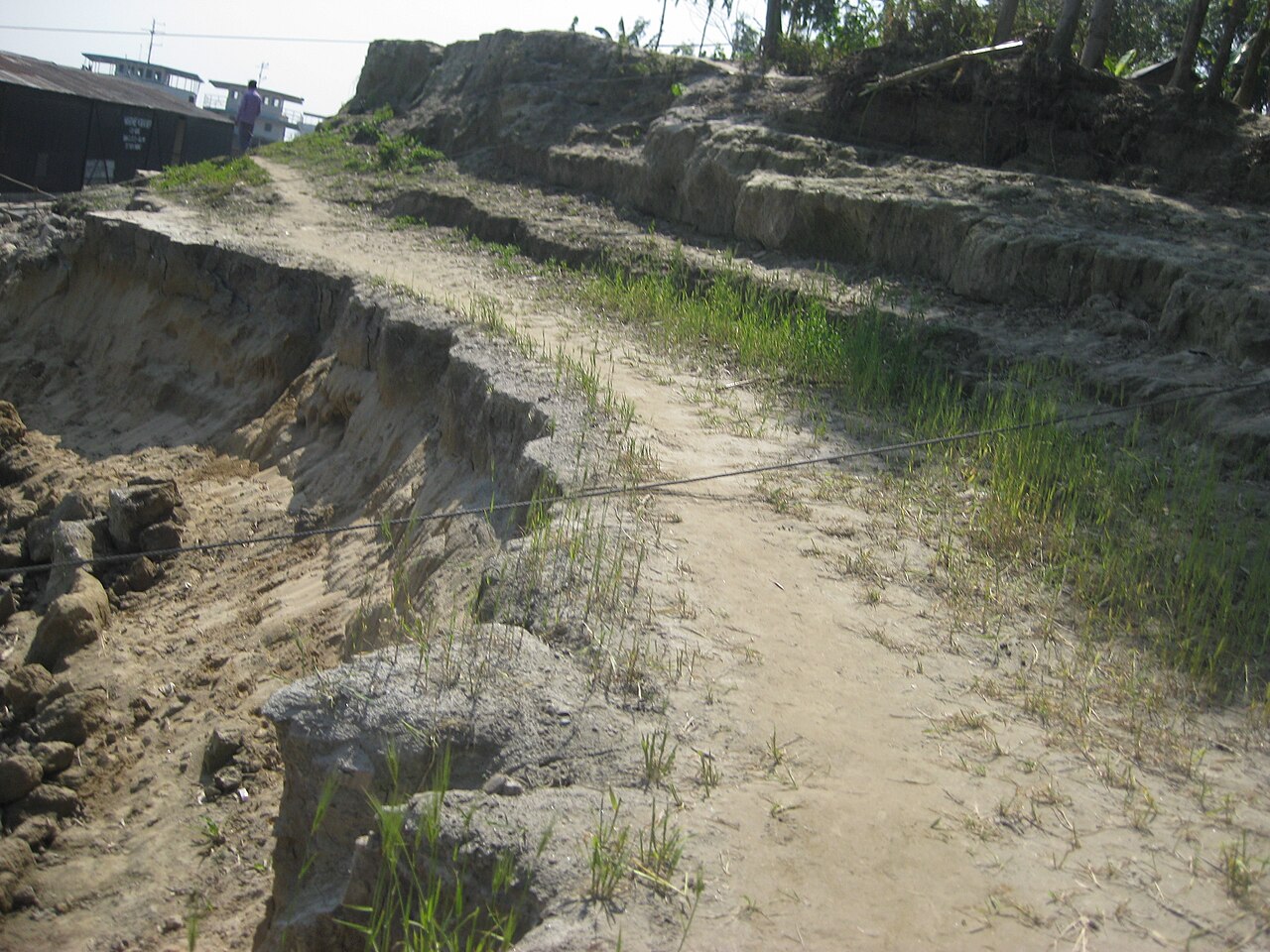
Jainal Abedin of Char Khitabkhan in Rajarhat, Kurigram, is 85 and has lost his home to the river 17 times. He has watched erosion since he was seven or eight and complains that he has never had government help to rebuild. His story is told in a Prothom Alo column by Tuhin Wadud, a professor of Bangla at Begum Rokeya University and director of the river protection organisation Riverine People.
On the Teesta bank the writer also met Noushad, whose home has gone five times, Belal, four times, and Abdul Khaleque, twice. Khaleque once owned a lot of land and now has 10 to 12 decimals. He did not want his son in a small job, but after the house went he had to send him to the Ansar and Village Defence Party. A fire leaves you the pond and the land, Noushad said, while the river leaves nothing.
By local count, about 300 families who lost their homes now live on Majher Char. What the char grows is sold at a makeshift landing near Char Khitabkhan Government Primary School. At Sarishabari in Rajarhat, Abdul Baten and his three brothers lost 2 acres and 50 decimals to the river a few years ago, and two of the brothers have moved to Dhaka.
On the Dharla the story repeats. After the river took the land of Hazrat Ali of Kurigram Sadar, he began driving a van, and has lived on an embankment for 20 years. The writer says thousands of people have homes on the Teesta and Dharla embankments, and that many were evicted when the Dharla protection embankment was built.
Erosion cannot be measured only in money, the writer argues. Families scatter, neighbours lose one another, and women suffer most. Many of the displaced borrow from NGOs or from moneylenders at high interest and are caught in a cycle of debt for life. Children on the chars have little chance of schooling, and there is hardly any health care.
In Tuhin Wadud's view, erosion control covers only a small part of the Teesta and Dharla banks, and the government could stop the erosion if it chose to. The views are the writer's own.
Photo: Ibrahim Husain Meraj / Wikimedia Commons (CC BY-SA 3.0)
Source: Prothom Alo


Comments
(0)