
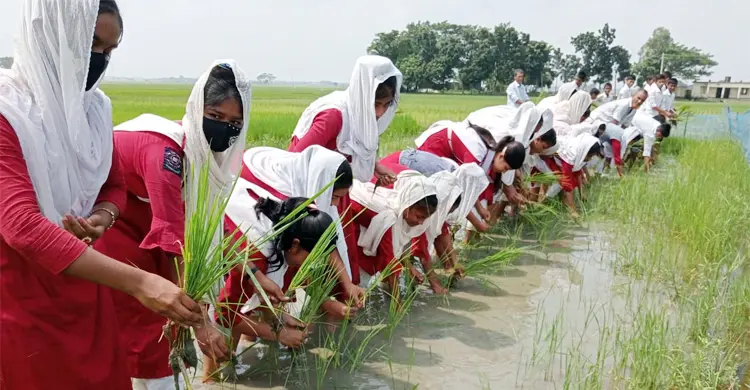
The young hands that hold books, notebooks and pens are now planting rice seedlings. Boys and girls together are learning every kind of work, including cooking. A science teacher at Khila High School in Netrokona has begun these hands-on activities to put the new curriculum into practice.
Hundreds of students have been preparing land and wading into the mud to plant rice seedlings all day. The students believe the lessons will be fully useful in real life. Shakil Ahmed, the science teacher at Khila High School in Atpara who is behind the unusual effort, has won everyone's praise.
Seedlings on 35 decimals
More than a hundred seventh-grade students were seen busy planting rice in a field under a blazing sun, as Shakil Ahmed taught a chapter of the syllabus hands-on. They went into the muddy water in their school uniforms. First they carefully cleared the weeds and levelled the land with a ladder harrow, then took seedlings from the field ridge and planted them. Under the guidance of an experienced farmer, the young farmers planted seedlings on 35 decimals of land from midday to afternoon.
Parents and local people came to watch, and parents said they liked what they saw.
Seventh-grade students Sadia Akter, Munni Akter and Imu Akter said the first chapter of their science practice book is called 'Fosoler Dak' (The Call of the Crop), covering sowing, care, storage of crops and more. "Our father is a farmer too, but we never went to the field to help him. From now on we will help him with farming."
A farmer as guest teacher
As set out in the lesson plan, farmer Hariz Uddin one day appeared in the seventh-grade science class. Shakil Ahmed had told the students the day before that a 'guest teacher' would come. Faced with the farmer, the students fired question after question. He was hesitant at first but gradually warmed up and answered their curiosity from his own experience.
Asked whether they now wanted to grow a crop with their own hands, the students answered "yes" in unison. Shakil then discussed it with the head teacher and with Hariz, who both responded positively. But by then the Boro planting season was over, so they had to wait for the Aman season.
Teacher Shakil Ahmed said: "If a student learns from childhood how to sow, tend and store a crop, it will help them become self-reliant. Having done this work, they will never look down on farming, and they will enjoy doing their own work. Practical skills learned beyond books are useful for life. That is why I brought them to the field."
Farmer Hariz Uddin, who owns the land and guided the students in the field, said: "These boys and girls have saved me several thousand taka. I never thought they would work so well."
Head teacher Khairul Alam said: "If the children apply the experience they have gained to work at home, their families will benefit greatly. Many children of this age are hooked on bad habits such as excessive mobile phone use, and some are joining gangs in crime. There is no alternative to activities like this to protect society."
District education officer Md Abdul Gafur said: "If every school taught children like Khila High School, students would become self-reliant and the country would move forward. This kind of new curriculum has been introduced in classes six and seven. Hands-on learning should be introduced in every school, as at that school."
Source: Jagonews24. First published in Bengali on The Agro News.
Comments
(0)