
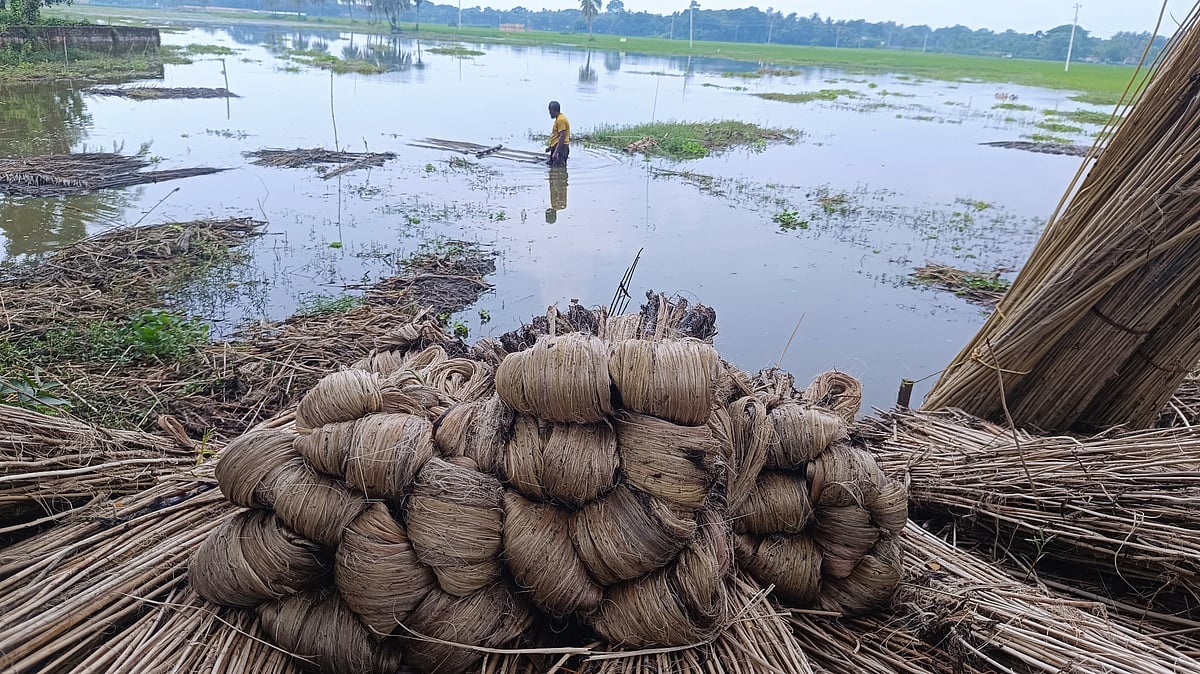
Jute is being retted in standing water, stripped in waist-deep bils and dried in golden rows along the tarmac roads of Satkhira Sadar, Tala and Kalaroa upazilas. With disease pressure low, yields good and prices holding, growers in the south-western district are counting on a profit this season.
According to the Satkhira office of the Department of Agricultural Extension, jute was grown on 11,675 hectares across the district's seven upazilas this year, up 68 hectares from 11,607 hectares last year. The production target is about 142,000 bales, each bale holding roughly 182 kilograms. Farmers report yields of 12 to 15 maunds a bigha.
Md Saiful Islam, deputy director of the department in Satkhira, said cultivation and output were satisfactory this year and harvesting was still going on in a few areas. Because the district has no jute-based industry, the fibre is sold both locally and outside the district.
The department puts the current price at Tk 3,200 to Tk 3,700 a maund depending on grade. Last year the season opened at Tk 3,400–3,500 a maund and closed at Tk 4,000–4,200. Saleh Mohammad Abdullah, the district agricultural marketing officer, said Patkelghata hosts a large jute market, traders also buy directly in the villages, and farmers can now check rates through several channels.
Seven farmers across the three upazilas said the usual fungal stem rot, leaf drying and hairy caterpillar attacks were less severe than in other years. Akbar Ali of Islamkati in Tala said he had to spray repeatedly last year; this year the weather was kind, the crop was good and the market price was fair.
Abul Hossain of Helatala in Kalaroa grows two bighas of jute every year; he got 25 maunds last year and expects about 30 this time. Kibria Sardar of Jhapaghat spent about Tk 5,000 on five kathas, including washing, and will get two and a half to three maunds of fibre plus 34 bundles of jute sticks. Asadul Sardar sowed 300 grams of seed on 11 decimals and harvested about two maunds; he expects Tk 60 to Tk 100 a bundle for the sticks.
Jute leaves return fertility to the soil, and the sticks sell as fuel and for other uses, so planting jute after the rice harvest has become a second income for many households. At Tujulpur, Mohammad Abdul Karim retted his crop for 18 days, stripped the fibre a few days ago and is now drying the bundles — expecting, he said, a good margin once costs are paid.
Source: Prothom Alo

Comments
(0)