
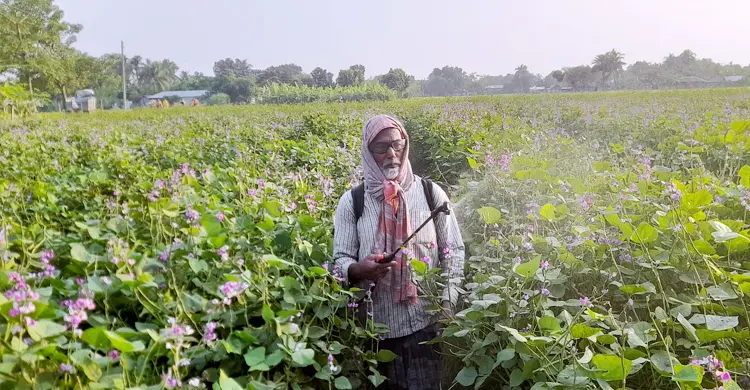
Beans have been grown commercially in Ishwardi upazila of Pabna for 26 years. Most are grown in Betbaria, Faridpur, Atgharia, Baghhachhla and Shekhpara villages of Muladuli union, where farmers grow beans on 90 percent of the land. But when the bean season comes, the smell of pesticide hangs in the village air. Farmers use Tk 8,000 to 9,000 worth of pesticide per bigha of beans, which no other crop requires.
A visit to Betbaria, Muladuli, Shekhpara, Baghhachhla, Atgharia and Faridpur villages of Muladuli union found only beans across the wide fields. Farmers were tending the plants; some were picking beans, some clearing weeds, and many were spraying pesticide. After spraying, the stench of poison in the area forces passers-by to cover their noses with handkerchiefs.
According to the Ishwardi upazila agriculture office, beans were grown on 1,130 hectares in the upazila last year. This year's target is 1,200 hectares, of which 850 hectares are in Muladuli union alone.
Spraying up to five days a week
Two kinds of pesticide are mostly used on beans: one to control insects and the other a fungicide to prevent rot. Pesticides such as Complesal Super and Mirakolan are also applied to the plants to boost yields; local farmers know these as bean plant vitamins.
To control aphids on bean flowers and young pods, pesticide must be sprayed five days a week. On some land where insect attack is heavier, farmers apply poison twice a day. As fungicides, farmers usually use products sold as Sunconazole, Folipur, Contaf, Lona, Autostin and Entracol, and for insect control products sold as Fenfen, Sumi Alpha, Beld Expert, Eraster, Emaplus, Lumectin, Confidor and Solemon, among others.
At least Tk 8,000 to 9,000 worth of pesticide is used per bigha of beans, sometimes more. Beans are grown on 1,200 hectares in Ishwardi, that is, 9,000 bighas. On that basis, at Tk 8,000 of pesticide per bigha, the 9,000 bighas of bean land use pesticide worth Tk 7 crore 20 thousand, the report calculates.
Farmers say there is no alternative
Nabir Uddin, a farmer of Muladuli village, said pesticide is now the biggest cost in growing beans. Use has risen and prices have gone up too. Tk 8,000 to 9,000 of pesticide must be used per bigha, and sometimes even more, he said.
Abdur Rahim, a farmer of Betbaria village, said beans have been grown on 95 percent of the village's land this year. Once the plants grow, poison (pesticide) must be applied every two or three days to prevent rot and control insects.
Using pesticide on crops spreads a stench and harms the environment, but there is nothing to be done, the farmer said. To grow beans you must use pesticide; there is no alternative.
Aminul Islam Babu of Muladuli village, known as "Shim Babu" (Bean Babu) for his fame in bean growing, said pesticide for one bigha of beans costs Tk 10,000-12,000. Various pesticides including granules, Sumithion, Tafgor, Fanthen and Okozim must be sprayed regularly. When some accidentally falls on their bodies, farmers fall ill and even lose consciousness, he said.
Ariful Islam, proprietor of Al-Amin Traders, a fertiliser and pesticide dealer in Muladuli bazaar, told Jagonews that beans, including early beans, are grown for seven or eight months in the area. When the weather is unfavourable, more pesticide is needed. Tk 8,000 to 10,000 of pesticide is used per bigha, and pesticide use is highest in the bean season, he said.
Officials warn of harm to soil and health
Rumana Yasmin, sub-assistant agriculture officer for Muladuli union, told Jagonews: "Our field-level review found that growing beans on one bigha costs Tk 39,000, of which Tk 7,000 to 8,000 goes on pesticide. When the weather is unfavourable, beans need more pesticide. In winter, if the sun is hotter, insect attacks on beans increase and more pesticide is needed. Several environment-friendly pesticides are now on the market, and we are advising farmers to use them so the environment is not harmed."
Excessive pesticide use is damaging the soil and increasing farmers' health risks, she said. Although farmers have been told again and again, they keep using excessive amounts and harming the environment and health.
Dr Shafiqul Islam Shamim, resident medical officer (RMO) at the Ishwardi Upazila Health Complex, said pesticide use in vegetable growing is extremely harmful to the human body. Vegetables grown with pesticide are risky to health; eating them can even cause cancer, and people can suffer kidney and liver damage, the birth of children with disabilities and various other complex diseases.
Upazila agriculture officer Mita Sarkar told Jagonews that beans are grown on 1,200 hectares in Ishwardi upazila. Pesticide is important for crop production, but excessive use is harmful to the environment and human health. "We always advise farmers to use pesticide in controlled doses, and we are also encouraging organic pesticide alongside chemical pesticide," she said.
Organic pesticide has no side effects, the environment will stay healthy and farmers' and consumers' health will not be harmed, Mita Sarkar added. Farmers are being made aware of using organic fertiliser at field days and demonstrations, she said.
Source: Jagonews24. First published in Bengali on The Agro News.



Comments
(0)