
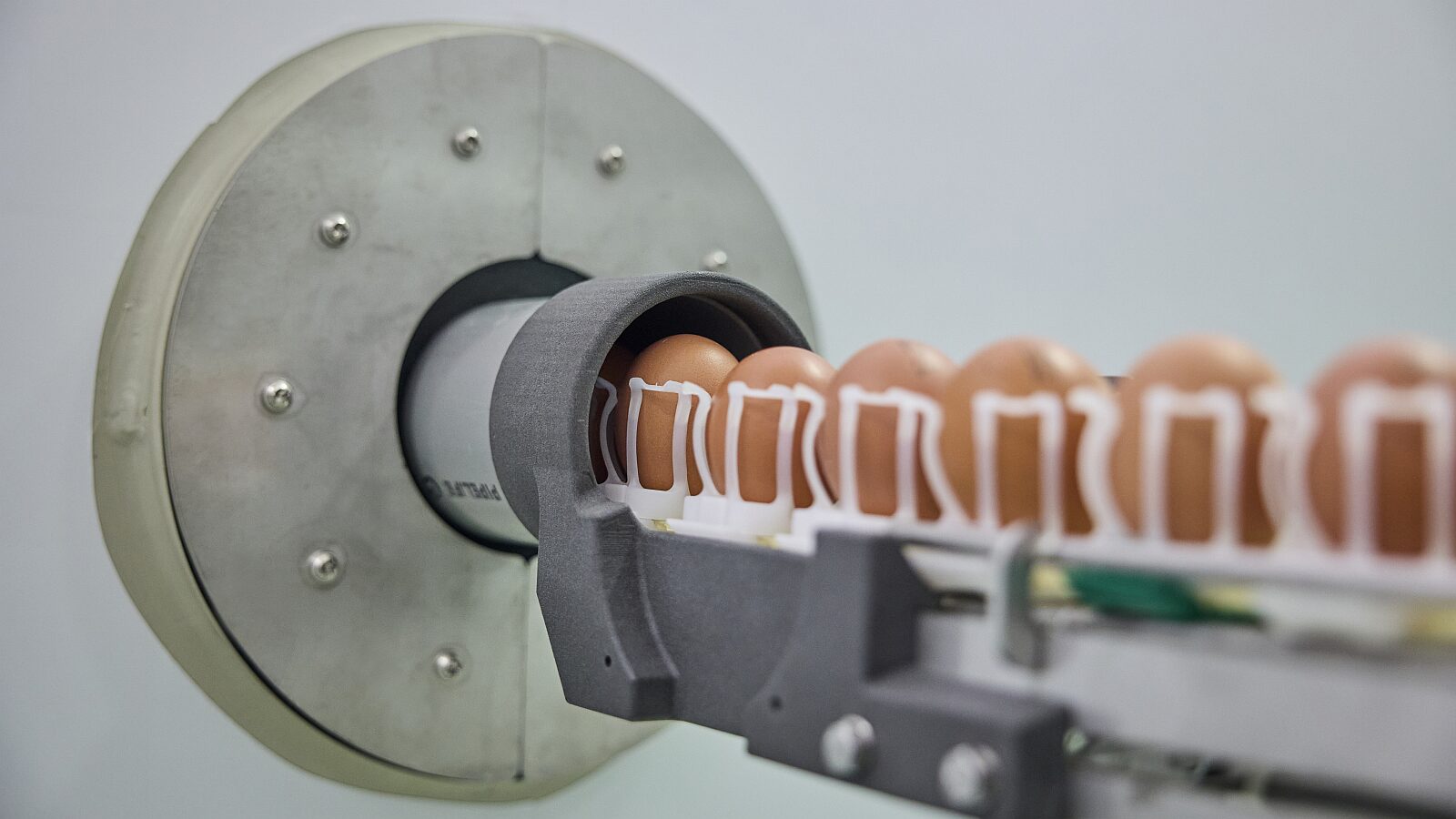
In ovo sexing — determining the sex of a chick before it hatches so that male eggs can be removed from incubators instead of male chicks being culled — has gone from zero to 40% market penetration in the European Union in five years. Whether it can spread to the United States and other markets with no legal pressure is now the industry's open question.
Hatcheries today incubate eggs for 21 days, employ trained sexers and cull half the chicks, because male layer chicks cannot lay and are uneconomic to raise for meat. The technology still costs more than the incubator space it frees, so someone in the chain has to pay. United Egg Producers, which represents 90% of US egg output, says it is "fully committed to the future adoption of commercial-scale in-ovo technology when it is economically and operationally feasible". Its senior vice-president Dr Larry Sadler told the PEAK Conference in April that whether consumers will pay more "is far from proven".
Europe moved because of regulation: Germany and France banned male chick culling, Austria added restrictions, Italy plans a phase-out by 2027 and the European Commission has pledged revised poultry-welfare rules by the end of 2026. According to the non-profit Innovate Animal Ag, the technology now covers more than 85% of the layer flock in Switzerland and 52% in Norway, neither of which has a ban. It is also reaching Brazil, through German equipment maker AAT, producer Raiar Orgânicos and the Hy-Line do Brasil hatchery, and Australia, where Specialized Breeders Australia installed an AAT Cheggy machine in May.
In the US, producers managing more than 4% of the layer flock — NestFresh, Vital Farms, Kipster and Sauder's Eggs — are switching as flocks retire, with equipment from Orbem, AAT/Cheggy and Seleggt. Robert Yaman of Innovate Animal Ag said the commodity market will follow only when the technology costs no more than manual sexing, though costs have already fallen significantly. "Five years ago this was a germ of an idea in a handful of hatcheries. Today it's the standard across over a third of Europe," he said.
Two approaches are commercial. Imaging through the shell includes AAT/Cheggy, whose hyperspectral cameras read feather colour at day 11–13 but only in brown eggs; Orbem, which pairs AI with MRI at day 11 or 12 and claims 99.5% accuracy at up to 24,000 eggs an hour; and Omegga, which images inside the incubator and says it can sex before day seven at up to 50,000 eggs an hour. The other, allantoic sampling, is used by HatchTech/SelEggt, which tests a drop of fluid by PCR at day nine with accuracy above 99.5%. Gene-edited markers and other methods remain in development.
The companies disagree on what the US needs. AAT CEO Jörg Hurlin calls Cheggy the cheapest, highest-throughput option and says premium and free-range eggs worldwide are mostly brown, but US retailers "are not willing to pay any extra". Omegga CEO Katharina Hesseler counters that US hatcheries are 10 to 20 times larger than Europe's and 90% of the US market is white eggs. Orbem raised a €55.5m ($64 million) Series B in January and has a second US installation going live; Omegga recently raised a €10m ($11.6 million) seed round.
For now the premium brands absorb the cost. NestFresh vice-president Mike Sencer said charging shoppers "would never get off the ground"; Vital Farms expects most of its hens to come from in-ovo-sexed hatches by 2028 without passing the cost on; Kipster USA carried the cost of its first flocks and is deciding how to share it before launching its brand in early 2027. The real change, Sencer predicts, will be technology that sexes eggs before incubation, so male eggs can be sold as liquid egg at full value.
Source: AgFunderNews


Comments
(0)