
On the mountainsides of the Choluteca department in southern Honduras lie the sugarcane fields that supply the country's first industrial plant for powdered sugarcane. The plant, developed by the Union of Sugarcane Producers of the South (UPROCASUR), has become an important source of local employment, with more than 200 permanent jobs and up to 1,000 during the harvest season.
The business began as an idea of the union's board. "We wanted to go beyond harvesting and start processing the sugar to take on more steps of the value chain," said Mauricio Larios, a board member and sugarcane producer, who recalls travelling to Colombia to learn better practices. Evenilda Morán, the organisation's president, says the plant now energises the local economy through the transport, harvesting, administrative, cleaning and technical services it hires.
Okra is doing similar work. In Honduras nearly 80 percent of the workforce survives in the informal economy, especially in rural areas, and the crop, exported in large volumes, is helping close that gap through companies such as CAVEXSA. What began as an association of small producers now employs more than 600 people permanently. It cultivates 200 manzanas of okra with an average yield of 2,625 seven-kilogram boxes, enough to export one container a day to the United States, Spain, England, France, Italy and Portugal. "Thanks to okra, I was able to pay off many debts and improve my home," said producer Denia Calderón.
CAVEXSA was born of a crisis. An agro-exporter persuaded producers to switch their crops wholesale and then failed to buy the harvest. "We sent full containers of okra and received only a fraction of what was expected. More than 180 producers were on the verge of bankruptcy," recalled Juan Ordóñez. The growers responded by forming their own company with control over production, processing and export, and rebuilt it into a regional benchmark for sustainable production, with funding that paid for equipment and facilities. UPROCASUR had its own shock in 2023 when an international buyer who had agreed to place large volumes died unexpectedly; the union sought assistance and kept going.
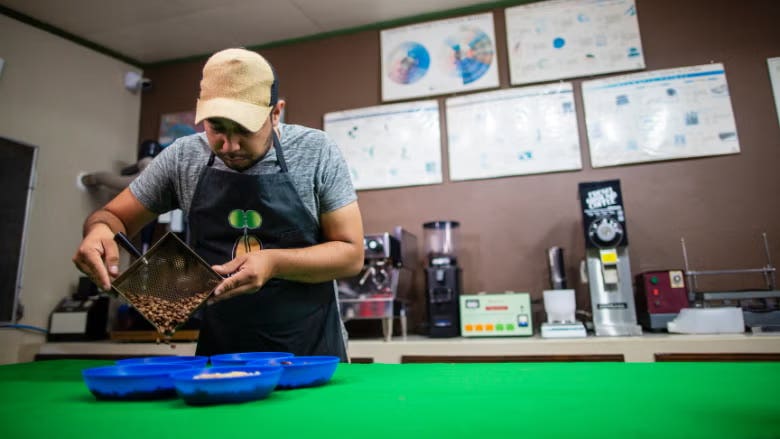
Coffee, one of the country's main agricultural drivers, also creates jobs in Choluteca through the San Marqueña Coffee Cooperative (COCASAM), which produces 11 quintales of coffee and exports all of it as specialty coffee to the United States and France. Ana Julia Ríos, a cooperative worker, says the job let her provide for five children after her husband died and now pays for the insulin she needs. Eric Pastrana, born on a coffee farm, has trained in the quality area and can now differentiate the coffees the cooperative exports.
All three organisations have been supported by the ComRural II project, implemented by the Government of Honduras with the World Bank Group. The project, aimed at agricultural competitiveness and rural employment, has promoted 19 business plans nationwide benefiting more than 10,000 people, and beyond financing it provides technical assistance, infrastructure, technology and training. Its Private Financial Ally schemes have leveraged more than US$14 million in private capital for initiatives such as UPROCASUR, CAVEXSA and COCASAM, and more than 3,200 Hondurans have secured a job through the business plans it supports. The project aligns with AgriConnect, the Bank Group's global initiative for small-scale agriculture that generates employment, growth and food security.
Source: World Bank


Comments
(0)