
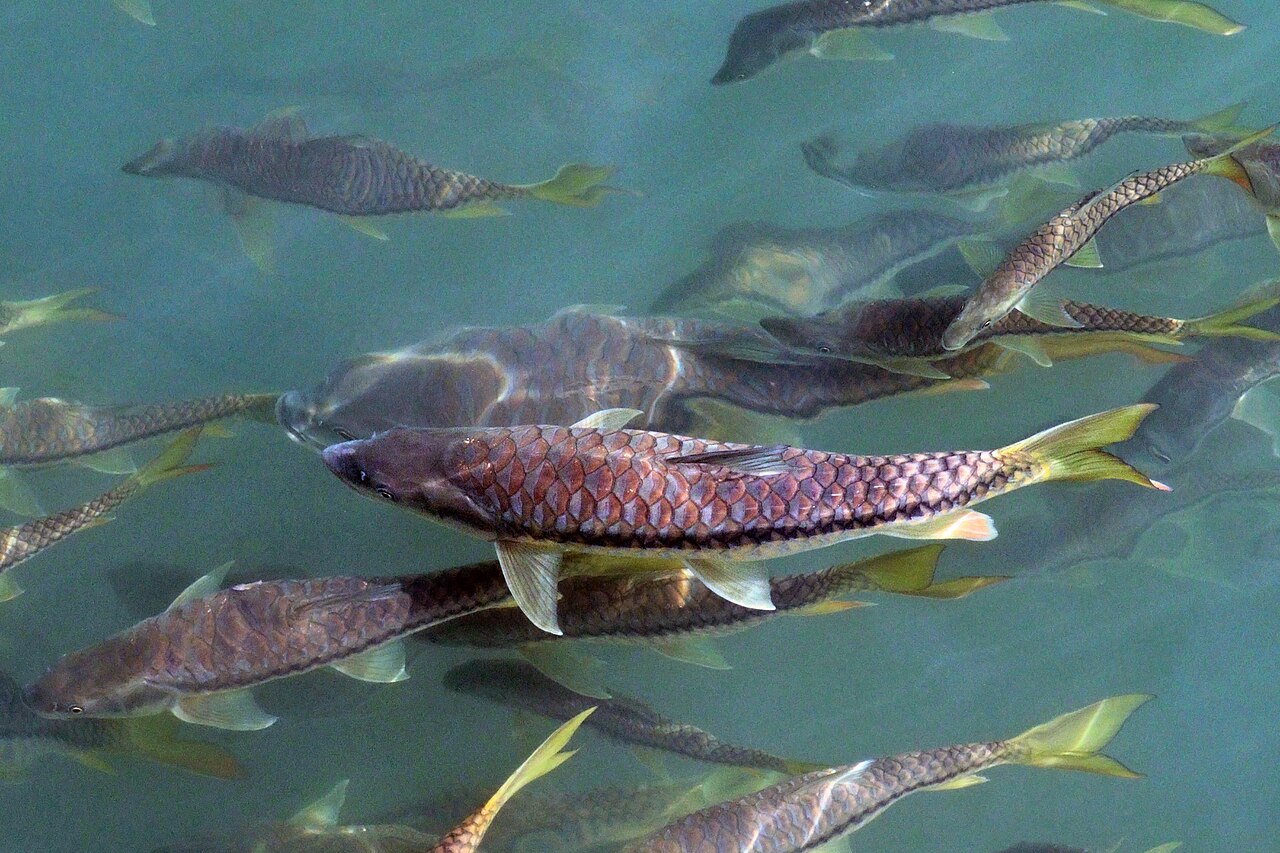
Migratory freshwater fish in the Himalayan headwaters of the Ganges-Brahmaputra-Meghna (GBM) basin are disappearing under the combined pressure of hydropower dams and climate-driven floods, Priyanka Shankar writes in a commentary for Mongabay India. The views are the writer's own.
She starts from the Global Assessment of Migratory Freshwater Fishes, published this year by the UN Convention on the Conservation of Migratory Species of Wild Animals (CMS) with the UN Environment Programme-World Conservation Monitoring Centre. It found that migratory freshwater fish populations have fallen 81% worldwide since the 1970s, and that 97% of the 58 fish species listed under the convention face extinction. The report names the GBM system, one connected pathway from the Himalaya to the Bay of Bengal, as a global priority region; fish biologist Zeb Hogan, one of its lead authors, calls it among South Asia's greatest migration landscapes.
The commentary points to recent disasters. In late August 2026 an ice and rock avalanche on the Nepal-Tibet border sent debris down the Bhote Koshi and Trishuli rivers, and ICIMOD's monitoring station at Galchchi recorded the water rising nine metres in 30 minutes. The flood killed hundreds of people and wiped out 281 megawatts of hydropower capacity. When it reached the Gandak and flooded West Champaran and Gopalganj in Bihar, high-altitude fish the villages had never seen turned up in their nets, and the Bihar government told people not to eat or sell them. After the October 2023 glacial lake outburst flood on the Teesta in Sikkim, an ICAR-National Bureau of Fish Genetic Resources study found the upper floodplain had widened by 138%, with sediment burying the pools and gravel beds where snow trout spawn and shelter in winter.
Dams are the second pressure. The golden mahseer, which can grow to more than 50 kilograms, once swam up Ganges tributaries to spawn before the monsoon. Radio telemetry work by the Wildlife Institute of India showed hydropower has broken its habitat into fragments; the Tehri dam on the Bhagirathi and the Srinagar dam on the Alaknanda cannot be passed, and genetic evidence suggests the Srinagar dam has cut off the upstream Alaknanda stocks entirely. Hatchery programmes at the ICAR-Directorate of Coldwater Fisheries Research in Bhimtal struggle to keep pace, the writer notes, because the mahseer matures late and lays relatively few eggs, and fish passes are rarely built into Indian dams.
Her answer is community stewardship. In Meghalaya's Garo Hills, villagers guard the Wachi Wari Community Fish Sanctuary on the Simsang river, where deep pools hold hundreds of chocolate mahseer under village bans on dynamite and poison fishing, and the surplus spills into open water that feeds the community. In Bhutan, communities protect snow trout by not fishing in the spawning season. In Poilwa village in Nagaland, residents mapped eight spawning grounds along seven kilometres of the Tepuiki river and closed them to fishing; native fish recovered within a few seasons, and household incomes followed.
Shankar concludes that the CMS assessment is a mandate to bring freshwater fish conservation into the mainstream, through shared tracking, protected migration routes and restored river connectivity.
Photo: Charles J. Sharp / Wikimedia Commons (CC BY-SA 4.0)
Source: Mongabay India

Comments
(0)