
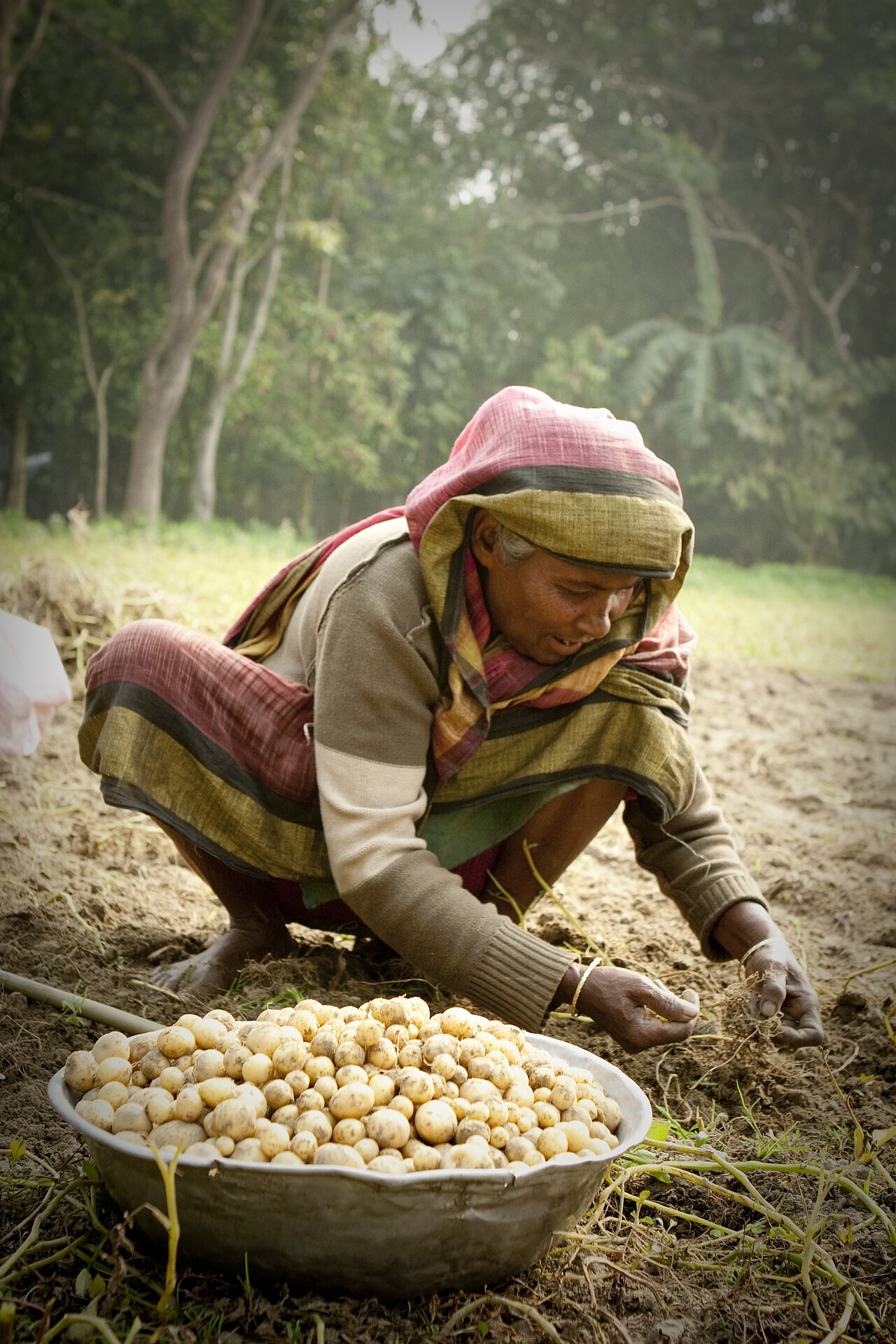
In a house on a Padma char in Harirampur, Manikganj, a small room beside the kitchen is lined with seed: in glass jars, cloth bundles and clay pots, each labelled by hand. The women of the house keep it. 'Every tree and every vegetable you see around here, the planning is ours,' said Amena Begum, 35.
Bitter gourd and yardlong beans climb the fence; tomato, aubergine, amaranth and chilli grow in the field; palmyra and areca palms line the edge of the beel so their roots hold the bank. The women decide which crop goes beside which, what is sown each season and which seed is saved for next year. On the chars the logic is simple: if a flood takes one crop, another survives, and when families have no money or time to buy seed after a flood, the saved seed turns the fields green again.
Yet their names are absent from land deeds, farmer lists and river-erosion compensation papers. Citing Bangladesh Bureau of Statistics data, the land-rights group ALRD says 74 percent of working women are in agriculture, while their share of effective land ownership is only four to five percent. Women are involved in 17 of the 21 kinds of work in crop production, including seed selection, harvesting, threshing, drying and storage.
Training from the agriculture office, subsidised fertiliser, incentive seed, easy credit and post-disaster help all follow the farmer list. Older women say that once bought seed, chemical fertiliser and pesticide arrived, the men's names went into the shop ledgers and loan papers: the knowledge stayed with the women, the decisions moved elsewhere.
The land itself does not stay put. Locals count at least 13 mouzas of Harirampur lost to the Padma in two decades, and about 1,000 bighas of cropland and more than a hundred homesteads in the past year alone. CEGIS estimates that some 158,000 hectares have been lost to Jamuna and Padma erosion since 1973. When men leave for city work after erosion, the women restart farming with the seed they kept.
The 'farmer card' programme launched this Pahela Baishakh gives, in its pre-pilot phase, cards to 20,671 landless, marginal and small farmers in 10 districts: Tk 2,500 a year in cash plus inputs at fair prices and easy credit. Manikganj is not among the ten. Applicants are asked for a land deed, khatian record or proof of cultivation, none of which is in Amena's name, and farmers are graded by the size of the family's land.
Development workers on the chars suggest counting actual cultivation rather than ownership, listing women and men of the same family as separate farmers, strictly applying the joint husband-and-wife settlement rule for khas land on the chars, and flagging women-headed households on erosion compensation lists.
This report is based on a feature by Laboni Mondal for Samakal.
Photo: Hridoye Mati O Manush / Wikimedia Commons (CC BY 2.0)
Source: Samakal

Comments
(0)