
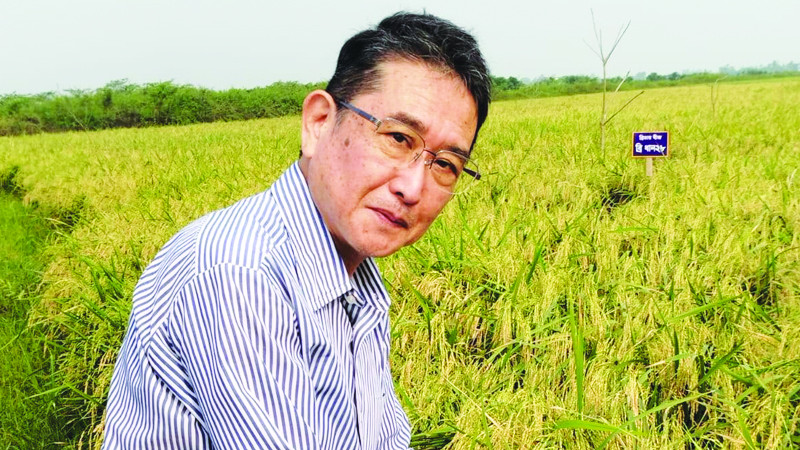
Japanese development researcher Tetsuo Tsutsui has spent four decades working on the farm economy and the livelihoods of marginal families in Bangladesh's haor wetlands. A feature by S M Mukul in Daily Bangladesh traces that path, from his arrival in 1985 as a 23-year-old JICA volunteer to the climate-resilient agriculture programmes he runs today.
According to the feature, Tsutsui began in 1986 as a junior expert in fish-farming extension on a JICA project at the Bangladesh Academy for Rural Development (BARD) in Cumilla. He returned in 1994 as fund-raising coordinator for the Japanese development organisation Shapla Neer, became head of its fair trade division at the Tokyo secretariat in 1996 and its resident representative in Bangladesh in 1998, extending its work to Narsingdi, Kishoreganj, Mymensingh, Tangail, Narayanganj and Munshiganj.
Working on the principle that people should build self-reliance from their own resources rather than look to aid, Tsutsui became Shapla Neer's deputy secretary general in 2002 and secretary general in 2008. He retired in 2014 and founded a new organisation, Share The Planet Association, which is implementing a JICA-supported project in the haor areas of Habiganj through the local NGO ASED.
His current work covers two regions: Kushtia, Jhenaidah, Chuadanga, Jashore and Satkhira in the south-west, and the haor districts of Netrokona, Kishoreganj, Habiganj and Sunamganj in the north-east, where local NGOs carry out field programmes to spread climate- and disaster-resilient farming technology and improve crop management. The feature says he keeps at least 14 development initiatives running, with about 80 per cent of the resources reaching beneficiaries directly.
He has also built a network in Bangladesh called CCAAN, through which the Bangladesh Rice Research Institute (BRRI), the Bangladesh Agricultural Research Institute (BARI), the International Rice Research Institute (IRRI), Habiganj Agricultural University, the Toyota Foundation, several Japanese government agencies concerned with agriculture and climate, and 14 farm-focused NGOs from Bangladesh and West Bengal share strategy, information and resources.
The feature sets out why the haor matters: the wetlands cover roughly a fifth of the country across 53 upazilas in seven districts, and supply about 60 per cent of Bangladesh's Boro rice, around a fifth of its cattle and about 22 per cent of its ducks. It also warns that excess fertiliser and pesticide from the fields is depleting oxygen in the water bodies and harming fish and other aquatic life.
Tsutsui's work has been recognised in Japan with the Asahi Social Welfare Award, the Okinawa Peace Prize, the Hiroshima Peace Prize, the Excellent NPO Award and the Japan Partnership Prize. The feature's author, S M Mukul, is a journalist, economic analyst and development researcher; the report is from Daily Bangladesh.
Source: Daily Bangladesh
Comments
(0)