
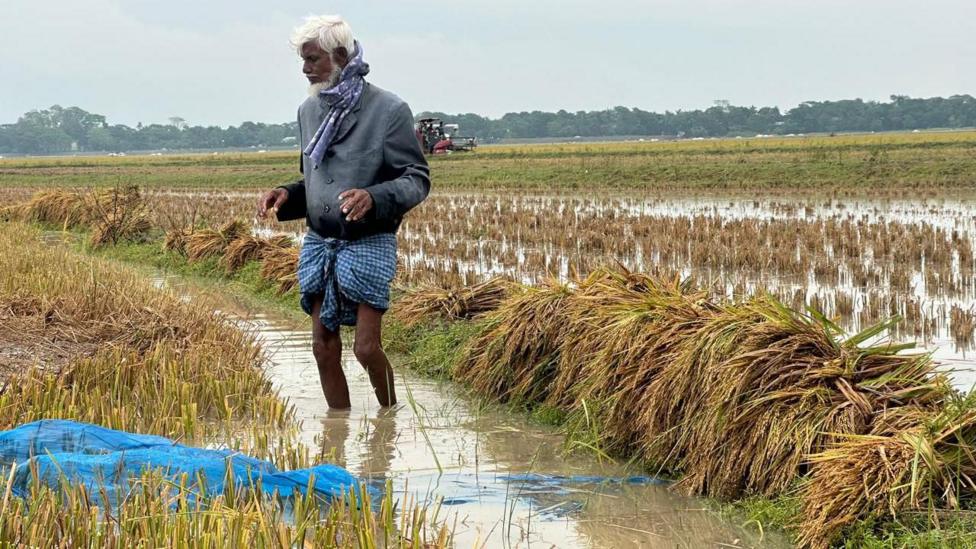
Days of heavy to very heavy rain have submerged large tracts of farmland in Netrokona and Moulvibazar, the haor districts of north-eastern Bangladesh, just as the boro harvest should be in full swing. In a bulletin on Wednesday afternoon the Flood Forecasting and Warning Centre reported 123 millimetres of rain in Netrokona in 24 hours, in the very heavy category; flooding is under way in both districts and may worsen, and warnings have been issued for Habiganj, Sylhet and Sunamganj. Heavy to very heavy rain is forecast for the region for three more days.
Farmers face a double bind: rain stops them cutting the ripe crop, and the overcast sky means what is cut cannot be dried. Sabuj Sardar of Gobindasree in Madan upazila says boro is normally harvested before the month of Baishakh, but rain through the whole of Chaitra kept him from cutting 32 katha of paddy, which is now under water; labour cannot be found in the rain and vehicles cannot reach the fields. Osman Sheikh of Khaliajuri planted 121 bighas and still has 85 to cut; he could not afford the labour to salvage paddy from under the water.
Md Delwar Hossain, agriculture officer for Khaliajuri upazila, says boro was planted on 20,232 hectares there and 51 percent, 10,462 hectares, had been cut with harvesters by the previous day, but the rain has halted work because neither machines nor labourers can operate. About 2,780 hectares inside the embankments went under in two or three days, and a further 3,851 hectares of standing paddy are at risk. In this one upazila 19 percent of the cultivated area is threatened, with an estimated value of Tk 104 crore.
He does not expect the submerged crop to recover. "Where the paddy has gone under, there is no chance of the water dropping, because the rivers are rising and the rainwater inside the embankments has nowhere to go. Ultimately, if it stays under water for five to seven days it will decompose," he said. The labour cost of cutting paddy under water, he added, would not be covered by what the grain would fetch.
Md Amirul Islam, deputy director of the Department of Agricultural Extension in Netrokona, says about 4,712 hectares in the district have been damaged by the continuous rain; 65 percent of the haor paddy is in, but across the district as a whole only about 22 percent of the boro has been harvested. Counting rain from 14 March, two spells of hail, the very heavy rain of 28 March and the current downpour, the district's financial loss stands at about Tk 62.65 crore. Sunamganj is faring better: Mohammad Omar Faruk, deputy director of the district agriculture office, says 46 percent of the boro across haor and upland areas has been cut, only two percent of the cultivated area has been damaged, and four or five days of sun would finish the harvest, though flash floods from India would raise the danger.
Boro in the haors runs a month ahead of the rest of the country: seed is sown around 20 November, seedlings transplanted between 25 and 30 December, and the crop cut from about 15 April to 15 May. Answering a supplementary question in the 13th Jatiya Sangsad on Wednesday, Prime Minister Tarique Rahman said he had instructed the administrations of three districts three days earlier to act on the weather forecast, and that affected farmers would be located and given government support for the next three months. The centre warns that rivers in Netrokona and Kishoreganj may rise for three days and that the Surma and Kushiyara could flood low ground beside the haors of Sylhet and Sunamganj.
Source: BBC Bangla

Comments
(0)