
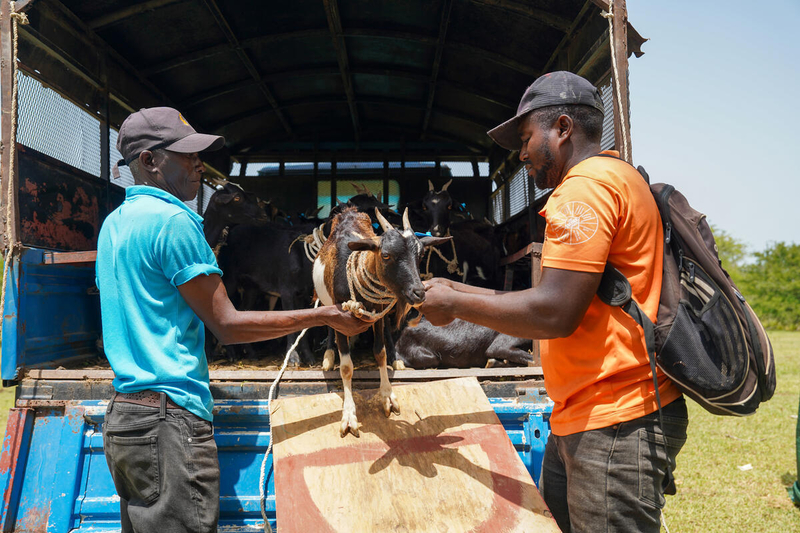
Port-au-Prince — Some 13,000 vulnerable households in Haiti, roughly 65,000 people, are receiving seed and small livestock under an emergency food production programme run by the Food and Agriculture Organization of the United Nations (FAO), the agency said on 17 September. The distributions cover ten municipalities in the high-needs departments of Artibonite, Centre and Ouest.
The programme is funded with more than $16 million through the Regional Humanitarian Pool Fund for Latin America and the Caribbean (RHPF LAC) and will ultimately reach 326,000 people. Farming households in crisis-affected communities are receiving over 205 tonnes of crop and vegetable seed and over 160,000 small livestock chosen to fit local production and eating habits.
Haiti is living through one of the world's most severe food crises. Violence, economic instability, broken supply chains and repeated climate shocks have cut access to food and weakened local production and rural livelihoods. According to the latest Integrated Food Security Phase Classification (IPC) report, more than half of the population is in acute food insecurity.
"In humanitarian crises, emergency food production is a life-saving intervention that empowers vulnerable households to quickly produce food and reduce reliance on importations and repeated humanitarian assistance," said Pierre Vauthier, FAO Representative in Haiti. He called the distributions a milestone for the regional fund, giving affected households "the tools and supplies they need, when they need them most".
FAO says communities are involved from start to finish, from identifying and validating the households that qualify to checking that the assistance matches local needs. Vauthier described the campaign as "implemented by Haitians for Haitians", enabling families to grow nutritious food and protect their livelihoods through their own effort.
In the second phase, over 160,000 small animals — ducks, poultry, guinea fowls, rabbits and goats — will go to more than 29,394 households, giving families a quick source of protein and other animal products. FAO says the staggered distributions are meant to cut the use of harmful coping strategies and reduce dependence on continued aid, putting households on a path to producing for themselves.
The Haiti operation is one of nine emergency food production interventions FAO is running with money from Country-Based Pooled Funds managed by OCHA. The others are in Bangladesh, Chad, Colombia, the Democratic Republic of the Congo, Ethiopia, Honduras, Myanmar and the Syrian Arab Republic, where rapid seed and livestock support helps crisis-hit rural households keep producing at a fraction of the cost of other forms of assistance.
Source: FAO Newsroom
Comments
(0)