
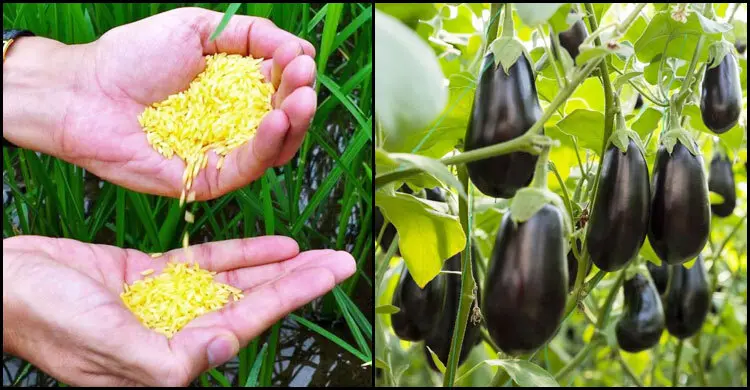
Civil society representatives have written to the government calling for a halt to the commercial approval of Golden Rice and the withdrawal of commercial approval for Bt brinjal.
The letter, sent on Monday, 27 May, was addressed to the secretary of the Ministry of Agriculture, the secretary of the Ministry of Environment, Forest and Climate Change, and the director generals of the Bangladesh Agricultural Research Council and the Bangladesh Rice Research Institute.
It asks them, in the wider interest of the country and nation, to stop commercial approval of Bt brinjal and Golden Rice and to refrain from granting commercial approval to any genetically modified crops or foods.
Golden Rice plans
In the letter, the civil society representatives note media reports of 4 April that the International Rice Research Institute (IRRI) and the Bangladesh Rice Research Institute (BRRI) jointly held a high-level government meeting to introduce a rice variety called Golden Rice, on the argument that it is rich in vitamin A.
According to those reports, a delegation of IRRI's "Healthier Rice Programme" project sought the government's cooperation to release GMO Golden Rice in Bangladesh, and the government gave assurances of approval. Besides IRRI, the US charity the Bill & Melinda Gates Foundation is supporting the Golden Rice project, and the patent holder of the rice is the foreign agrochemical company Syngenta.
They further note that various studies say Bangladesh is a centre of origin of rice and once had 15,000 rice varieties, and that 7,500 varieties are reportedly still preserved at the Bangladesh Rice Research Institute. Introducing genetically modified rice and food crops in a biodiversity-dependent country like Bangladesh has alarmed them, they say.
The Philippine court ruling
This is especially so, they say, since on 17 April the Court of Appeals in the Philippines specifically ordered a halt to commercial cultivation of Golden Rice and Bt brinjal. The court said these may not be commercially introduced until the government ensures all safety (independent and adequate scientific research) and meets legal obligations (the biosafety rules, the Cartagena Protocol and others).
The ruling also withdrew the biosafety approval for Golden Rice. The civil society representatives argue that where no other country has given Golden Rice commercial approval, where a Philippine court has ruled specifically against that approval, and where natural alternative sources of vitamin A exist and are easily available in Bangladesh, there is no room to commercialise genetically modified, company-patented Golden Rice here on the pretext of providing more vitamin A.
Bt brinjal
The letter also says the Bangladesh government had earlier approved the commercial release of genetically modified Bt brinjal in haste. Not only civil society and environmental organisations but many government agencies too had raised concerns during that approval process. Bt brinjal trials began at the same time in Bangladesh, India and the Philippines, but neither India nor the Philippines approved its commercial release.
Indian lawmakers had expressed the view that such crops profit only companies, not the general public and farmers. Bt brinjal's commercial cultivation was approved in Bangladesh, owing to the excessive zeal of the Ministry of Agriculture, on the basis of a summary of the same safety analysis on which India and the Philippines had refused final approval, the letter says.
The civil society representatives believe that for Bangladesh, one of the world's leading countries for rice and brinjal diversity, to turn to company-patented seeds instead of natural pest management is self-defeating.
Through the letter, they asked the authorities, in the wider national interest, to refrain from granting commercial approval to any genetically modified crops or foods and to withdraw approvals already given. They also pledged every kind of cooperation on the matter.
The signatories
The letter was signed by Sultana Kamal, founding president of Manabadhikar Shongskriti Foundation (MSF); Khushi Kabir, coordinator of Nijera Kori; Farida Akhter, executive director of UBINIG; Dr Iftekharuzzaman, executive director of Transparency International Bangladesh (TIB); Shamsul Huda, executive director of the Association for Land Reform and Development (ALRD); Zakir Hossain, chief executive of Nagorik Uddyog; Alamgir Kabir, general secretary of Bangladesh Poribesh Andolon (BAPA); Dr MA Sobhan, president of Beej Bistar Foundation; Sakiul Millat Morshed, executive director of SHISUK; Pavel Partha, researcher at BARCIK; Ibnul Sayeed Rana, member of the anti-GMO alliance; Badrul Alam, president of Bangladesh Krishak Federation; Aminur Rasul, member secretary of Unnayan Dhara Trust; Sima Das Simu, vice-president of Nari Grantha Prabartana; Jahangir Alam Jony, director of Nayakrishi Andolon; and Syeda Rizwana Hasan, chief executive of the Bangladesh Environmental Lawyers Association (BELA).
Source: Jagonews24. First published in Bengali on The Agro News.

Comments
(0)