
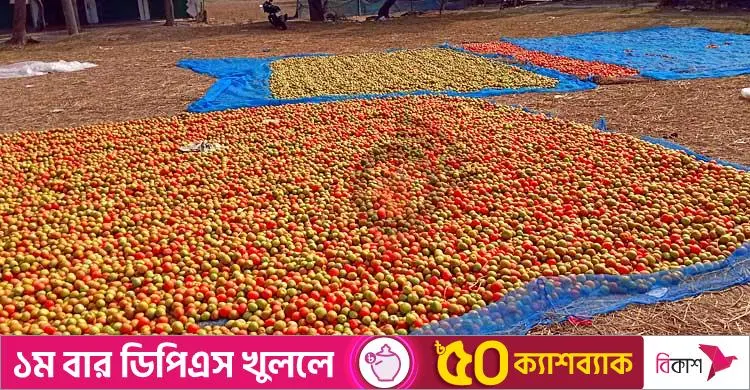
Most of the country's tomatoes are grown in Rajshahi, and within the district Godagari upazila grows the most, which is why it is called the "kingdom of tomatoes". Yet although there has been a "silent revolution" in tomato farming over the past seven years, the area under the crop has not increased. Farmers say price swings from year to year stop them settling on the crop.
According to the Department of Agricultural Extension (DAE) in Rajshahi, tomatoes were grown on 2,650 hectares in Godagari in 2018-19, producing 58,595 tonnes. In 2019-20 the area was 2,150 hectares and output 49,525 tonnes; in 2020-21, 2,460 hectares and 59,040 tonnes; in 2021-22, 2,850 hectares and 71,250 tonnes; in 2022-23, 3,015 hectares and 87,435 tonnes; and in 2023-24, 2,245 hectares and 65,105 tonnes. In the latest year, 2024-25, tomatoes have been grown on 2,670 hectares with a target of 74,760 tonnes. At an average of Tk 15 a kg, that would bring in Tk 112 crore 14 lakh. Eight thousand farmers are directly involved.
Sold straight from the field
People involved say the tomatoes are sold from the field itself. Because production and sale are easy, farmers are turning to tomatoes. Cultivation usually begins after the aus rice is harvested. Some 17-20 varieties are grown in Godagari, most of them hybrids. Tomatoes are far more profitable than any other field crop, but fear of losses over yields, seed and prices means the area rises in some years and falls in others.
Naimul Islam, a farmer from the Helipad area of Godagari, told Jagonews24: "There isn't as much tomato farming in Godagari as before. What is grown now is all sold in the field. You used to see heaps of tomatoes beside the fields; you don't now. But farming continues. Traders buy the tomatoes right in the field, and there is profit."
Bibhuti Bhushan, a farmer from Go-gram, said: "I have grown tomatoes for several years. Last year I didn't get a good price, so this time I grew them on a small plot and put the rest under mustard. The season is over now, and I got a good price."
Farmer Abdul Hadi said he grew the variety called 642 this year, while many others grew other varieties. There are comparatively fewer tomatoes on the plants this year and the yield has not been good, but the price is fairly good.
Traders and officials
Tomato trader Shamsul Alam Babu said Godagari's tomatoes have a good year followed by a bad one. Cultivation falls and rises mainly depending on the market, seed and yields. This year there are good tomatoes and good prices. He said he sends a truckload of tomatoes to Dhaka every day, and they go to Dhaka, Chattogram, Sylhet and Cumilla. But because prices are high this year, traders are making losses.
Upazila agriculture officer Mariam Ahmed said tomatoes are grown twice a year in the area, including a summer crop that fetches farmers higher prices. This year those tomatoes sold in the market at Tk 15-160 a kg.
She said that at an average of Tk 15 a kg, income would be Tk 112 crore 14 lakh. Besides, the tomato trade has created temporary work for 8,000 to 9,000 people.
Source: Jagonews24. First published in Bengali on The Agro News.

Comments
(0)