
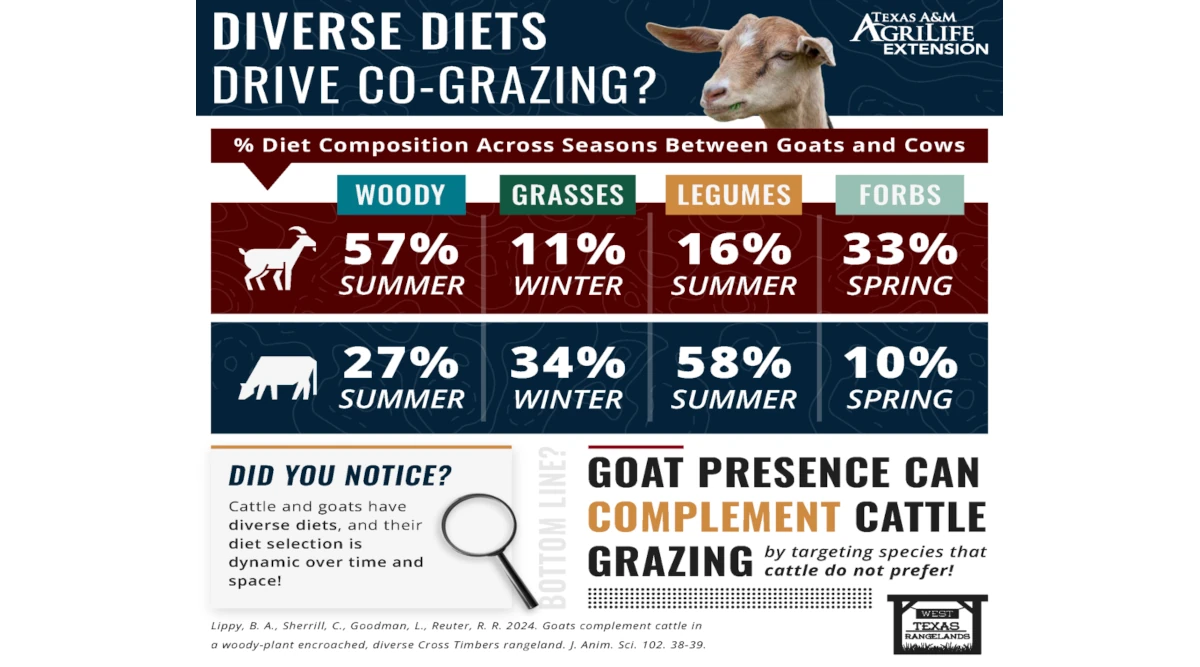
Texas ranchers looking to use their forage better, lift productivity and hold back woody brush without hurting livestock performance may find part of the answer in a second species. Research from the Cross Timbers region shows that cattle and goats occupy distinct feeding niches on the same landscape, which is why co-grazing can work so well, writes Kara Matheney of West Texas Rangelands.
The study, published by Lippy and colleagues in the Journal of Animal Science in 2024, found goats consumed substantially more woody vegetation and forbs than cattle, while cattle relied far more on grasses and legumes. Both species shifted their diets with the seasons but kept those different preferences all year.
Cattle are grazers, built to harvest large amounts of grass close to the ground. Goats behave as browsers, picking leaves, twigs, shrubs, vines and broadleaf plants that cattle largely ignore. Because rangeland is rarely a single plant type, a single-species herd leaves part of the forage unused while the preferred plants take a disproportionate share of the grazing pressure.
The most significant rangeland challenge in Texas is the spread of mesquite, juniper and other brush into grassland, cutting forage production, altering wildlife habitat and affecting water. Goats are not a silver bullet, the article says, but their steady browsing of woody species complements mechanical and chemical brush control and can suppress regrowth over time.
Diverse grazing also adds flexibility in drought. Different plant groups decline at different times when rain fails, and animals that can use a wider range of vegetation give a manager more options. Over the long run, spreading grazing pressure across more species can shift the plant community and reduce the advantage held by less desirable plants.
Beyond forage, producers cite diversified income, more balanced grazing and better rangeland condition among the benefits of running two species. Success depends on fencing, predator control, labour, marketing and each operation's goals. The underlying lesson, Matheney writes, is that livestock are not just consumers of forage but tools for shaping the range when they are allowed to do what they naturally do best.
Source: Morning Ag Clips
Comments
(0)