
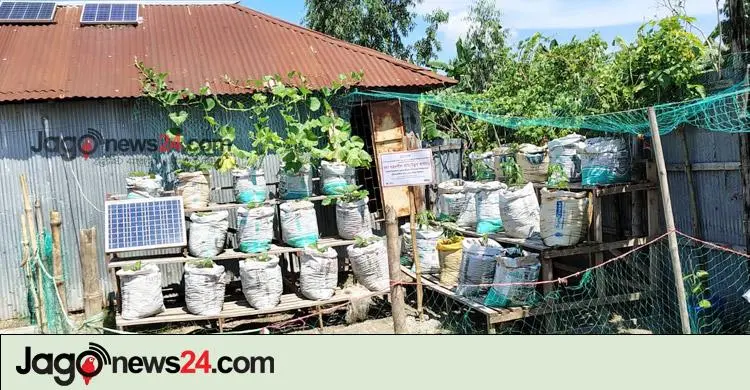
To make up for losses from heavy rain and floods, farmers on the chars of Gaibandha have taken up early-variety vegetable farming. From morning to evening they prepare land, plant seedlings and tend their crops. In remote char areas of Sadar, Sundarganj, Fulchhari and Saghata upazilas they are filling sacks with soil to grow vegetables and spices. Platforms set up in rows, built with flood heights in mind, are producing ginger, turmeric, bottle gourd, pumpkin, aubergine and other vegetables and spices. Homemakers are joining farmers in this novel way of coping with floods.
When flood waters rise, field crops and the vegetables grown around homesteads are destroyed. Farmers in Gaibandha's four char-bound upazilas are no exception. To find a way out, the district Department of Agricultural Extension (DAE) is promoting a method of growing vegetables and spices in soil-filled sacks placed on platforms or on high ground.
Farm production is disrupted by floods more or less every year on some 165 chars and in 18 riverside unions of the district. The district agriculture department and the non-government development organisation SKS Foundation are working on a joint plan to encourage farmers and homemakers to adopt and keep up the practice.
Farmers' experience
Md Saidul Islam, a farmer from Nakhiyar Para village in Haripur union of Sundarganj upazila, said: "Seventy per cent of the villages on the char go under flood water every year. When there is a flood, water even gets into the houses. The field crops drown too. The vegetables women grow around the homestead also go under and rot. So by growing vegetables on platforms they can meet their own needs and earn some money."
Asma Begum of Char Charita Bari village said: "I grew ginger in 50 sacks and earned Tk 7,000 to 8,000 a month. That is how I run my household."
Moni Begum, a homemaker in Haldia union of Saghata upazila, said: "I first took training and started growing vegetables in sacks. Now that the vegetables are doing well at home, about 12 people in the next village have started growing turmeric, ginger, aubergine and other winter vegetables in sacks the same way."
Aiz Uddin, a farmer from the same village, said: "Vegetable prices are high anyway during floods, and buying vegetables is hard for us. Growing vegetables in sacks on platforms is new, but if people in flood-hit areas farm this way, they can grow their own food in a small space in the yard."
Md Sufian, a farmer from a neighbouring village, said: "There is no chance of flood damage. Each sack will make a profit of Tk 220. So next year I plan to grow turmeric in 400 sacks and make a profit of about Tk 80,000."
Officials see promise
Nurul Huda, sub-assistant agriculture officer for Haripur union of Sundarganj upazila, said: "Local farmers and homestead-based women are showing great enthusiasm for growing ginger, turmeric and other vegetables and spices in sacks. In this union the method has stirred interest among farmers as a promising production system. It will help meet families' vegetable needs in the area in future. Many have also taken it up commercially, which will have a positive economic impact on the area."
He added: "Under the supervision of the district DAE, vegetables, ginger and turmeric have been grown in sacks at more than 100 households in Haripur union through the government programme."
The method is becoming more popular among people in Gaibandha by the day, attracting both farmers and homestead-based homemakers. Sack farming could open new possibilities on Gaibandha's chars as a flood-resilient method and help reduce flood damage.
Md Atikul Islam, deputy director of the DAE in Gaibandha, said: "Char farmers are growing vegetables on platforms, meeting their own needs and selling in the market. This is giving them income and also meeting their nutritional needs. Those interested in growing vegetables this way will be given all kinds of support."
Source: Jagonews24. First published in Bengali on The Agro News.

Comments
(0)