
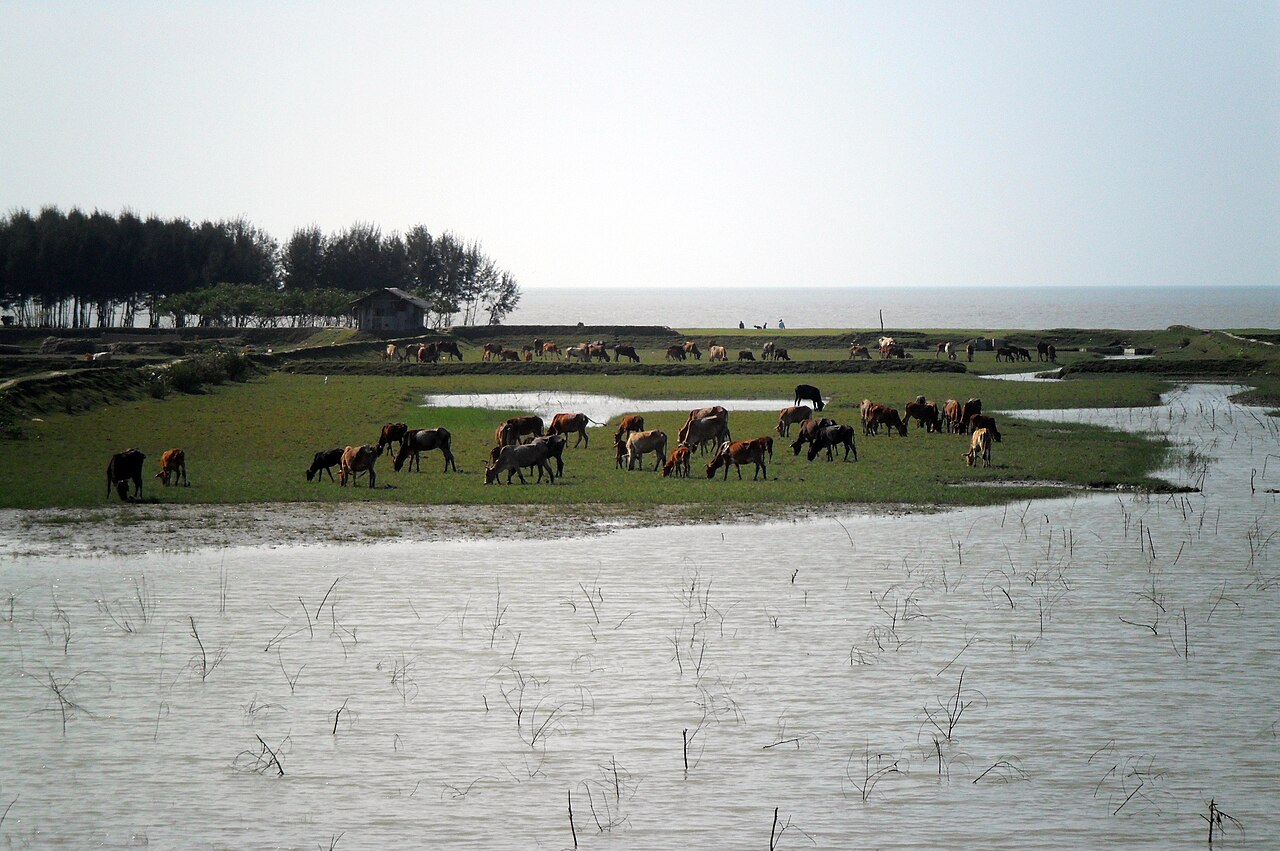
Two months ago the Teesta chars of Sundarganj in Gaibandha were under water. Now they are pasture, and char people spend the day there from dawn to dusk with thousands of cattle and goats. Researchers at the Institute of Epidemiology, Disease Control and Research (IEDCR) warn that anthrax could spread from these grazing grounds.
Their reasoning is that animals killed by anthrax are thrown into the river and wash up on the chars, so the grass there is more likely to carry spores. The Teesta runs through the Tarapur, Belka, Haripur, Chandipur, Kanchibari, Shantiram, Sripur and Kapasia unions of Sundarganj, where livestock rearing on the chars is most common, and char animals are sold in markets across the upazila's 15 unions and its municipality.
According to the upazila livestock and health offices, the first infection appeared in Belka union last October: at least 10 cattle and goats died, 35 people were infected by the official count and one woman died. In August this year six people fell ill after an infected cow was slaughtered in Kanchibari, and slaughter of infected cattle in Sarbananda, Tarapur and Bamandanga then infected 49 people officially. On 9 September a sick cow was slaughtered in Bachhati village and its meat shared among about 100 families; tests found anthrax in the meat.
Dr Daulat Khan, a medical anthropologist at IEDCR, said anthrax spores can survive in soil for about 100 years. An animal that dies of the disease must be buried at least six feet deep, but many people float the carcass in the river, and the spores settle in the char soil and return to livestock through the grass. Dr Md Rafiqul Islam, deputy chief epidemiologist of the Department of Livestock Services (DLS) epidemiology cell, said animals must be vaccinated every year, vaccination must continue, and cattle and goats should be kept off char grass.
Md Mozaharul Islam, chairman of Haripur union parishad, said almost every household on the Teesta chars keeps a small cattle farm and char grass is the animals' main feed for about six months a year. Upazila livestock officer K M Iftekharul Islam said 45,000 cattle in the upazila have already been vaccinated against anthrax and the work continues, covering animals within three kilometres of each outbreak site. For now, he said, there are hardly any cases.
Beyond Gaibandha, anthrax was reported in Rangpur, Dinajpur, Meherpur and Kushtia in September. In Gangni, Meherpur, 412 cases were recorded by 20 September, 262 of them after contact with goat meat and 130 with beef. Daulatpur in Kushtia had 54 cases from August to 24 September. In Adampara, Pirgachha, Rangpur, 13 people were diagnosed; the beef behind those infections was reportedly bought from Sundarganj.
The advice for farmers and char households: do not slaughter a sick or suddenly dead animal, bury carcasses safely instead of dumping them in the river, vaccinate every year, and do not buy or eat meat unless the animal's health has been checked. Itching, blisters and sores on the skin are the familiar signs of the disease in people.
The report is by A Mannan Akand, Samakal's Sundarganj (Gaibandha) correspondent.
Photo: Moheen Reeyad / Wikimedia Commons (CC BY-SA 4.0); cattle grazing at Anandabazar, Chattogram.
Source: samakal

Comments
(0)